


- The best guitar string material depends on your instrument type, playing style, and tonal goals. Coated strings extend longevity significantly and preserve tone better, especially with modern ultra-thin coatings. Matching string material to pickups and environment is essential for achieving optimal sound and durability.
The best guitar string material is defined by your instrument type, playing style, and tonal goals. Nylon suits classical and flamenco guitars, delivering warmth and smooth feel. Steel alloys serve acoustic players, with bronze and phosphor bronze as the dominant winding materials. Nickel variants, including nickel-plated steel and pure nickel, are the standard for electric guitars. Beyond raw material, coating technologies and wire alloy compositions now play a significant role in how strings sound and how long they last. Understanding these factors is the difference between strings that fight your guitar and strings that unlock it.
What are the best guitar string materials for tone and feel?
String material is the single biggest variable in how your guitar sounds and responds under your fingers. Each material has a distinct tonal character, and knowing those characters lets you make deliberate choices rather than guessing.

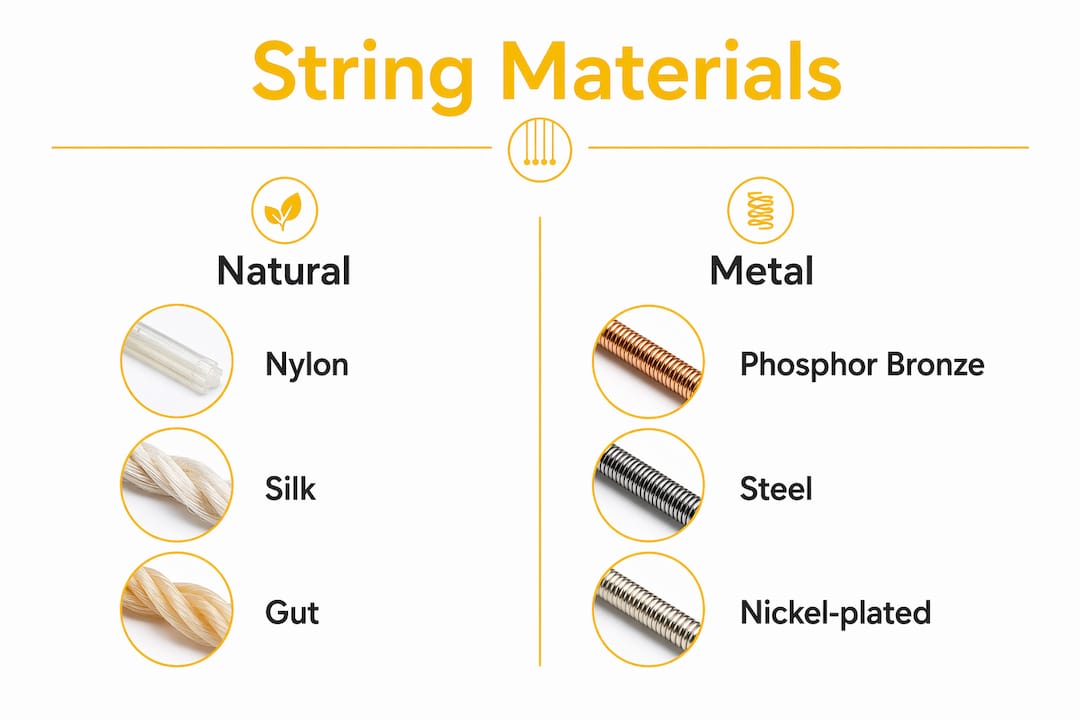
Nylon strings are the foundation of classical and flamenco playing. Nylon replaced gut in the mid-twentieth century, offering greater tuning stability and durability while preserving the warm, rounded tone that defines the classical tradition. The treble strings are monofilament nylon, while the bass strings use metal wire wound over a nylon core. The result is a smooth, gentle feel that is far easier on fingertips than steel.
Steel strings are the standard for acoustic and electric guitars. They produce a bright, crisp tone with strong attack and projection. On acoustic guitars, the plain steel treble strings are paired with wound bass strings, where the winding material shapes the overall tonal character of the set.
Bronze and phosphor bronze are the two dominant winding materials for acoustic guitar strings. Phosphor bronze delivers warmer tone and greater sustain, while 80/20 bronze (roughly 80% copper, 20% zinc) gives a sharper, brighter sound with more pronounced treble response. Phosphor bronze suits fingerpickers and players who want a full, balanced sound. 80/20 bronze suits strummers and players who want cut and clarity.
Nickel-plated steel, pure nickel, and stainless steel are the three main options for electric guitar strings. Each has a distinct tonal profile that interacts with your pickups in different ways.
- Nickel-plated steel produces a balanced, even tonal response and is the most widely used electric string material across genres.
- Pure nickel delivers a warmer, rounder sound with softer attack, favoured by blues and vintage rock players.
- Stainless steel is the brightest option, with strong output and excellent corrosion resistance, though some players find it harsher on frets.
Silk and steel hybrid strings offer a mellow alternative for acoustic players who find standard steel strings too stiff or bright. A silk wrapping between the steel core and the outer winding softens the tension and tone, making them popular for fingerstyle players and those with lighter-touch guitars.
Pro Tip: If you are new to acoustic guitar, start with phosphor bronze strings in a light gauge. They are forgiving on fingertips, warm in tone, and work well across most playing styles.
How do coatings and alloy compositions affect string life?
String material alone does not tell the full story. The coating applied to a string and the precise alloy used in its manufacture both have a measurable effect on performance and longevity.
Coated strings carry a thin, corrosion-resistant layer over the winding wire. Coatings increase string life by three to five times compared with uncoated strings, and Cleartone Strings report increases in output of 36% and sustain of 48% with their coating process. That is a significant performance claim, and it reflects how much oxidation and debris accumulation normally degrade an uncoated string’s tone over time.
The tradeoff has historically been feel. Some players dislike the slightly slick or plastic-like texture of coated strings. However, ultra-thin coatings under one micron now preserve the tactile feel of uncoated strings while still resisting corrosion. In 2026, this technology has become more accessible across mid-range string products, not just premium lines.
| Feature | Coated strings | Uncoated strings |
|---|---|---|
| Lifespan | 3 to 5× longer | Standard |
| Tone retention | Preserves fresh tone longer | Degrades faster with sweat and oxidation |
| Tactile feel | Can feel slicker; ultra-thin coatings minimise this | Natural, preferred by many purists |
| Cost | Higher upfront | Lower upfront |
| Best for | Players who change strings infrequently | Players who change strings regularly |
Beyond coatings, the alloy composition and wire specifications used in manufacturing shape tonal nuance in ways the simple label “bronze” or “nickel” does not capture. United Wire Technologies produces wire for approximately 80% of the US guitar string market, and their work shows that alloy mix and wire width directly influence attack, harmonics, and surface chemistry. Two sets labelled “phosphor bronze” from different manufacturers can sound noticeably different because of these variables. String material is better understood as a stack of factors rather than a single label.
Pro Tip: If you sweat heavily when playing, coated strings are worth the extra cost. Perspiration is the primary cause of string corrosion, and coated strings will hold their tone far longer in those conditions.
What materials should electric guitarists choose for their pickups?
For electric guitarists, string material affects the acoustic signal transferred to your pickups more than it shapes raw acoustic tone. The magnetic field of a pickup reads the vibration of the string, so the material’s magnetic properties and surface condition both influence what the pickup sends to your amplifier.
Matching string brightness to your pickups is a practical and cost-effective approach to shaping tone. If your pickups are bright and glassy, pure nickel strings will mellow the output without requiring any hardware changes. If your pickups are warm and dark, nickel-plated steel or stainless steel strings will add clarity and presence. This interaction is more reliable than chasing a generic “best” string material without accounting for your specific guitar setup.
Here is how the main electric string materials align with common playing styles and genres:
- Nickel-plated steel suits rock, pop, country, and most general playing. It is the default choice for a reason: balanced output, reliable feel, and wide availability.
- Pure nickel suits blues, jazz, and vintage rock. The warmer, rounder character complements single-coil pickups and lower-output humbuckers.
- Stainless steel suits metal, hard rock, and players who need maximum brightness and corrosion resistance. It is harder on frets over time, which is worth factoring in.
- Monel guitar strings are a less common but historically significant option. Monel is a nickel-copper alloy used on early electric strings before nickel-plated steel became dominant. Players seeking a vintage, slightly compressed tone sometimes return to monel for its distinctive character.
For players building their first electric guitar setup, the right guitar and string combination matters more than either element alone. A bright single-coil guitar with stainless strings will sound very different from the same guitar strung with pure nickel. Knowing your pickup type is the starting point for any string material decision.
What should acoustic and classical guitarists consider?
Acoustic and classical players face a different set of material decisions, where the string must do more acoustic work without electronic amplification to compensate.
For classical guitarists, nylon is the only appropriate choice. The warm tone and smooth feel of nylon are intrinsic to the classical sound, and the lower tension of nylon strings is matched to the lighter bracing and construction of classical instruments. Fitting steel strings to a classical guitar risks structural damage.
For acoustic steel-string players, the choice between 80/20 bronze and phosphor bronze is the most consequential material decision. The table below summarises how each suits different playing contexts:
| String material | Tonal character | Best suited for |
|---|---|---|
| 80/20 bronze | Bright, crisp, strong treble | Strumming, singer-songwriters, recording |
| Phosphor bronze | Warm, balanced, good sustain | Fingerpicking, folk, all-round acoustic playing |
| Silk and steel | Mellow, low tension, soft feel | Beginners, light-touch guitars, gentle fingerstyle |
| Nylon | Warm, round, smooth | Classical, flamenco, nylon-string acoustic |
Beyond material, gauge interacts directly with the winding material to affect playability and tone. Lighter gauges in phosphor bronze feel easier to play and suit smaller-bodied guitars. Heavier gauges in 80/20 bronze produce more volume and projection, which suits larger dreadnought or jumbo bodies.
- Identify your guitar body type and bracing. Lighter-braced guitars respond better to lighter-gauge strings.
- Consider your playing style. Fingerpickers benefit from phosphor bronze in light or medium-light gauge. Strummers often prefer 80/20 bronze in medium gauge.
- Think about your genre. Folk and country players often favour phosphor bronze. Bluegrass players frequently choose 80/20 bronze for its cutting brightness.
- Factor in your environment. If you play in humid or warm conditions, phosphor bronze oxidises more slowly than 80/20 bronze, giving you longer string life.
The acoustic guitar string materials guide reinforces that bronze alloy type and wire specs shift attack and harmonics in ways that go well beyond the simple “bronze” label. Two phosphor bronze sets at different price points can sound and feel quite different because of wire finishing and alloy ratios.
Key takeaways
The best guitar string material is not universal. It is determined by instrument type, pickup characteristics, playing style, and how long you need the strings to last before changing them.
| Point | Details |
|---|---|
| Material varies by instrument | Nylon for classical, phosphor or 80/20 bronze for acoustic, nickel variants for electric. |
| Pickup matching shapes electric tone | Use pure nickel to mellow bright pickups; nickel-plated steel for balanced output. |
| Coatings extend string life significantly | Coated strings last three to five times longer and preserve fresh tone, especially with ultra-thin coatings. |
| Alloy composition matters beyond the label | Wire specs and alloy ratios affect attack and harmonics; two “bronze” sets can sound very different. |
| Gauge and material work together | Lighter gauges suit smaller-bodied guitars and fingerpickers; heavier gauges suit strummers and larger bodies. |
Why I stopped chasing the “best” string and started matching instead
After years of handling guitars at Musicstreet and talking to players at every level, the most common string mistake I see is treating material as a standalone decision. Players read that phosphor bronze is “warmer” or that pure nickel is “vintage” and buy accordingly, without considering what guitar they are putting those strings on or what pickups are already in it.
The honest truth is that string material affects corrosion resistance and acoustic transfer to pickups more than it creates immediate tonal transformation. A set of pure nickel strings on a dark-sounding guitar with low-output pickups will not suddenly produce a bright, cutting tone. But those same strings on a bright single-coil guitar will do exactly what you want.
Coated strings are genuinely underrated for most players. The tactile objection is largely solved by modern ultra-thin coatings, and the longevity benefit is real. For anyone who does not change strings every week, coated strings are the more economical and tonally consistent choice over time. The players who resist them are often comparing a fresh uncoated set to a week-old coated set, which is not a fair test.
My practical advice: start with your guitar type and pickup configuration, then choose material to complement or correct what you already have. Check out the full guitar string types guide for a deeper look at how each material category breaks down in practice.
— Musicstreet
Find your ideal strings at Musicstreet

Choosing the right string material is easier when you have expert guidance alongside quality products. At Musicstreet, we stock a wide selection of premium guitars from brands including PRS, Gibson, Fender, and Martin, along with strings and accessories to suit every playing style and budget. Whether you are setting up a new acoustic, refining the tone of your electric, or exploring classical playing for the first time, our team is on hand to help you make the right call. Visit Musicstreet’s guitar shop to browse our full range, or read our best electric guitar strings 2026 guide for current material recommendations across the most popular electric string sets.
FAQ
What is the best string material for acoustic guitar?
Phosphor bronze is the most widely recommended material for acoustic guitar strings, offering warm tone, good sustain, and longer life than 80/20 bronze. Players who prefer a brighter, crisper sound should consider 80/20 bronze instead.
Do coated strings sound as good as uncoated strings?
Modern ultra-thin coated strings closely match the feel and tone of uncoated strings while lasting three to five times longer. Uncoated strings may have a slight edge in initial brightness, but coated strings retain that fresh tone far longer.
What string material is best for electric guitar?
Nickel-plated steel is the standard choice for most electric guitarists, delivering a balanced tonal response across genres. Pure nickel suits players seeking warmth and vintage character, while stainless steel suits those who want maximum brightness and corrosion resistance.
Can I use steel strings on a classical guitar?
Steel strings should never be fitted to a classical guitar. Classical instruments are built for the lower tension of nylon strings, and steel strings can cause serious structural damage to the neck and top.
What are monel guitar strings used for?
Monel strings are a nickel-copper alloy used on early electric guitars before nickel-plated steel became the industry standard. Players seeking a vintage, slightly compressed tonal character sometimes choose monel for its distinctive warmth and historical authenticity.


Share:
How to buy guitar strings: a practical guide
Guitar practice tips that build real skills fast