


Selecting guitar effects pedals can feel overwhelming when you’re faced with hundreds of options across multiple categories. Each pedal promises to transform your sound, but without understanding the fundamental types and their functions, you risk purchasing gear that doesn’t suit your playing style. This article simplifies the selection process by breaking down pedal categories, highlighting top choices within each type, and providing practical guidance on building an effective pedalboard. You’ll learn how to match pedals to your musical needs, arrange them for optimal tone, and avoid common purchasing pitfalls that plague guitarists at every skill level.
Table of Contents
- Understanding Guitar Effects Pedal Categories
- Top Guitar Effects Pedals In Each Category
- Comparing Guitar Pedals: Choosing The Right Ones For Your Sound
- Optimising Your Pedalboard: Order And Setup Tips
- Explore Premium Guitar Gear At MusicStreet
Key takeaways
| Point | Details |
|---|---|
| Five main categories | Gain, modulation, time-based, filter, and utility pedals cover all essential sound effects needs |
| Signal chain matters | Proper pedal ordering optimises impedance, reduces noise, and ensures effects process signals correctly |
| Start small | Three to four quality pedals covering tuner, overdrive, and delay functions handle 90% of common guitar sounds |
| Component quality wins | The design and components influence tone more than whether a pedal is analogue or digital |
| Match to style | Choose pedals based on your musical genre and playing technique rather than popularity alone |
Understanding guitar effects pedal categories
Guitar effects pedals fall into five main types: gain, modulation, time-based, filter, and utility. Each category serves distinct sonic purposes and addresses specific tonal needs in your signal chain. Understanding these classifications helps you build a versatile pedalboard without redundant purchases.
Gain pedals shape your guitar’s distortion characteristics and sustain qualities. This category includes overdrive, distortion, and fuzz pedals that add harmonic content and compression to your signal. Overdrive pedals produce warm, tube-like saturation ideal for blues and rock. Distortion pedals create heavier, more aggressive clipping suited to hard rock and metal. Fuzz pedals generate extreme harmonic saturation with a vintage character popular in psychedelic and stoner rock.
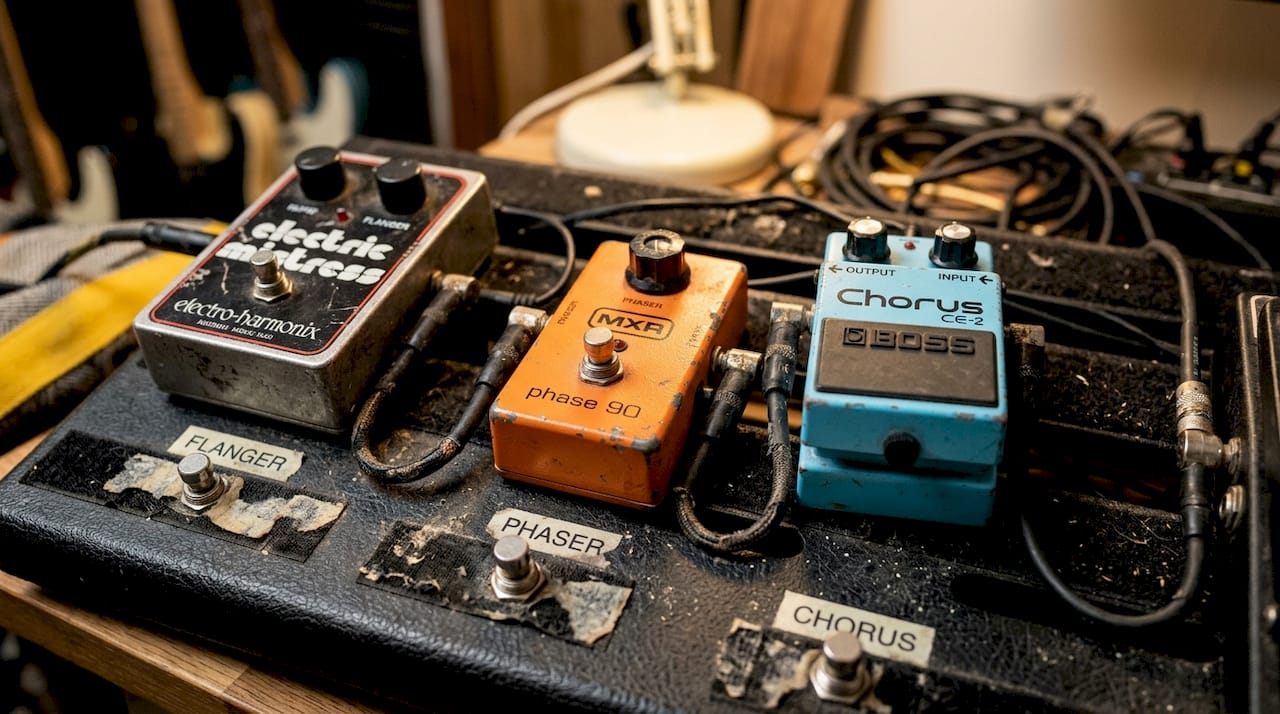
Modulation effects add movement and texture by altering pitch, phase, or amplitude. Chorus pedals thicken your sound by layering slightly detuned copies of your signal. Phaser and flanger effects create sweeping, jet-like tones through phase cancellation. Tremolo modulates volume rhythmically for pulsing textures. These effects work brilliantly on clean tones and add dimension to rhythm parts.
Time-based effects create echoes, repeats, and spatial ambience. Delay pedals repeat your signal at set intervals, from quick slapback to long, atmospheric trails. Reverb pedals simulate acoustic spaces, adding depth and dimension. Both effects prove essential for lead playing and creating sonic landscapes. Digital versions offer precise control whilst analogue models provide warmth and character.
Filter effects shape your tone dynamically in response to playing dynamics or foot control. Wah pedals sweep through frequency ranges for expressive lead tones. Envelope filters trigger frequency sweeps based on your picking attack, creating funky, vocal-like textures. These pedals add human expression to electronic processing.
Utility pedals handle practical functions beyond tone shaping. Tuner pedals ensure accurate intonation and often include buffered outputs. Compressor pedals even out dynamics and add sustain. Noise gates eliminate unwanted hum and feedback. Looper pedals record and layer phrases for practice or performance. EQ pedals provide surgical tone control. Every well-designed pedalboard includes several utility functions to maintain signal integrity and performance readiness. Explore more about how these categories work together in our guitar effects types explained guide.
Top guitar effects pedals in each category
Within each pedal category, certain models have earned reputation through decades of professional use and player satisfaction. The Boss BD-2 Blues Driver achieves 4.8/5 ratings across 1,890 reviews, making it the benchmark overdrive pedal. Its asymmetrical clipping circuit produces natural tube-like compression with excellent touch sensitivity. The Ibanez Tube Screamer remains the gold standard for mid-focused overdrive, particularly beloved by blues and rock players. For tighter, more transparent gain, the Boss SD-1 Super Overdrive offers asymmetrical clipping with a characteristic mid-hump boost that cuts through band mixes.
Modulation pedals offer diverse textures across the category. The MXR Phase 90 stands as the best phaser pedal for its simple interface and lush, sweeping tones heard on countless classic recordings. The Electro-Harmonix Small Clone chorus pedal delivers the thick, shimmering textures that defined 1980s guitar sounds. For tremolo effects, the Boss TR-2 provides reliable amplitude modulation with adjustable wave shapes. These modulation classics prove their worth through consistent performance and intuitive controls.
Time-based effects vary widely in character and application. The Boss DD-8 Digital Delay offers 11 delay modes from vintage analogue emulation to modern shimmer effects. The TC Electronic Flashback provides tape-style delay with modulation for organic, musical repeats. For reverb, the Electro-Harmonix Holy Grail delivers lush spring, hall, and plate algorithms in a compact enclosure. The Strymon BlueSky offers studio-quality reverb with extensive parameter control for players seeking premium ambience. Understanding the differences between these approaches helps you select the right tool for your musical context, as detailed in our overdrive guide.
Filter effects centre on dynamic tonal control. The Dunlop Cry Baby remains the archetypal wah pedal, offering vocal-like frequency sweeps under foot control. The Electro-Harmonix Q-Tron envelope filter creates synth-like filter effects triggered by your picking dynamics. Both pedals reward expressive playing and add human character to processed tones.
Utility pedals form your pedalboard’s foundation. The TC Electronic PolyTune provides fast, accurate tuning with polyphonic detection. The MXR Dyna Comp compressor smooths dynamics whilst adding percussive attack. The Boss NS-2 Noise Suppressor eliminates hum without affecting your tone. The TC Electronic Ditto Looper offers simple, reliable phrase sampling. These tools ensure your pedalboard functions reliably in performance situations.
Comparing guitar pedals: choosing the right ones for your sound
Selecting pedals requires understanding how tonal characteristics, format differences, and component quality affect your sound. Analogue pedals process signals through physical circuits, typically offering warmth and organic response. Digital pedals use processors to model effects, providing versatility and precise parameter control. However, component quality and circuit design influence tone more than the analogue versus digital distinction. A well-designed digital delay often outperforms a poorly executed analogue version.
Prioritise pedals that cover the most versatile sounds first. Starting with three to four pedals including a tuner, overdrive, and delay or reverb covers 90% of common guitar sounds. This focused approach prevents gear acquisition syndrome whilst ensuring you master each tool thoroughly. Add specialised effects only when your musical needs clearly demand them. Quality over quantity produces better results than accumulating unused pedals.
The standard signal chain order optimises tone and reduces noise. Place your tuner first for accurate muting and signal monitoring. Dynamics pedals like compressors come next to even out your signal before tone shaping. Filter effects such as wah pedals work best before gain stages. Gain pedals follow in order from lowest to highest saturation. Modulation effects process best after distortion. Time-based effects like delay and reverb belong at the chain’s end before your amplifier. This sequence ensures each effect processes an appropriate signal type whilst minimising noise and impedance mismatches.
Budget considerations matter when building a pedalboard. Entry-level pedals from Boss, MXR, and Electro-Harmonix offer professional quality at accessible prices. Boutique manufacturers provide unique circuits and premium components at higher costs. Consider buying used pedals from reputable sellers to access quality gear within budget constraints. Avoid purchasing pedals based solely on hype or popularity. Test pedals with your specific guitar and amplifier combination whenever possible.
| Pedal Type | Analogue Strengths | Digital Strengths | Priority Level |
|---|---|---|---|
| Overdrive | Warm, organic response | Precise parameter recall | Essential |
| Delay | Warm, musical repeats | Multiple delay types, tap tempo | Essential |
| Reverb | Natural decay character | Diverse room simulations | High |
| Modulation | Organic movement | Multiple effect types | Medium |
| Wah | Direct, expressive control | Preset positions, auto-wah | Low |
Pro Tip: Test pedals in the context where you’ll actually use them. A pedal that sounds amazing in a quiet shop might disappear in a full band mix. Conversely, an effect that seems subtle alone might provide exactly the right enhancement in ensemble playing. Always evaluate gear based on your real-world musical situations.
Explore comprehensive pedal selection strategies in our ultimate guitar pedal guide for detailed setup instructions.
Optimising your pedalboard: order and setup tips
The standard signal chain order follows this sequence: tuner, dynamics, filters, gain, modulation, time-based effects, then amplifier. This arrangement optimises impedance matching, reduces noise, and ensures each effect processes appropriate signal types. Deviating from this order sometimes produces creative results, but understanding the standard provides a reliable starting point.
Follow these steps for optimal pedalboard setup:
- Position your tuner first to enable silent tuning and provide a consistent input impedance for downstream pedals.
- Place compressor pedals after the tuner to control dynamics before tone shaping begins.
- Insert wah and envelope filters before gain pedals so they process a clean signal with full frequency content.
- Arrange gain pedals from lowest to highest saturation, allowing you to stack overdrives for increased distortion.
- Position modulation effects after gain stages to avoid modulating distortion artefacts and noise.
- Place delay and reverb pedals last in the chain to create space and ambience without washing out earlier effects.
- Connect your final pedal output to your amplifier’s input, completing the signal path.
Setup considerations extend beyond simple ordering. Use quality patch cables to minimise signal degradation and noise. Isolated power supplies prevent ground loops and eliminate hum. Velcro or pedalboard mounting systems keep pedals secure during transport and performance. Label your settings or photograph pedal positions to recreate favourite sounds quickly.
Pro Tip: Experiment with unconventional pedal orders once you understand the standard approach. Placing modulation before distortion creates unique textures. Running delay into overdrive produces lo-fi, degraded repeats. These creative choices sometimes yield signature sounds that distinguish your playing. Document successful experiments so you can recreate them reliably.
Proper signal chain order dramatically affects your tone and noise floor. Placing a noise gate at the wrong position might cut off natural sustain, whilst modulation before distortion can create unusable warbling. Take time to understand why each position matters rather than blindly following rules.
Learn advanced chain techniques and troubleshooting methods in our guides on essential tips for guitar effects chains and basics of pedalboards.
Explore premium guitar gear at MusicStreet
Building the perfect pedalboard requires access to quality gear and expert guidance. MusicStreet specialises in premium guitars and effects from trusted manufacturers, offering both new and carefully inspected pre-owned equipment. Our Huntingdon showroom lets you test pedals with professional amplifiers before purchasing, ensuring compatibility with your existing setup.

Our curated selection includes classic pedals from Boss, MXR, and Electro-Harmonix alongside boutique options from smaller manufacturers. Every pedal receives professional inspection and testing before sale. We provide expert advice on pedalboard building, signal chain optimisation, and tone matching. Free UK delivery on qualifying orders brings professional gear directly to your door. Whether you’re assembling your first pedalboard or expanding an existing rig, MusicStreet offers the products and expertise to achieve your ideal tone. Visit our premium guitar shop to explore our current effects pedal inventory and discover how quality gear elevates your playing.
FAQ
What are the five main types of guitar effects pedals?
The five main categories are gain, modulation, time-based, filter, and utility pedals. Gain pedals include overdrive, distortion, and fuzz for adding saturation and harmonic content. Modulation effects like chorus, phaser, and flanger add movement and texture. Time-based pedals create delay and reverb for spatial effects. Filter pedals such as wah and envelope filters shape frequency content dynamically. Utility pedals handle tuning, compression, noise reduction, and looping functions essential for performance.
Why is the signal chain order important for guitar pedals?
Proper pedal ordering optimises impedance matching between effects and reduces unwanted noise in your signal path. Each effect type processes specific signal characteristics most effectively, so placing a wah before distortion preserves frequency content whilst positioning modulation after gain prevents modulating noise and artefacts. Correct ordering ensures your tone remains clear and each effect functions as designed. Experimentation sometimes yields creative results, but understanding standard order provides a reliable foundation.
Which pedals should beginners start with?
Beginners should start with a tuner, overdrive, and either delay or reverb pedal. These three to four pedals cover 90% of common guitar sounds whilst remaining manageable to learn and integrate. A tuner ensures accurate intonation, overdrive adds versatility to clean and driven tones, and time-based effects create depth and dimension. Starting small prevents overwhelming gear acquisition syndrome and allows you to master each tool thoroughly. Quality options exist at various price points from manufacturers like Boss, MXR, and TC Electronic.
What is the difference between analogue and digital pedals?
Analogue pedals process signals through physical electronic circuits, typically offering warm, organic tones with natural response characteristics. Digital pedals use processors to model effects, providing versatility, multiple effect types, and precise parameter recall. However, component quality and circuit design influence sound more than the analogue versus digital distinction. Well-designed digital pedals often match or exceed analogue versions in tonal quality whilst offering practical advantages like preset storage and extended parameter ranges. Choose based on the specific sounds you need rather than format alone.


Share:
What is a combo amp: complete guide for guitarists 2026
What is amp biasing: guide to guitar amp tone and performance