


- “Musicstreet” often refers to both a specific Cambridgeshire retailer and a general category of guitar shops, causing confusion among musicians seeking particular services or inventory. A great guitar store offers diverse stock, expert repairs, knowledgeable staff, and ongoing support, regardless of its name or location. Visiting in person provides tactile assessment and expert guidance that online shopping cannot fully replace, making local, trusted shops invaluable for long-term musical growth.
Type “Musicstreet” into a search engine and you might get anything from a Cambridgeshure institution to a generic list of local shops near you. That ambiguity frustrates countless guitarists every day, whether they are brand-new players hunting for their first acoustic or seasoned professionals seeking a specific vintage model. Established in 2014 10 chequers court , Huntingdon , Musicstreet is a real, independent specialist run by founder Toony Rawson. But the name also functions as shorthand for an entire retail experience. This guide will help you understand the difference, find the right shop for your needs, and make the most of every visit or online order.
Table of Contents
- What is ‘ Musicstreet’? Understanding the name and its meaning
- Choosing the right guitar store: what to look for
- Why location still matters: the in-store advantage in a digital era
- Essential tips for your visit or online purchase
- What most guitarists overlook when choosing their store
- Find your sound with the right guitar shop
- Frequently asked questions
Key Takeaways
| Point | Details |
|---|---|
| Understand your options | ‘Musicstreet’ can refer to both a specific retailer and a range of specialist shops in the UK. |
| Choose based on service and stock | Look for stores that offer variety, professional advice, and repair services for the best experience. |
| Visiting in person has unique value | In-store visits give you hands-on opportunities, expert guidance, and a sense of community. |
| Prepare before you buy | Know what you want and what to ask—online or in person—for a smarter, more satisfying purchase. |
What is ‘Musicstreet’? Understanding the name and its meaning
When guitarists talk about “Musicstreet,” they are rarely being precise. The phrase carries two meanings simultaneously, and knowing which one applies in your situation can save you real time and money.
On one level, it is a proper noun: Musicstreet in Huntingdon is a specific, independent, bricks-and-mortar retailer with a genuine trading history. On another level, it is a generic category description, something like saying “the mechanic” when you mean any qualified car repairer. Both uses are legitimate, but they lead you in entirely different directions.
“When searching specifically for ‘Musicstreet’ in the UK, you may need disambiguation: research surfaces a retailer called Musicstreet in Huntingdon, but there is no single universally recognised UK chain using exactly that name. Multiple similar names exist across the country.”
This matters because the UK independent guitar retail scene is remarkably diverse. Cities including Manchester, Bristol, Edinburgh, and Leeds all have specialist shops with names that sound almost identical online. Some focus purely on electric guitars and amplifiers. Others lean heavily into acoustic and classical instruments. A few specialise almost entirely in used and vintage stock.
Here is what this diversity looks like in practice:
- Independent specialists with deep expertise in a single category (e.g., vintage electrics)
- Full-range stores carrying everything from entry-level beginner packs to professional instruments
- Repair-led businesses that sell guitars but really thrive on workshop services
- Boutique dealers handling premium and custom-order instruments only
- Online-first retailers with a physical showroom attached, like MusicStreet in Huntingdon, Cambridgeshire
Our ultimate guide to guitar shops explores these categories in more detail, but the key takeaway right now is this: do not assume that any shop calling itself “Musicstreet” offers what you need without investigating further. The name tells you very little. The stock, the staff, and the services tell you everything.
Choosing the right guitar store: what to look for
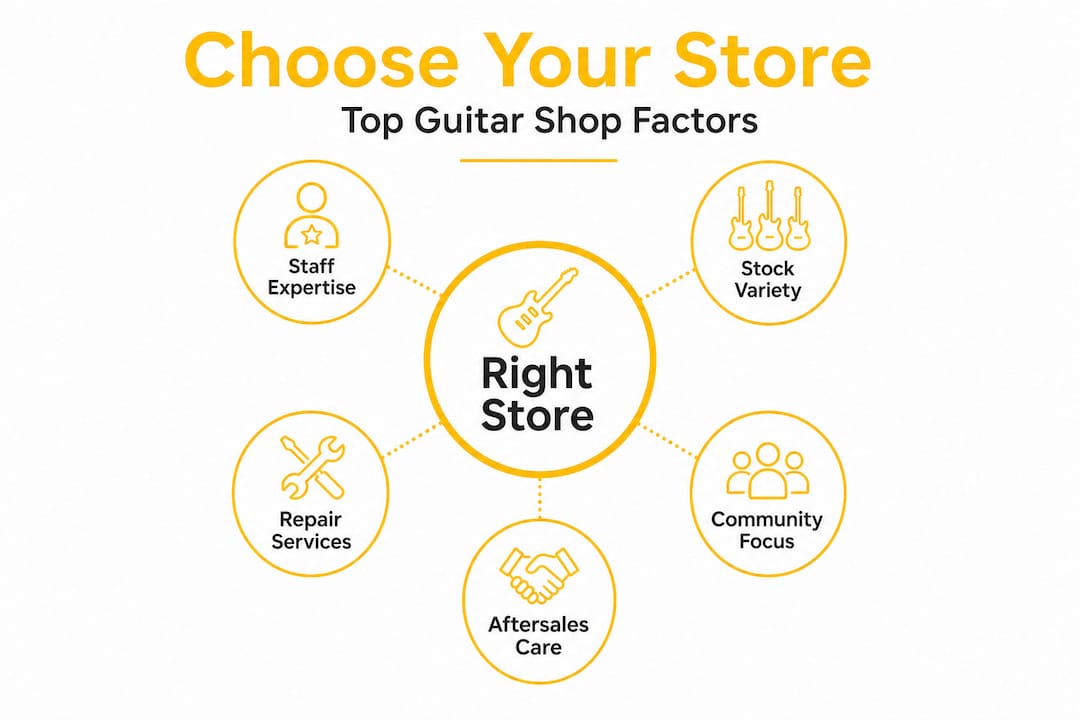
Now that you know why the name alone is not a reliable guide, let us look at what actually separates an excellent guitar retailer from a mediocre one. The criteria fall into four broad areas, and a genuinely great shop will score well in all of them.
1. Stock variety and brand representation
A strong guitar store carries instruments across multiple genres, playing levels, and price brackets. You want to see electric, acoustic, and bass options under the same roof, along with a solid accessories section covering strings, straps, cases, and tuners. A shop stocking only one or two brands is limiting you before you have even picked up an instrument.
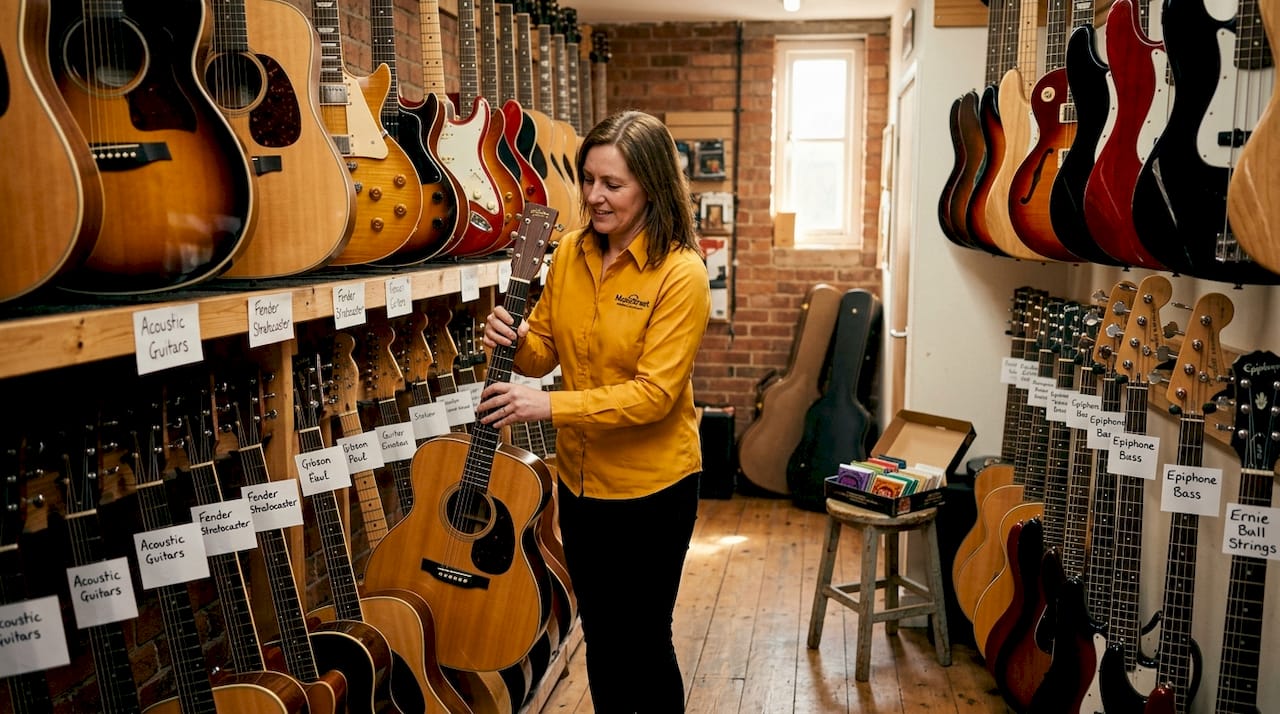
Equally important is the presence of used or pre-loved stock. Second-hand guitars often represent extraordinary value and sometimes offer quality unavailable at the same price point brand new. Our guide to best guitar accessories can help you think about the full picture of what a well-stocked shop should offer alongside the instruments themselves.
2. In-house repair and setup services
A specialist positioned for both selling and repairing guitars is immediately more trustworthy than a shop that simply orders boxes and puts price tags on them. Why? Because repair technicians understand instruments at a deeper level. They know what a properly set-up guitar feels like, which means the guitars they sell are far more likely to leave the shop in genuinely playable condition.
Setup quality is one of the most underrated factors in guitar buying. A poorly set-up guitar with high action (the distance between the strings and the fretboard) will be painful to play and may discourage a beginner unnecessarily.
3. Knowledgeable, passionate staff
Great staff do not just answer questions. They ask them. They want to know what music you play, what amplifier you already own, and what budget you are working within. That conversation shapes their recommendation in ways that no algorithm can replicate.
4. Aftersales support and community
Does the shop offer a warranty? Will they help you if something goes wrong three weeks after purchase? Do they run workshops, events, or lessons? These factors turn a transaction into a relationship.
Here is a quick comparison to guide your choice:
| Feature | Independent specialist | Large chain retailer | Online-first retailer |
|---|---|---|---|
| Product range | Deep in niche areas | Broad but often shallow | Very broad |
| Staff expertise | Usually very high | Variable | Limited interaction |
| Repair services | Typically available | Rare | Not usually offered |
| Try before you buy | Yes | Yes | No |
| Price flexibility | Often negotiable | Fixed | Competitive but fixed |
| Aftersales support | Personal and direct | Generic | Varies by policy |
Pro Tip: Before visiting any shop, check their social media pages. The way a shop interacts with its followers online tells you a great deal about the enthusiasm and knowledge of the people working there.
Our guitar shopping tips article goes deeper into the practical side of evaluating a retailer before you commit.
Why location still matters: the in-store advantage in a digital era
Online shopping has made it easier than ever to compare prices and read reviews from the comfort of your sofa. But buying a guitar without playing it first is a significant risk, even for experienced players. An instrument that looks flawless in product photography can feel completely wrong in your hands.
The physical experience of visiting a guitar shop is irreplaceable in several specific ways. Consider how a guitar’s neck profile affects playability. A “C” profile feels very different from a “U” profile or a slim “D” shape under your thumb, and no photograph conveys that. Weight balance, fret edges, and the responsiveness of the electronics are all things you can only assess through touch and sound. Shops like The Guitar Store, independent and bricks-and-mortar since 1987, exist precisely because players need that tactile experience.
Here is a breakdown of what in-person visits offer that online channels simply cannot:
- Immediate sound comparison: Play the same riff through three different guitars and the right one will announce itself.
- Real-time expert input: A knowledgeable staff member can spot technique issues that might be affecting what you think you want.
- Honest condition assessment: Particularly relevant for used instruments. You can inspect the fretboard wear, check for cracks, and test every control.
- Relationship building: Shops that know you will alert you to incoming stock that matches your wish list.
- Community connection: Many shops host events, open-mic sessions, and clinics where you can meet other players.
| In-store shopping benefit | Why it matters |
|---|---|
| Try-before-you-buy | Feel and sound cannot be replicated digitally |
| Expert advice | Personalised guidance saves costly mistakes |
| Repair access | Fast turnaround on setups and fixes |
| Community events | Inspiration and networking with other guitarists |
| Negotiation potential | Price matching or bundle deals are often possible |
Supporting local and independent retailers also has a broader cultural value. When an experienced specialist stays in business, their knowledge stays in the community. That is worth something beyond the individual transaction.
For players who are curious about the used market, our guide to used guitars in the UK explains what to look for when buying pre-loved instruments in person. And if you are shopping for someone else, ideas for personalised musician gifts can complement whatever instrument a shop helps you choose.
Pro Tip: When you visit a shop in person, bring your current guitar if you have one. Comparing it side by side with something new gives you an immediate, honest reference point that abstract descriptions cannot provide.
Essential tips for your visit or online purchase
Whether you are walking through the door of your local independent or browsing a carefully curated online shop, preparation dramatically improves your outcome. Here is a structured approach that works for both scenarios.
-
Define your needs before you start shopping. Genre matters enormously. A blues player and a metal player have very different requirements even if both want a solid body electric. Know your style, your current level, and your honest budget before you look at a single instrument.
-
Inspect the instrument thoroughly. In person, check the neck for straightness by sighting along the fretboard from the headstock. Look for fret wear, check that tuning pegs turn smoothly, and confirm that every electronic control works without crackling. Online, request detailed photos of the headstock, neck joint, and body binding, and ask for a short video of the guitar being played.
-
Ask about aftersales support. Any retailer worth trusting will offer a guarantee period. Ask specifically what happens if you encounter a fault within the first 30 days. Good shops, covering instrument categories from beginner to professional, understand that buyer confidence depends on knowing they are not on their own after the sale.
-
Factor in accessories and maintenance from the start. A new set of strings, a decent strap, a case, and a tuner can add £50 to £150 to your initial outlay. Some shops will bundle these in if you ask, particularly on higher-value purchases. Others offer ongoing maintenance plans that cover annual setups and minor repairs. These packages represent excellent value over time.
-
Check delivery and returns policies when buying online. Free UK delivery is now a baseline expectation for reputable retailers. Confirm the returns window and who covers the cost of returning an item before you place your order.
For a detailed look at what is available in the electric guitar market right now, our guide to the best electric guitars covers the most exciting current options across a range of budgets. If you are shopping for someone else and want broader inspiration, this musician gift guide covers everything from starter packs to premium accessories.
Pro Tip: Never let a salesperson pressure you into a decision on the day. A great guitar will still be a great guitar tomorrow. If you feel rushed, that is information about the shop’s culture, and it is not encouraging information.
What most guitarists overlook when choosing their store
Here is something we rarely say out loud: the guitar on the wall is almost secondary to the people behind the counter.
We have seen players buy instruments from anonymous online platforms, save thirty pounds on the list price, and then spend months frustrated by a poor setup, no support, and no one to call when something goes wrong. Meanwhile, players who invest in a relationship with a knowledgeable independent retailer consistently report faster progress, better decisions, and a deeper enjoyment of the instrument overall.
The stores that leave a lasting impression are not the ones with the most square footage. They are the ones where the owner remembers what you played last time you visited, recommends a workshop because they think it suits your playing style, and will genuinely talk you out of a purchase if they believe it is wrong for you. That kind of advice cannot be automated.
An independent specialist focused on both sales and repairs since 2014 builds that trust through consistency over decades, not through a slick website or a lower price point. The knowledge base accumulated over that many years is genuinely rare and genuinely valuable.
Think also about the educational dimension. Shops that host clinics, masterclasses, and informal playing sessions give you access to learning opportunities that simply do not exist in a purely transactional retail environment. These events introduce you to players at different levels, expose you to gear you might never have considered, and connect you to a community that sustains your motivation through the inevitable difficult patches.
Long-term relationships with great retailers also tend to produce tangible financial benefits. Staff who know you will notify you when something matching your wish list comes in before it appears online. They may negotiate on price or throw in a setup when you buy a second instrument. A good tip on guitar strap advice or a recommendation for a complementary accessory from someone who knows your playing makes a real difference over time.
The uncomfortable truth is that the cheapest transaction is rarely the best investment. Your relationship with a quality guitar store is one of the most undervalued assets in your musical life.
Find your sound with the right guitar shop
Ready to put this knowledge into practice and find a guitar that genuinely excites you?
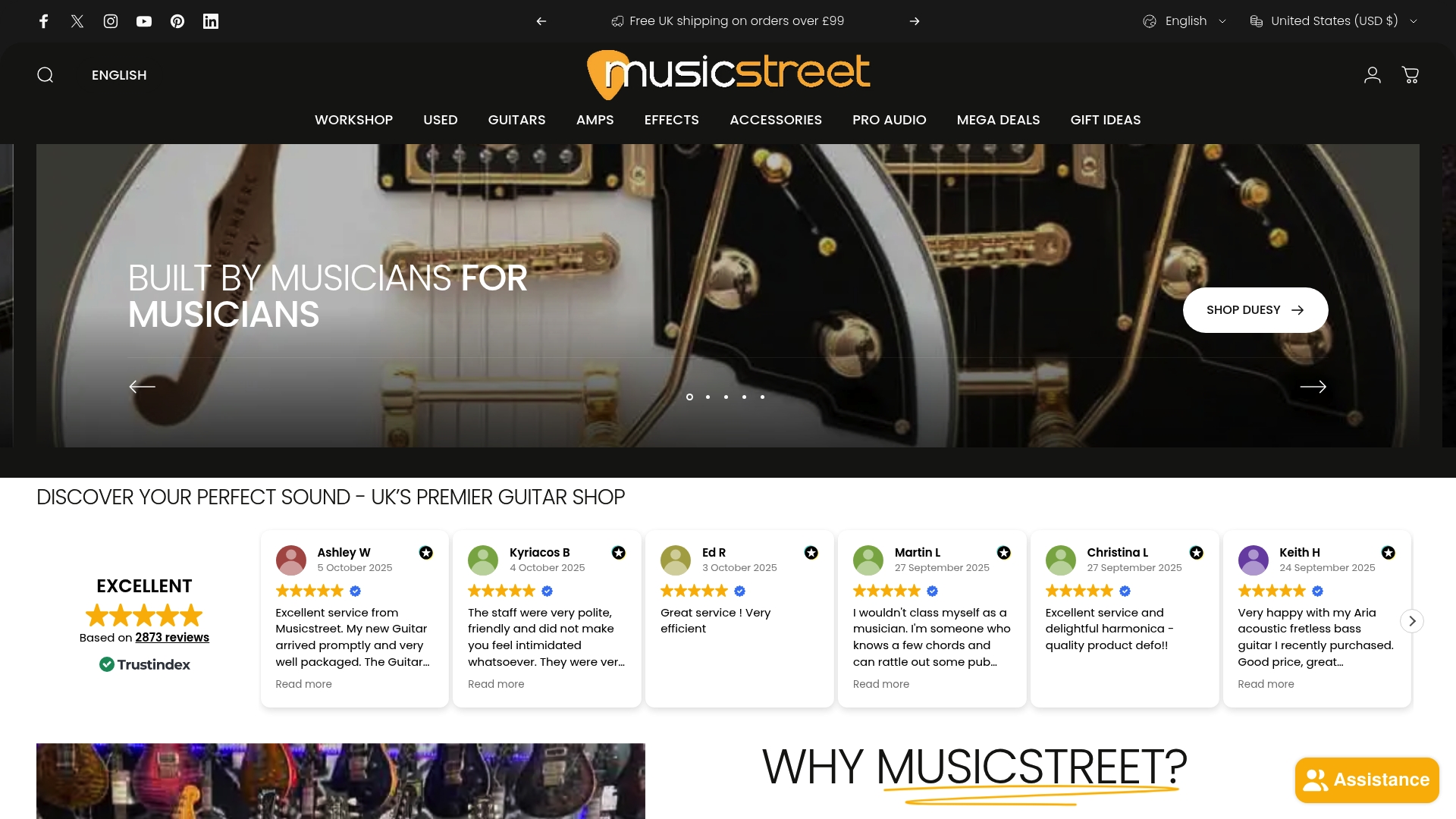
At MusicStreet, we have built our reputation on exactly the kind of personalised, expert-led service this guide describes. Our team in Huntingdon works with players at every level, from complete beginners to working professionals, offering a curated selection of new and pre-loved guitars across all styles and budgets. Every instrument is professionally inspected before it reaches you, and our aftersales support means you are never left to figure things out alone. Browse our full range, read our in-depth buying guides, or get in touch directly at explore our premium guitar shop. We would love to help you find the one.
Frequently asked questions
Is there a national chain called ‘Musicstreet’ in the UK?
No, there is no nationwide chain by this exact name in the UK. The term refers to independent retailers, and multiple shops use similar names across different towns and cities.
What services does Musicstreet in Huntingdon provide?
Musicstreet offers both sales and repairs, operating as an independent specialist since 1987. It serves local guitarists looking for instruments and ongoing maintenance support.
How can I choose the right guitar store for my needs?
Look for a shop with a broad stock range, skilled and genuinely passionate staff, in-house repair services, and clear aftersales support. A store specialising in both sales and repairs is a strong indicator of real expertise.
Is it better to buy a guitar in-store or online?
Visiting a shop lets you assess feel, sound, and condition firsthand and gives you access to real-time expert advice. Online shopping offers convenience and potentially wider choice, but works best when paired with a retailer who provides detailed product information and a strong returns policy.
Do guitar stores in the UK offer customisation or maintenance?
Many independent UK guitar stores offer professional setups, repairs, and custom modifications alongside their standard sales. Shops positioned as both sales and repair specialists are your best starting point for this kind of work.


Share:
Steve Vai's Ibanez JEM and PIA: A Complete Guide to the World's Most Iconic Signatures
Top benefits of solid body guitars: tone, durability, and more