


- Most acoustic guitarists focus on selecting the right guitar but overlook the importance of pickups in capturing tone. Understanding how magnetic, piezo, and microphone pickups sense different vibrations helps players optimize their amplified sound and manage feedback effectively. Blending multiple pickup types with proper control strategies offers the most versatile and reliable tone for live and studio performances.
Most guitarists spend weeks choosing the perfect acoustic guitar, then assume any pickup will do the job. That thinking costs you tone. Every pickup technology interacts with your instrument differently, capturing vibration from the strings, the saddle, or the surrounding air, and each produces a distinct amplified voice. The gap between a thin, harsh signal and a rich, natural acoustic tone often comes down not just to which pickup you choose, but how different technologies work together. This guide walks through every major type and shows you how to get the best from each.
Table of Contents
- How acoustic pickups work: the basics
- Piezo pickups: clarity and under-saddle design
- Magnetic and microphone pickups: unique sonic emphasis
- Choosing and blending acoustic pickups: strategies for great tone
- Why the single-pickup mindset limits your acoustic guitar potential
- Explore premium pickup solutions at MusicStreet
- Frequently asked questions
Key Takeaways
| Point | Details |
|---|---|
| Types impact tone | Magnetic, piezo, and microphone pickups produce distinct amplified sounds due to sensing different vibration sources. |
| Hybrid systems add flexibility | Blending mic, piezo, and magnetic pickups offers greater control and clarity, reducing issues like feedback or harsh tones. |
| Placement and controls matter | Careful pickup positioning and use of blend/phase/EQ controls are essential for achieving reliable, musical live sound. |
| Upgrade for performance | Upgrading or combining pickups can transform your guitar’s reliability and stage tone, benefiting both beginners and pros. |
How acoustic pickups work: the basics
Before you can make a smart choice, you need to understand what each pickup is actually sensing. This matters far more than most players realise.
The three main categories are magnetic, piezo, and microphone pickups, and each captures a completely different type of energy. Understanding the pickup role in tone is the first step towards improving your amplified sound.
Here is what each type actually detects:
- Magnetic pickups use coils and magnets to sense the movement of metal strings directly. They produce a warm, electric guitar style tone that suits fingerpickers and those who want a vintage, bluesy quality from their acoustic.
- Piezo pickups convert mechanical vibration (from the saddle and bridge) into an electrical signal. They emphasise the attack and definition of each note, making them a favourite for live strumming and projection.
- Microphone pickups capture airborne sound from inside or around the body. They deliver the most natural acoustic tone but are also the most sensitive to feedback in loud environments.
As outlined in a thorough guitar pickup guide, magnetic and piezo pickups sense different vibrations and therefore sound and behave differently in live amplification. Neither is universally superior. Your venue size, playing style, and tonal goals all determine which suits you best.
Understanding what your pickup senses is more important than brand or price. A cheap mic pickup will always feel more natural than an expensive piezo if you are recording in a quiet studio setting.
Think of it this way: a microphone pickup is like having a tiny ear inside your guitar, while a piezo element is like pressing a sensor directly against the wood. Both gather acoustic information, but the story each tells is quite different.
Piezo pickups: clarity and under-saddle design
Piezo technology is the most widely used acoustic pickup system in the world, and for good reason. It is reliable, consistent, and handles high stage volumes without collapsing into feedback.

The word “piezo” comes from the Greek word for pressure. Piezo crystals (or ceramic elements) generate a small electrical charge when compressed. In an acoustic guitar, under-saddle piezo pickups are typically implemented as a thin strip beneath the saddle slot, aimed at efficient coupling with string and bridge vibrations. Every time a string is plucked, the force travels through the saddle, squeezes the piezo strip, and produces a corresponding electrical signal.
Here is how a typical under-saddle installation works, step by step:
- The existing saddle is removed from the bridge slot.
- A thin piezo strip, often just 2 to 3 millimetres thick, is laid flat inside the slot.
- A wire passes through a drilled hole in the guitar body to an endpin jack or preamp.
- The saddle is replaced on top, pressing down onto the piezo element.
- The preamp (if included) handles basic EQ and battery power for a stronger output signal.
The result is a clean, articulate signal with excellent string separation. Each note rings distinctly, which suits players who perform intricate fingerstyle arrangements or fast lead lines in a live band context.
However, piezo has a well-known weakness: that infamous “quack.” When the high frequencies are over-emphasised and the mid-range warmth is missing, the tone can sound brittle, glassy, or artificial. This typically happens when the piezo element is unevenly loaded under the saddle, or when no onboard EQ is available to shape the signal.
Pro Tip: If your piezo sounds harsh, do not reach for the amp’s treble knob first. Check whether the saddle is sitting flat and applying even pressure across the entire piezo strip. An uneven fit is one of the most common causes of thin piezo tone.
For more on getting the best from this technology, the detailed breakdown of piezo pickup details covers installation options and preamp pairings thoroughly. If you are still in the process of choosing an acoustic guitar, it is worth checking whether a built-in piezo system comes included, as factory-fitted units are often better calibrated than aftermarket installs.
Piezo systems are the go-to choice for gigging musicians who need dependable output night after night. Their consistent performance under stage conditions is practically unmatched.
Magnetic and microphone pickups: unique sonic emphasis
Piezo systems are not the only option. Magnetic soundhole pickups and internal microphones each offer something distinct, and knowing when to use them changes everything.
Magnetic soundhole pickups
These slot into your guitar’s soundhole without any drilling or permanent modification. They work exactly like an electric guitar pickup, sensing string vibration through magnetic fields. The tone tends to be warm, full, and slightly compressed. Think of classic acoustic blues or jazz recordings where the guitar sounds almost electric but retains a woody body.
Pros:
- Easy installation with no permanent alterations
- Low feedback risk compared to microphone systems
- Warm, vintage tonal character
Cons:
- Limited sensitivity to body resonance and air movement
- Can sound too “electric” for players who want a natural acoustic voice
- Works best with metal strings; nylon string players see very limited results
Microphone pickups
Internal microphones (mounted inside the body, near the soundhole, or clipped to the guitar externally) are the closest thing to simply placing a studio microphone in front of your instrument. They capture the natural resonance of the wood, the air moving inside the body, and the full character of your acoustic tone.
The trade-off is reliability. Microphones re-capture amplified sound from your speakers, creating feedback loops at performance volumes. This makes them difficult to use as a standalone solution at loud gigs.
Here is a simple comparison to help you assess each type:
| Feature | Magnetic | Microphone | Piezo |
|---|---|---|---|
| Tonal character | Warm, electric | Natural, airy | Clear, articulate |
| Feedback risk | Low | High | Low to medium |
| Installation | Non-invasive | Varies | Requires routing |
| Live performance | Very good | Challenging | Excellent |
| Studio recording | Good | Outstanding | Good |
| Nylon string compatibility | Poor | Excellent | Good |
Pro Tip: Microphone pickups truly shine in small venues, folk sessions, and studio recording where you can control the monitoring environment. If you play large stages, pair your microphone element with a piezo for backup and use blend controls.
This is precisely where hybrid systems come in. Many commercial acoustic solutions are hybrids, combining mic and piezo, or magnetic and mic, with onboard blend and EQ controls to manage tone and feedback during performance. A blend knob lets you dial in more microphone warmth during a quiet passage, then shift towards piezo when the drummer kicks in louder.
When setting up a hybrid system, feedback control tips become essential reading. Managing the balance between your mic and piezo signals is arguably more important than the individual quality of either pickup alone. You can also explore a broader hybrid pickup evaluation framework if you want to assess multiple systems side by side.
For players still weighing up whether an acoustic vs electric setup suits their needs, understanding how acoustic pickups work often tips the decision. Knowing you can get a warm magnetic tone or a natural mic sound from an acoustic instrument changes the picture considerably.
Choosing and blending acoustic pickups: strategies for great tone
With all three technologies understood, the real skill lies in matching and combining them for your specific goals. There is no single “best” pickup; there is only the right combination for your instrument, venue, and playing style.
Here is a practical process for choosing your approach:
- Identify your primary context. Are you mainly gigging in loud venues, recording at home, or playing intimate acoustic sets? Each context favours a different technology.
- Consider your guitar’s body style. Larger dreadnoughts often produce strong low-end that can get boomy; a piezo with an EQ that cuts lows helps. Smaller parlour guitars may benefit more from a microphone pickup to capture their natural tone.
- Decide on active or passive. Active vs passive systems offer different output levels and tonal shaping possibilities. Active systems include onboard preamps for stronger signal and more EQ control, while passive systems keep things simple.
- Choose a hybrid if versatility matters. Blend control and phase/EQ strategy are central to avoiding brittle “quack,” boomy lows, or harsh high end. A hybrid system gives you the knobs to solve all of these problems on the fly.
- Plan for feedback from the start. Internal microphones can re-capture amplified sound, so hybrid systems are often used specifically to improve live reliability. If you choose a microphone element, always pair it with a phase switch and place it away from speaker stacks.
Tone is not just about what you plug in. It is about where you stand, how you EQ, and how you blend. A thoughtful hybrid system in the hands of an attentive player will always outperform a premium single pickup used without care.
Phase controls deserve a special mention. When you blend a mic with a piezo, the two signals may arrive slightly out of phase, meaning they partially cancel each other out. This creates a hollow, thin sound. A phase switch on your preamp or DI box corrects this instantly, and it is one of the most overlooked tools in live acoustic performance.
Onboard EQ is equally valuable. A three-band EQ (bass, mid, treble) lets you address the specific acoustic character of your guitar before the signal even reaches the amplifier. Cutting a small amount of low-mid around 300 to 400 Hz can remove the muddy, boomy character that large-bodied guitars often produce when amplified.
Practical advice on upgrading pickups is worth reviewing before you commit to a system, especially if your current guitar has a factory-fitted pickup that has never quite impressed you. Sometimes the guitar itself is excellent and only the pickup system needs updating to transform your tone completely.
For those working with a mixing desk, stereo widening tips can also enhance how your acoustic guitar sits in a full band mix once your pickups are sorted.
Why the single-pickup mindset limits your acoustic guitar potential
Here is something the broader guitar world rarely says directly: the obsession with finding the single “best” acoustic pickup is holding players back. Most forum discussions, YouTube reviews, and gear guides frame pickup selection as a binary choice. Piezo or mic. Active or passive. Budget or premium.
Real performance rarely works that cleanly.
The players who consistently deliver the richest, most reliable acoustic tone in live settings almost all use blended systems. Not because they have unlimited budgets, but because they understand that no single technology captures everything a guitar does. Blending is not a luxury for session musicians or touring professionals. It is a practical strategy available to anyone willing to spend a little extra on a modest preamp and a secondary pickup element.
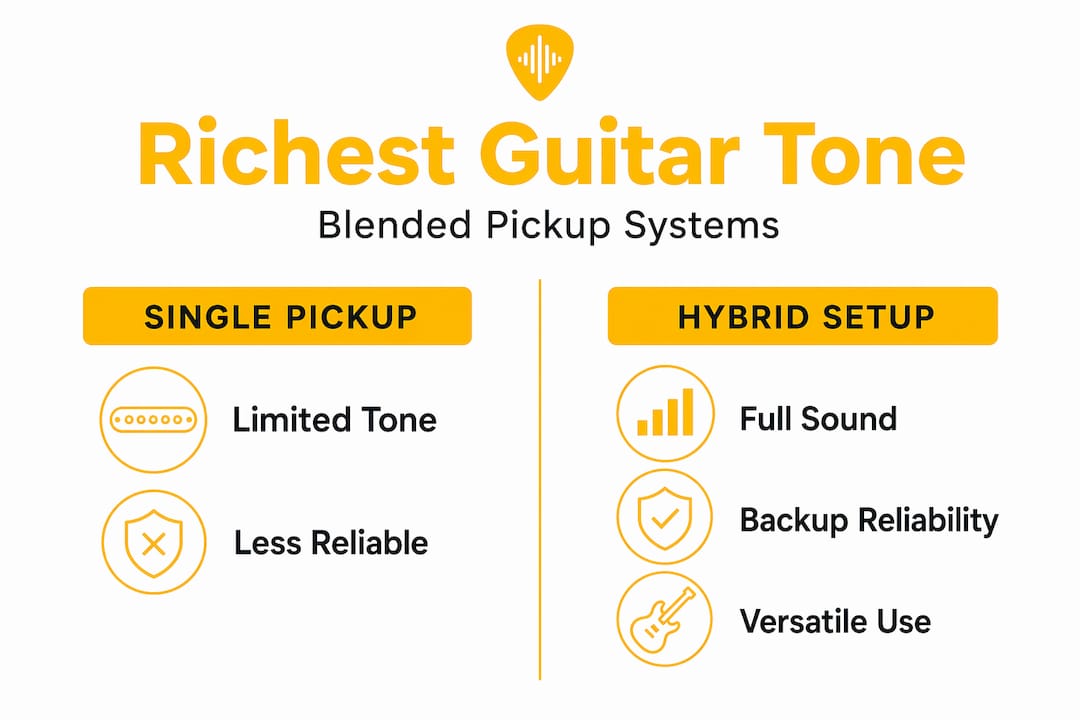
There is also a reliability argument that gets overlooked. A piezo backup signal running quietly alongside your microphone pickup gives you something to fall back on if feedback becomes unmanageable, or if your microphone cable develops a fault mid-set. That safety net has saved more than a few performances.
The most versatile combination we consistently recommend, based on real-world use across folk, country, and fingerstyle settings, is an under-saddle piezo paired with a small internal microphone and a simple blend preamp. This setup covers everything from thunderous strumming with full projection to delicate fingerpicking with natural warmth. Understanding how your pickups shape sound at every level of the signal chain gives you genuine control, and that control is what separates a confident performance from an anxious one.
Stop shopping for the perfect pickup. Start building the right system.
Explore premium pickup solutions at MusicStreet
Whether you are just beginning to explore acoustic amplification or looking to upgrade an existing setup, MusicStreet is here to help you find the right solution without the guesswork.

Our premium guitar shop stocks a wide range of acoustic guitars with factory-fitted pickup systems, alongside standalone pickup upgrades and hybrid solutions from leading brands. Our team understands the nuances between technologies because we use and test them ourselves. From a first undersaddle piezo to a sophisticated blended system, we offer personalised guidance for every level of player. You can browse in-store at our Huntingdon showroom, try before you buy, or shop online with expert support just a message away. Explore our dedicated resource on piezo pickup technology as a starting point.
Frequently asked questions
What is the difference between piezo and magnetic acoustic pickups?
Piezo pickups sense vibrations from your guitar’s saddle and bridge, while magnetic pickups detect string vibration using magnets, producing a distinctly different amplified tone. As noted by leading gear reviewers, magnetic and piezo pickups sense different vibrations and therefore behave differently in live amplification.
Can I use multiple pickups on my acoustic guitar for better tone?
Yes, blending pickups such as a mic and piezo or magnetic and mic with onboard controls lets you tailor your amplified tone and minimise feedback effectively. Many commercial solutions are hybrids with onboard blend and EQ controls to manage tone and feedback in performance.
Why does my piezo pickup sometimes sound thin or ‘quacky’?
Piezo pickups emphasise string and saddle vibration, which can produce a brittle or glassy tone without proper EQ. Blend control and phase/EQ strategy are central to avoiding brittle “quack,” boomy lows, or harsh high end.
How can I minimise feedback during live acoustic performances?
Feedback is best managed through careful pickup placement, blend controls, and onboard EQ, with hybrid systems offering the strongest live reliability. Internal microphones can re-capture amplified sound, so hybrid systems are widely used to improve live performance dependability.


Share:
Set guitar intonation accurately for better sound
What is Fender Custom Shop: a guide for guitar enthusiasts