


An acoustic-electric guitar includes built-in pickups and a preamp for amplification without changing its natural tone. Both guitar types share similar construction and unplugged sound, but electric components only influence amplified sound. Choosing depends on performance environment, with acoustic-electrics ideal for live gigs and standard acoustics better for studio and practice use.
An acoustic-electric guitar is defined as an acoustic instrument fitted with built-in pickups and a preamp, allowing it to be amplified without changing its natural tone. A standard acoustic guitar produces sound entirely through the resonance of its wooden body, with no electronics involved. The difference between acoustic electric and acoustic guitar types is simpler than most players expect. Brands like Martin Guitar and Fender both offer models across both categories, and understanding what separates them helps you choose the right instrument for your playing style, budget, and the venues where you perform.
How do acoustic and acoustic-electric guitars differ in construction and sound?
The core acoustic guitar features that shape tone are body shape, wood type, and internal volume. The soundboard acts like a speaker cone, and different woods like mahogany or rosewood affect overtone and tonal character in distinct ways. Mahogany produces a warm, focused midrange. Rosewood opens up the high end and adds depth to the low frequencies.
Acoustic-electric guitars share these same construction principles. The body, bracing, and tonewoods are chosen with the same care as on a purely acoustic instrument. The difference is what sits inside or on the body: a pickup system and a preamp unit, typically mounted in a cutaway in the upper bout.
Pickup types vary across acoustic-electric models:
- Piezo pickups sit under the saddle and sense string vibration directly through the bridge. They are the most common type and deliver a clear, articulate signal.
- Microphone pickups are mounted inside the body and capture the resonance of the soundboard itself, producing a warmer and more natural tone.
- Hybrid systems combine both, giving players the ability to blend the two signals for a more balanced amplified sound.
Unplugged, an acoustic-electric guitar sounds virtually identical to a standard acoustic of the same construction. The electronics add negligible weight and do not alter how the soundboard vibrates. The tonal difference only becomes apparent once the guitar is plugged in and the preamp’s EQ controls are engaged.
Pro Tip: When testing an acoustic-electric in a shop, always play it unplugged first. If the acoustic tone does not satisfy you, no pickup system will fix it once amplified.

What are the advantages and disadvantages of each guitar type?
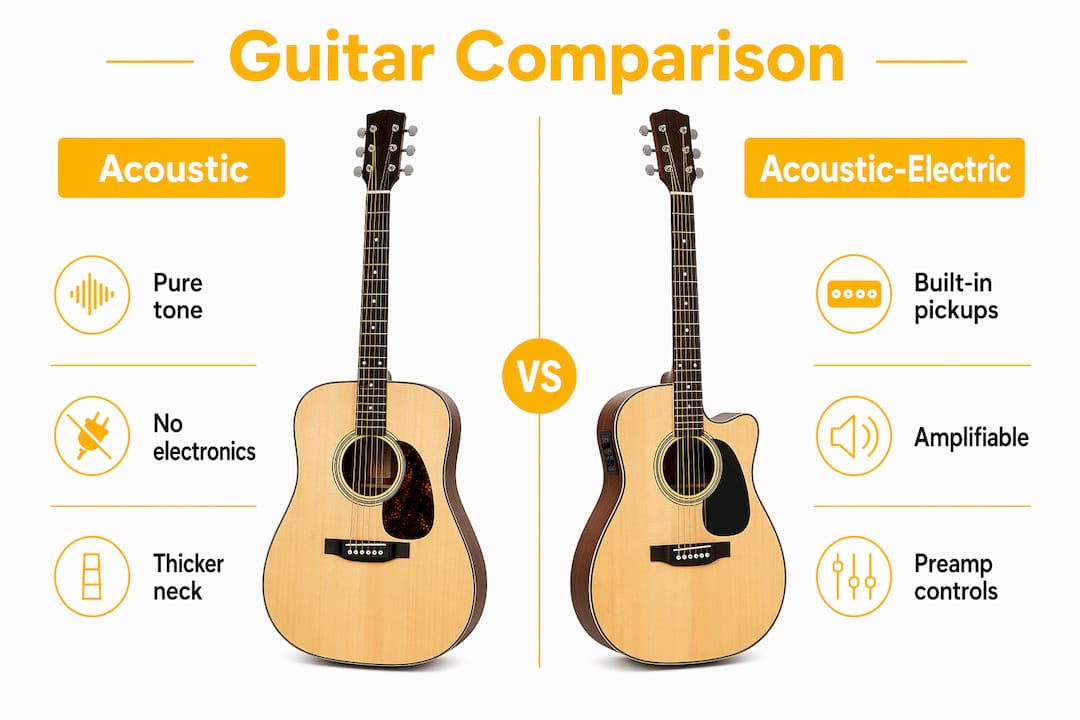
Choosing between acoustic guitar types means weighing practical trade-offs against your specific needs. Neither type is universally better. Each suits a different set of circumstances.
Advantages of a standard acoustic guitar:
- Simpler construction with no electronics to maintain or replace.
- Generally lower purchase price at equivalent build quality.
- Pure, unprocessed tone that many players and recording engineers prefer.
- No batteries, cables, or amplification required for practice or small gatherings.
Advantages of an acoustic-electric guitar:
- Plug directly into amplifiers or PA systems without needing an external microphone.
- Onboard preamp provides volume control, tone shaping, and feedback management.
- Versatile enough to perform unplugged or amplified depending on the venue.
- Eliminates the need for clip-on or soundhole pickups, which can affect tone and fit inconsistently.
Disadvantages to consider on both sides:
Acoustic-electric guitars often cost more due to the addition of electronics, and the pickups and preamp require periodic maintenance. A dead battery mid-performance is a real and avoidable frustration. Standard acoustics, by contrast, require an external microphone or a clip-on pickup to be heard in a live setting, which can be more cumbersome and less reliable than an onboard system.
Playability is broadly similar between the two types. Acoustic guitars generally have thicker necks and higher gauge strings compared to electric guitars, and acoustic-electrics share these physical characteristics. Beginners should expect the same learning curve on either type. The choice is not about ease of playing. It is about where and how you intend to perform.
When should you choose an acoustic-electric over a standard acoustic?
The playing environment is the single most important factor when choosing between acoustic guitars. A quiet living room and a pub stage are entirely different situations, and the right guitar for one is often wrong for the other.
Choose an acoustic-electric guitar if:
- You perform live regularly in venues with a PA system or amplification rig.
- You play in a band setting where you need to match volume with other instruments.
- You want the flexibility to practise unplugged at home and plug in for gigs without owning two guitars.
- You play genres like folk, country, pop, or rock where live amplification is standard.
Choose a standard acoustic guitar if:
- You primarily practise at home or record in a studio where microphone placement gives you full control over tone.
- You want the lowest possible cost at a given quality level.
- You prefer a signal chain with no electronics between your strings and your listener.
- You play intimate acoustic sets where a single microphone on a stand is sufficient.
Pro Tip: If you are a beginner unsure about performing live, consider an acoustic-electric from the start. You will not pay a significant penalty in tone or playability, and you will avoid buying a second guitar when gigs begin.
Studio recording is one area where the standard acoustic often wins. Engineers frequently prefer to mic an acoustic guitar rather than use the onboard pickup, because a well-placed condenser microphone captures the full resonance of the body in a way that a piezo pickup cannot replicate. That said, many recording sessions use the DI signal from an acoustic-electric as a reference track or blend it with a microphone signal for texture.
For a more detailed breakdown of acoustic vs electric guitar choices for beginners, Musicstreet’s buying guides cover the full range of considerations.
Do electronics change the acoustic character of an acoustic-electric guitar?
Electronics do not alter the fundamental acoustic character of an acoustic-electric guitar. This is the most persistent misconception among players new to the format.
Martin Guitar’s Dave Doll states this directly: electronics merely amplify the guitar’s natural sound without altering its intrinsic tone. The pickup captures string vibration and converts it to an electrical signal. The preamp boosts that signal and allows basic EQ adjustments. Neither component changes how the soundboard resonates when you strum unplugged.
“Electronics are a tool to share acoustic sound with larger audiences, not to change the instrument’s intrinsic tone.” — Dave Doll, Martin Guitar
This contrasts sharply with how a standard electric guitar works. Electric guitars rely on electronic pickups rather than acoustic resonance to produce their sound. They use steel strings and thinner necks, and the body shape has minimal effect on the amplified tone. An acoustic-electric guitar retains all the acoustic properties of its construction. The electronics are an addition, not a replacement.
The preamp’s EQ controls do allow players to shape the amplified tone, cutting feedback frequencies or boosting the low end for a fuller stage sound. Those adjustments affect only the amplified signal. Pull the cable out and the guitar sounds exactly as it would without any electronics fitted.
Key takeaways
The core difference between acoustic-electric and acoustic guitars is the presence of onboard electronics that enable amplification, while both types share the same fundamental acoustic construction and unplugged tone.
| Point | Details |
|---|---|
| Electronics do not alter acoustic tone | An acoustic-electric sounds the same unplugged as a comparable standard acoustic. |
| Wood and construction still define tone | Mahogany and rosewood affect character regardless of whether a pickup is fitted. |
| Acoustic-electrics suit live performance | Onboard pickups and preamps remove the need for external microphones on stage. |
| Standard acoustics cost less at equal quality | No electronics means a lower price point for the same level of craftsmanship. |
| Test both unplugged before buying | If the acoustic tone does not satisfy you unplugged, amplification will not improve it. |
My honest view on which guitar type to buy
I have seen players agonise over this decision for weeks, then buy the wrong guitar because they focused on the wrong question. The question is not “which sounds better?” Both types can sound exceptional. The question is “where will I actually play this guitar?”
The most common mistake I see is beginners buying a standard acoustic because it feels purer or more traditional, then discovering six months later that they want to play at open mic nights and need amplification. Buying a second guitar is an avoidable expense. An acoustic-electric from a reputable brand like Martin, Fender, or Gibson gives you both options in a single instrument.
The second mistake is assuming that a higher-priced acoustic-electric is always better than a mid-range standard acoustic. Electronics add cost. A well-built acoustic without pickups will often outperform a cheaper acoustic-electric in raw tone quality. If you never intend to perform live, that extra spend on electronics delivers nothing.
Technology in pickup systems has improved considerably. Modern piezo and hybrid systems from brands like Fishman and LR Baggs produce a far more natural amplified tone than the systems fitted to guitars a decade ago. If you tried an acoustic-electric years ago and disliked the plugged-in sound, the current generation of instruments is worth revisiting.
My advice is to test any guitar you are considering both unplugged and amplified before committing. Musicstreet’s physical store in Huntingdon, Cambridgeshire offers exactly that opportunity, with expert staff who can walk you through the differences in person. That hands-on comparison is worth more than any amount of online research.
— Music
Guitars for every playing style at Musicstreet
Musicstreet stocks a carefully selected range of acoustic and acoustic-electric guitars from brands including PRS, Gibson, Fender, and Martin, covering everything from beginner-friendly models to professional-grade instruments.

Whether you are looking for a pure acoustic for home practice or an acoustic-electric built for the stage, the team at Musicstreet provides expert guidance to match you with the right instrument. Every guitar is professionally inspected before sale, and competitive pricing is backed by insurance-supported warranties. Browse the full acoustic and electric guitar range online, or visit the Huntingdon store to play before you buy. Free UK delivery is available on qualifying orders.
For a closer look at specific models, Musicstreet’s guide to Fender acoustic guitars covers both acoustic and acoustic-electric options across beginner and intermediate levels.
FAQ
What is the main difference between acoustic-electric and acoustic guitars?
An acoustic-electric guitar has built-in pickups and a preamp that allow it to be plugged into an amplifier or PA system. A standard acoustic guitar produces sound entirely through its wooden body with no electronics.
Does an acoustic-electric guitar sound different unplugged?
No. Unplugged, an acoustic-electric sounds virtually identical to a standard acoustic of the same construction. The electronics only affect the amplified signal.
Are acoustic-electric guitars harder to play than standard acoustics?
Playability is broadly the same. Both types share similar neck profiles and string gauges. The added electronics do not affect how the guitar feels or responds under the fingers.
Which guitar type is better for beginners?
Both are suitable for beginners. An acoustic-electric offers more long-term flexibility if live performance is a goal, while a standard acoustic costs less at equivalent build quality for players focused on home practice.
Do I need a special amplifier for an acoustic-electric guitar?
An acoustic-specific amplifier or a PA system produces the best results, as these are designed to reproduce the natural frequencies of an acoustic instrument. A standard electric guitar amplifier can be used but may colour the tone in ways that suit electric rather than acoustic sounds.






Share:
Acoustic guitar brands list: the 2026 buyer's guide
Acoustic vs electric guitar: which type is right for you?