


The main classical guitar types are: the traditional Spanish classical, the flamenco, the parlour/romantic (small-bodied), the 3/4 and travel guitars, the cutaway/electro-acoustic crossover, and the modern concert variants — lattice-braced and double-top designs. Construction is what separates them: bracing pattern, top wood, scale length and action height determine tone, projection and how the instrument feels under your hands. The classical guitar as a standardised family of nylon-string instruments with a 650 mm scale took shape in the 19th century and has branched into these distinct forms since.
Where to start, by goal:
- Beginner or student: a full-size traditional Spanish classical with a solid cedar top gives you the warmest, most forgiving response for the money.
- Young player or small hands: a 3/4-size or short-scale (630–640 mm) instrument reduces string tension and fret spacing, making technique easier to develop.
- Flamenco study: a cypress-bodied flamenco guitar with a lower action and golpeador (tap plate) is the right starting point, not a standard classical.
- Concert projection or large-hall performance: a lattice-braced or double-top modern concert guitar delivers the volume and tonal complexity that fan-braced student models cannot match.
- Travel or practice away from home: a 3/4 or dedicated travel guitar keeps playability intact without the bulk.
The sections below cover construction and tone trade-offs in depth, then move into buying checklists, price bands, care guidance and UK-specific retail advice.
Key takeaways
Construction drives everything: the bracing pattern, top wood and back/sides choice determine a classical guitar’s tone, projection and long-term development more than any other factor.
| Point | Details |
|---|---|
| Match type to goal | Flamenco players need a flamenco guitar; students need a fan-braced classical; concert performers need lattice or double-top. |
| Solid top is the key upgrade | A solid cedar or spruce top transforms tone over laminate and is achievable from around £300. |
| Scale and nut width affect comfort | Short scale (630–640 mm) and narrower nut (50–51 mm) suit smaller hands; standard 650 mm and 52 mm suit most adults. |
| Cedar vs spruce | Cedar gives immediate warmth and suits UK humidity; spruce is brighter and develops over years of playing. |
| Musicstreet offers setup and inspection | New and pre-owned classical and electro-acoustic guitars are available with professional setup and UK delivery from Musicstreet. |
Table of Contents
- What are the main classical guitar types?
- How construction shapes the tone you actually hear
- Scale length, nut width and neck shape: what fits your hands
- Nylon strings, tension and action: matching setup to your playing
- What to check when buying a classical guitar
- Typical price bands and what you get at each level
- Keeping your classical guitar in good condition
- Buying a classical guitar in the UK: trying before you buy
- Sources
- FAQ
What are the main classical guitar types?
The modern classical guitar family covers more ground than most beginners expect. Here is each type, what it sounds like, and who it suits.
Traditional Spanish classical
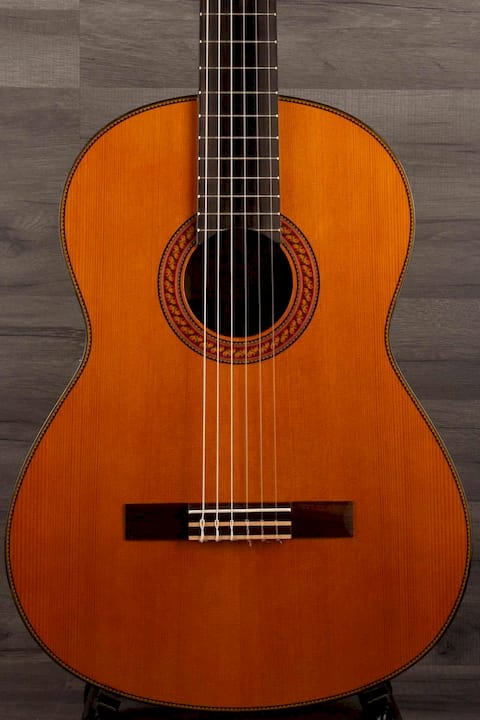
The baseline instrument: a full-size body (typically 650 mm scale), fan-braced spruce or cedar top, rosewood or mahogany back and sides, and a wide nut (usually 52 mm). The neck joins the body at the 12th fret, the action sits higher than on a steel-string acoustic, and there is no cutaway. Tone is warm, rounded and sustaining. This is the instrument most classical method books assume you are playing, and it suits beginners through to advanced amateurs.
Flamenco guitar
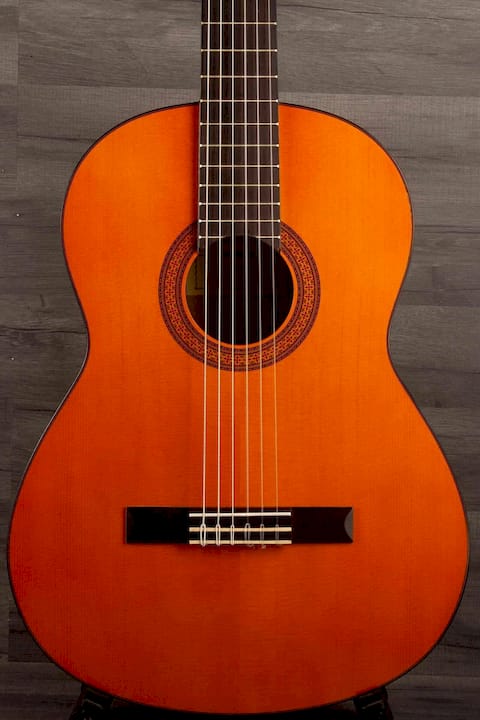
Visually similar to the Spanish classical but built for a different purpose. Cypress back and sides (occasionally sycamore or maple on modern instruments) keep the body lighter and produce a brighter, drier, more percussive tone. The action is set lower than on a classical guitar, which allows the fast, rhythmic rasgueado and picado techniques of flamenco without excess string resistance. A golpeador (tap plate) protects the top from knuckle strikes. If you are studying flamenco, starting on a standard classical will teach you the wrong physical habits.
Parlour and romantic guitar
These small-bodied instruments predate Antonio de Torres’ 19th-century standardisation of body proportions and fan bracing, which remains the baseline for most traditional classical designs today. A parlour or romantic guitar has a narrower waist, smaller lower bout and shorter scale, producing an intimate, mid-forward tone that suits solo repertoire from the early Romantic period (Sor, Giuliani, Mertz). They are not beginner instruments in the conventional sense, but players with smaller hands or those specialising in period repertoire find them genuinely useful.
3/4 and travel guitars
Scale lengths in the 580–630 mm range, smaller bodies and lighter construction. The primary audience is children (ages 6–11 roughly) and adults who want a portable practice instrument. Tone is thinner than a full-size guitar, but the best 3/4 models with solid tops are perfectly adequate for practice and informal performance. Worth noting: a 3/4 label does not mean the body is exactly three-quarters of a full-size guitar — it is a loose industry convention for the scale-length category.
Cutaway and electro-acoustic crossover
A cutaway body allows access to the upper frets (above the 12th), which is largely irrelevant for traditional classical repertoire but useful for players who cross between genres. The Yamaha FGC-TA TransAcoustic Electro Acoustic Cutaway in Vintage Tint and the Yamaha TransAcoustic FGC-TA in Black are good examples of this crossover category: nylon strings, cutaway body, built-in electronics and Yamaha’s TransAcoustic technology that produces reverb and chorus effects acoustically without an amplifier. These are not traditional classical guitars, but they are genuinely useful for players who perform in amplified settings or want one instrument for multiple styles.
Lattice-braced concert guitars
Developed in Australia by Greg Smallman (and adopted by players including John Williams), lattice bracing replaces the traditional fan-brace pattern with a grid of carbon-fibre or balsa/carbon composite struts. The result is a much thinner, lighter top that vibrates more freely, producing exceptional volume and projection. These instruments are built for large concert halls. They tend toward a brighter, more immediate response than fan-braced guitars, and they are almost exclusively found at the upper end of the market.
Double-top concert guitars
A double-top uses two thin layers of wood (typically spruce or cedar) sandwiching a Nomex honeycomb core. The construction reduces mass while maintaining stiffness, giving the top a similar free-vibration advantage to lattice bracing. Tonal character varies by maker, but double-tops generally offer strong projection, even response across registers and a slightly warmer quality than lattice instruments. Luthiers including Gernot Wagner and Matthias Dammann are associated with this approach. Like lattice guitars, these sit firmly in the concert and upper-intermediate market.
Pro Tip: When trying any classical guitar type in a shop, play a slow, sustained note on the open B string and listen for how long it rings and whether it blooms in volume after the initial attack. A guitar that opens up after the pluck is responding well — one that peaks immediately and dies quickly is telling you something about its top.
How construction shapes the tone you actually hear
The differences between classical guitar types come down to three decisions: bracing pattern, top wood and back/sides wood. Get these right for your playing goals and everything else follows.
Fan bracing vs lattice vs double-top
Fan bracing is the traditional approach, refined by Torres in the 19th century and still used on the vast majority of classical guitars. Spruce or cedar struts radiate outward from the centre of the lower bout, stiffening the top against string tension while allowing it to vibrate. The result is a warm, balanced tone with good sustain, though volume in a large hall is limited compared with modern designs.
Lattice bracing, as described by luthiers and dealers, replaces those wooden struts with a grid of lightweight composite material. The top can be made thinner and lighter, which increases its sensitivity to string vibration. The payoff is significantly greater projection and sustain. The trade-off is that lattice guitars can feel less forgiving to play — they respond to every nuance of touch, which rewards advanced technique but can expose inconsistencies in a student’s playing.
Double-top construction sits between the two in terms of feel. The Nomex core keeps mass low without the rigidity of a full carbon lattice, and many players find the tonal character more immediately familiar than a lattice guitar. Both systems are chosen specifically where extra projection and sustain are needed for large halls.
Spruce vs cedar soundboards
This is the most consequential single choice on any classical guitar. Spruce tops tend toward brightness, clarity and a longer “opening” period — the instrument often sounds better after years of regular playing as the wood becomes more responsive. Cedar tops give a warmer, more immediate response and reach their characteristic tone sooner, which makes them popular for students and players who want a guitar that sounds good from the first session.
A controlled acoustic study found that German spruce tops in the tested sample tended to show larger volume and longer sustain, while Canadian cedar tops were more homogeneous across registers. The authors note the sample size limits those conclusions and recommend further research. In practical terms: if you play Baroque or early Classical repertoire where articulation and brightness matter, spruce is worth considering. If you play Romantic or contemporary pieces where warmth and immediate response suit the music, cedar is a natural starting point.
A luthier’s perspective adds that spruce typically offers more harmonic detail and long-term tonal development, whereas cedar gives a warmer, more immediate response and is less sensitive to environmental shifts — a practical consideration in the UK’s variable climate.
Pro Tip: Cedar is generally more forgiving in the UK’s humidity fluctuations than spruce. If you store your guitar in a room that gets cold and damp in winter, cedar’s relative stability is a real advantage.
Back and sides woods
The role of back and sides woods is to reflect and colour the sound generated by the top. Rosewood (Indian or Brazilian) is the traditional choice: dense, rich and sustaining, it adds depth and complexity to the top’s output. Mahogany is warmer and more mid-forward, with less low-end complexity — often found on student instruments and producing a clear, focused tone. Maple is bright and articulate, adding definition without the warmth of rosewood. Cypress, as noted above, is the flamenco choice: light, dry and percussive.
The interaction between top and back/sides matters. A cedar top paired with rosewood back and sides can produce a very warm, full sound that risks muddiness in the bass. Spruce with rosewood tends to balance brightness and depth well. Complementary combinations are key to the desired tonal outcome, and understanding these pairings helps when comparing instruments in a shop.
| Construction element | Traditional/fan-braced | Lattice-braced | Double-top |
|---|---|---|---|
| Top thickness | Standard (2.5–3 mm) | Thin (2 mm) | Two thin layers with Nomex core |
| Projection | Moderate | High | High |
| Sustain | Good | Very long | Long, even |
| Tonal character | Warm, balanced | Bright, immediate | Warm to neutral |
| Best suited to | Student to advanced amateur | Concert performance | Intermediate to concert |
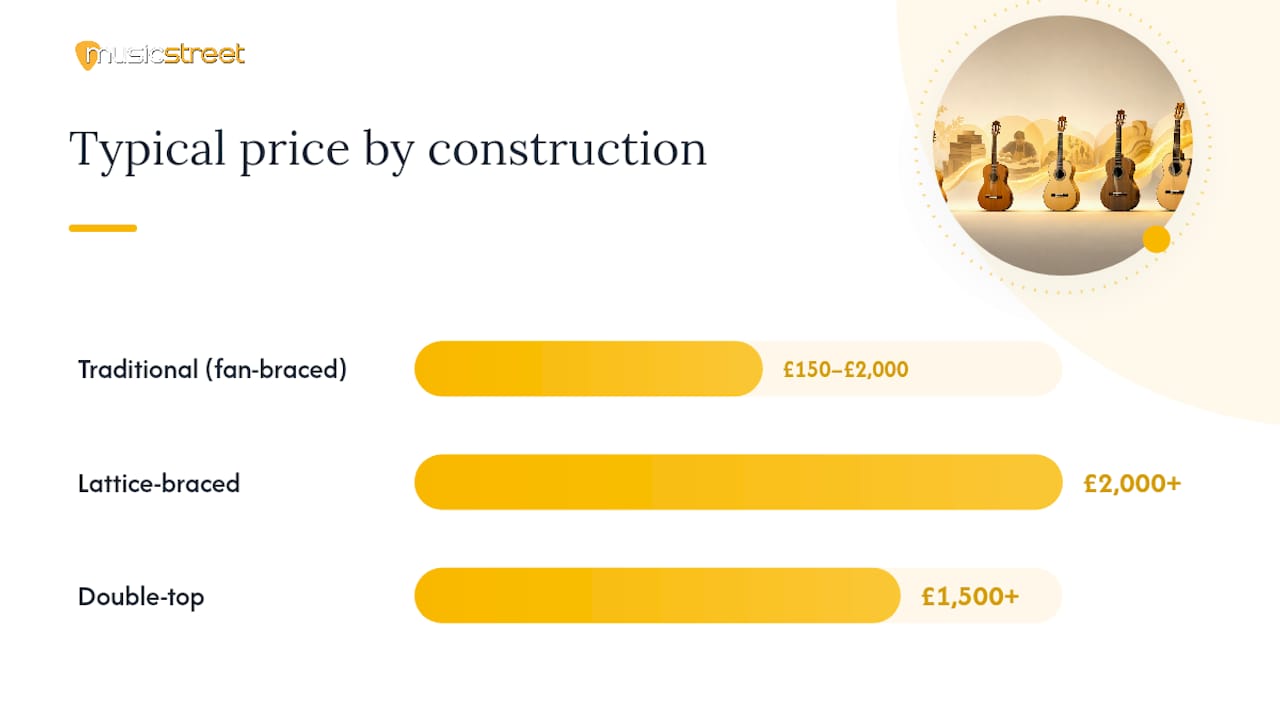
| Typical price range | £150–£2,000 | £2,000+ | £1,500+ |
Scale length, nut width and neck shape: what fits your hands
Playability is not just about skill level. A guitar that does not fit your hands physically will slow your progress regardless of how good the instrument sounds.
Scale length
The standard classical guitar scale is 650 mm, measured from nut to saddle. This determines string tension and fret spacing. Short-scale instruments (typically 630–640 mm) reduce both: strings feel looser under the fingers, frets are slightly closer together, and chord stretches are less demanding. For players with smaller hands, or anyone returning to the instrument after a break, a short-scale guitar can make a meaningful difference to comfort and progress.
A 3/4-size guitar typically has a scale of around 580–610 mm. These are primarily for children but some adults with very small hands find them workable for practice.
Nut width
Standard classical nut width is 52 mm. This is wider than most steel-string acoustics (typically 43–44 mm) and is designed to give the right hand enough string spacing for fingerstyle technique without the fingers catching adjacent strings. Some manufacturers offer 50–51 mm options, which suits players transitioning from steel-string or those with narrower hands. Going narrower than 50 mm starts to compromise classical fingerstyle technique, so treat anything below that as a crossover instrument rather than a traditional classical.
Neck profile and action
Classical guitar necks are typically flatter in profile than steel-string acoustics — closer to a shallow C or D shape. Action at the 12th fret (the distance between the string and the top of the fret) is usually 3.5–4 mm on the bass strings and 3–3.5 mm on the treble strings for a standard classical setup. Flamenco setups run lower: 2.5–3 mm bass, 2–2.5 mm treble.
In-store checklist for playability:
- Fret the low E string at the first fret and check for buzzing — if it buzzes at normal playing pressure, the nut slot is too low or the neck has a back-bow.
- Capo at the first fret and measure action at the 12th fret with a ruler or feeler gauge. Bass strings: 3.5–4 mm for classical, 2.5–3 mm for flamenco. Treble strings: 3–3.5 mm classical, 2–2.5 mm flamenco.
- Sight down the neck from the headstock toward the body. A slight forward bow (relief) is normal. A back-bow or severe forward bow indicates a neck problem.
- Play a chromatic scale from the open strings to the 12th fret on each string. Any buzzing or dead notes points to fret wear or uneven frets.
- Check the join between neck and body at the 12th fret. On a traditional Spanish classical, this joint is integral to the construction — any gap or movement here is a serious structural issue.
Pro Tip: Bring a small steel ruler (30 cm) to any in-store visit. Measuring action at the 12th fret takes ten seconds and tells you more about a guitar’s setup than any amount of playing around the shop.
Nylon strings, tension and action: matching setup to your playing
String choice is the cheapest and most immediate way to change how a classical guitar feels and sounds. Most players underestimate how much difference a string change makes.
Types of nylon strings
- Clear/transparent nylon: the traditional choice, warm and rounded in tone. D’Addario Pro-Arté and Savarez Alliance are widely available in the UK.
- Rectified nylon: the string is ground to a precise diameter after manufacture, giving a slightly rougher surface and a more consistent feel. Tone is similar to clear nylon but with a slightly drier character.
- Carbon (fluorocarbon): brighter, louder and with more sustain than traditional nylon. Savarez Alliance and D’Addario Carbon are the main options. Carbon strings suit players who want more projection or who play in amplified settings.
- Composite/coated: wound bass strings with a polymer coating that extends life and reduces finger squeak. Useful for players who sweat heavily or live in humid conditions.
Tension choices
Normal tension is the standard starting point: balanced feel, moderate volume, comfortable left-hand effort. High tension increases volume and projection but demands more from the left hand — useful for concert performance but tiring for long practice sessions. Low tension reduces left-hand effort and suits players with hand or wrist issues, though projection and sustain drop noticeably.
Action and setup by use case
- Classical recital: normal tension strings, action at the upper end of the standard range (4 mm bass, 3.5 mm treble) for clean projection and minimal buzz.
- Flamenco: low action (2.5–3 mm bass), high-tension strings for snap and percussive response. Some buzz is acceptable in flamenco — it is part of the sound.
- Home practice: normal or low tension, action set to personal comfort. If your fingers ache after 20 minutes, lower tension strings are worth trying before assuming technique is the problem.
- Travel: carbon strings hold tuning better in temperature changes and are worth the extra cost on a travel guitar.
A professional setup (saddle adjustment, nut slot filing, neck check) is worth booking once a year for a regularly played instrument, and whenever you change string gauge or tension significantly. Most UK guitar shops can turn this around in a week.
What to check when buying a classical guitar
Whether you are buying new or secondhand, the same inspection logic applies. A well-set-up £400 guitar will outperform a neglected £1,000 one in almost every practical way.
Physical inspection checklist:
- Top: look for cracks running from the soundhole toward the bridge, or from the bridge toward the lower bout. Hairline cracks can be repaired; large cracks through the top are a serious devaluation.
- Bridge: check that it sits flush against the top with no lifting at the front or back edge. A lifting bridge affects intonation and, if left, will eventually pull free.
- Neck: sight down from the headstock. Slight forward relief is correct. Any twist is a problem.
- Frets: run your thumb along the fret ends on the treble side. Sharp, protruding ends indicate the fretboard has dried out and shrunk — common on guitars stored in low humidity.
- Tuning machines: turn each peg slowly. They should move smoothly with no slipping or grinding.
- Evidence of repairs: look for discolouration, mismatched finish or visible glue lines around the top, back join or neck heel. Ask the seller directly about any repair history.
In-store playing test:
- Play each open string and let it ring. Listen for even sustain and no rattles from loose bracing.
- Play a slow scale across all six strings from the open position to the 12th fret. Any dead or buzzing notes flag a setup or fret issue.
- Play a slow lyrical phrase (an arpeggio or a simple melody) and listen for balance between bass and treble registers. A good guitar does not have one register that dominates.
- Play a fast arpeggio (a Giuliani study or similar). The guitar should respond cleanly without the notes blurring together.
- Tune the guitar, play for five minutes, then check tuning again. Persistent tuning instability on a new guitar points to a nut slot or machine head problem.
Questions to ask the seller:
- What is the top wood, and is it solid or laminate?
- When was it last set up, and by whom?
- Has it had any repairs? If so, what and when?
- Does it come with a case, and what is the return or warranty policy?
Pro Tip: On a secondhand guitar, ask to see the inside of the body through the soundhole with a torch. Look for loose bracing struts (they will show as gaps between the strut and the top), any cracked kerfing along the sides, and evidence of moisture damage (tide marks or warped wood). These are the hidden problems that a quick play-test will not reveal.
Price-band guidance
Buying guidance from specialist dealers maps student, intermediate and concert price bands to expected construction and tonal outcomes, and identifies a solid top as the single most important specification once budget allows.
- Student (under £300): laminate or laminate-top instruments. Adequate for learning but limited tonal development. Prioritise setup quality over brand name.
- Intermediate (£300–£1,000): solid top becomes standard. This is where tone starts to reward practice. Yamaha, Cordoba and similar brands offer reliable options in this range.
- Concert (£1,000 and above): all-solid construction, selected tonewoods, luthier or semi-luthier build. Concert-level instruments offer superior responsiveness and tonal detail and are often beneficial for committed students as well as professionals. Armrests and soundports are luthier preferences rather than definitive markers of concert status.
Typical price bands and what you get at each level
The jump from student to intermediate is the most impactful upgrade most players will make. The jump from intermediate to concert is more nuanced.
Student guitars (under £300)
Laminate tops dominate this bracket. Laminate is stable and resistant to humidity changes, which is practical for a beginner who may not yet know about guitar care. Tone is functional but flat — the guitar does not develop or open up with playing the way a solid top does. At this level, the most important thing is that the guitar is set up correctly. A poorly set-up £250 guitar is harder to play than a well-set-up one, and that difficulty will slow progress.
Intermediate guitars (£300–£1,000)
A solid cedar or spruce top becomes realistic here, and the tonal difference over laminate is immediately audible. Back and sides are often laminate rosewood or mahogany at the lower end of this bracket, moving to solid back and sides above £600–£700. This is the range where tonewood selection and complementary top/back/side pairings start to matter practically. A solid-top guitar in this bracket, properly set up, will serve most players through grade 8 and beyond.
Whether the upgrade to a higher-end instrument is worth it depends on your goals. Musicstreet’s guide on high-end guitars addresses this question directly and is worth reading before committing to a significant spend.
Concert guitars (£1,000 and above)
All-solid construction, carefully selected tonewoods, and either a traditional luthier build or a semi-production luthier process. At the upper end (£3,000+), lattice and double-top instruments appear. These are not just louder — they respond differently to touch, offering a dynamic range and tonal complexity that factory instruments cannot replicate. Concert instruments are not strictly for professionals; serious students also benefit from the responsiveness and tonal range of concert-grade guitars, particularly when preparing for diploma or performance examinations.
Resale value holds better at this level, particularly for named luthier instruments. A well-maintained concert guitar from a respected maker can appreciate over time.
| Best for | Tone character | Projection | Playability | Typical price | Construction notes |
|---|---|---|---|---|---|
| Beginner/student | Warm, functional | Low to moderate | Depends on setup | Under £300 | Laminate top and back/sides |
| Intermediate player | Warm or bright, developing | Moderate | Good with solid top | £300–£1,000 | Solid top; laminate or solid back/sides |
| Advanced amateur | Rich, complex | Good | Excellent | £1,000–£3,000 | All-solid; selected tonewoods |
| Concert/professional | Full, complex, dynamic | High | Exceptional | £3,000+ | Luthier build; lattice or double-top options |
Keeping your classical guitar in good condition
A classical guitar is more sensitive to environmental changes than a steel-string acoustic. The lighter construction and thinner top that give it tonal beauty also make it vulnerable to humidity and temperature swings.
Daily and weekly habits
- Wipe the strings with a dry cloth after every session. Sweat accelerates corrosion on wound bass strings and degrades nylon trebles.
- Wipe the body and neck with a slightly damp cloth (not wet) weekly. Avoid silicone-based polishes on unfinished or French-polished tops.
- Store the guitar in its case when not in use. A gig bag offers minimal protection against knocks and temperature changes; a hard case is significantly better.
- For long storage (more than a few weeks), slacken the strings slightly to reduce tension on the top and bridge. Do not detune completely — the neck needs some tension to stay stable.
Humidity and temperature in the UK
A digital hygrometer (available for under £15) placed near the guitar tells you what the environment is actually doing.
Keep the guitar away from radiators, direct sunlight and exterior walls in winter.
Maintenance schedule
- String changes: every 4–8 weeks for regular players, or when strings lose brightness and feel rough under the fingers.
- Professional setup: once a year for a regularly played instrument. A setup includes checking neck relief, adjusting saddle height, inspecting frets and lubricating the nut slots.
- Fret level and dress: every 5–10 years depending on playing frequency. Signs you need it: buzzing that a saddle adjustment does not fix, or notes that fret out on bends.
- Bridge and top inspection: at every string change, look at the bridge for any lifting and check the top around the soundhole for any new cracks.
A CruzTools Groovetech Acoustic Guitar Player Tech Kit covers the basic tools for string changes and minor adjustments between professional setups.
Pro Tip: The most common cause of top cracks in UK homes is placing the guitar near a radiator in winter. Even a metre of distance makes a significant difference. If you play in a cold room, let the guitar acclimatise for 20–30 minutes before playing rather than bringing it straight from a cold car boot into a warm house.
Buying a classical guitar in the UK: trying before you buy
The UK has a reasonable spread of guitar retailers, but specialist classical guitar stock is thinner outside London. Knowing how to make the most of an in-store visit, and when online buying is a sensible alternative, saves time and money.
Making the most of an in-store visit
- Ring ahead and ask whether the shop has classical guitars in your target price range available to try. Many smaller shops carry limited classical stock.
- Bring your own strings if you have a preferred brand. A shop guitar may have old or mismatched strings that make it harder to judge the instrument’s true tone.
- Ask for a quiet space or a demo room. Trying a guitar on a busy shop floor with amplified instruments playing nearby makes it genuinely difficult to assess tone and projection.
- Take your time. Play the same phrase on two or three guitars in the same price bracket and compare directly. The differences between types and models become much clearer in direct comparison than in isolation.
- Ask whether the shop offers a setup before purchase. A guitar that leaves the shop properly set up for your playing style is worth more than one that ships in factory condition.
Online buying considerations
- Check the return policy before purchasing. A 14-day or 30-day return window is standard for UK online retailers and gives you time to assess the instrument properly at home.
- Ask the retailer specific questions about the instrument before buying: top wood (solid or laminate), action measurements at the 12th fret, and whether a setup has been carried out.
- For secondhand instruments, ask for detailed photographs of the top, bridge, neck join and inside the body through the soundhole.
- Factor in the cost of a professional setup after purchase. Even a new guitar from a reputable brand may need a setup adjustment to suit your playing style.
When Musicstreet’s services reduce online buying risk
Musicstreet, based in Huntingdon, Cambridgeshire, offers professional instrument inspection, expert setup and post-sale support on both new and pre-owned guitars. For buyers who cannot travel to try instruments in person, the combination of detailed product listings, inspection reports and a clear returns process addresses most of the risk that comes with buying online. The classical guitar techniques guide on the Musicstreet blog is also a useful companion resource for players deciding which type suits their repertoire goals.
A note from Musicstreet
The question we hear most often in the shop is not “which brand should I buy?” — it is “which type is right for me?” Players arrive having read about lattice bracing or double-tops and assume those are the instruments they need, when often a well-set-up intermediate fan-braced guitar with a solid cedar top would serve them far better for the next five years. The type has to match where you are now, not where you hope to be. If you are unsure, come in and play a few side by side. That half-hour will tell you more than any amount of reading.
Musicstreet: new and pre-owned classical guitars with professional setup
Musicstreet stocks new and pre-owned guitars across the full price range, from student instruments to crossover electro-acoustics. For players exploring the cutaway and electro-acoustic end of the classical spectrum, the Yamaha FGC-TA TransAcoustic Electro Acoustic Cutaway is available in both Vintage Tint and Black finishes, with built-in TransAcoustic effects that work without an amplifier — a practical choice for players who perform in varied settings.
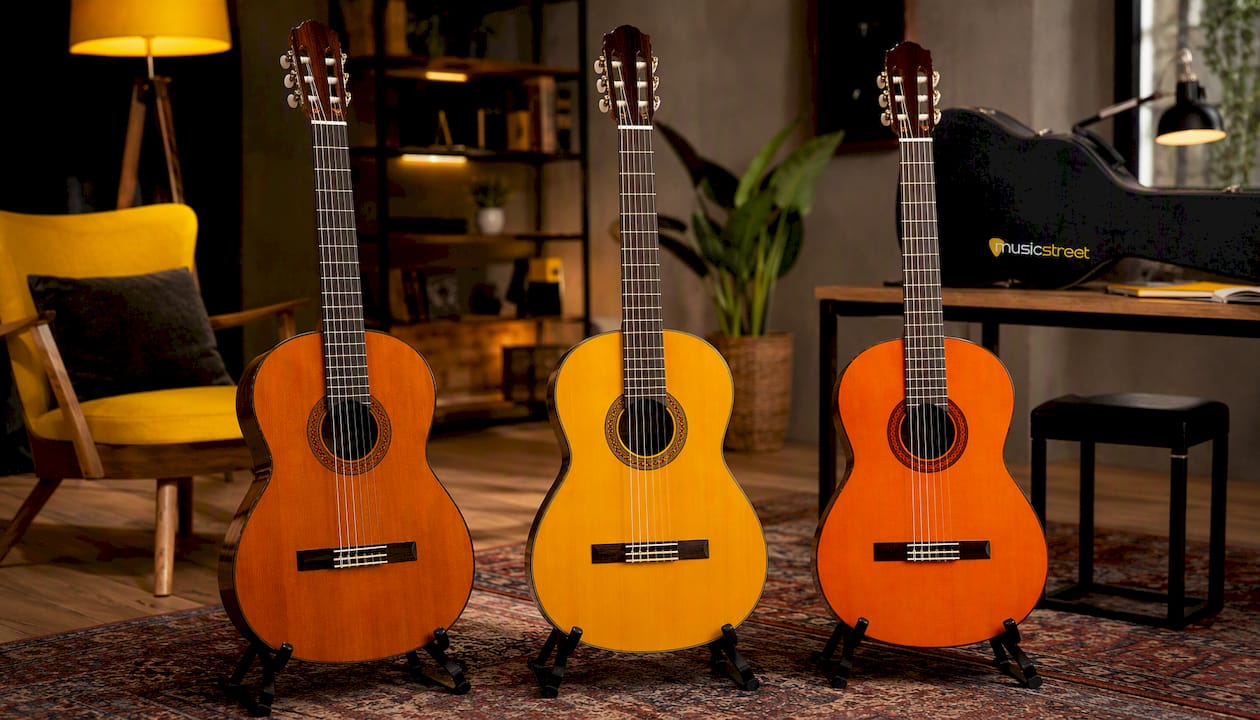
Every instrument sold by Musicstreet comes with a professional inspection. Pre-owned guitars are assessed for structural integrity, fret condition and setup before listing. New instruments can be set up to your specification before dispatch. Free UK delivery applies on qualifying orders, and the team at the Huntingdon store is available for in-person appointments, demo sessions and setup consultations. Browse the full range or book a visit at Musicstreet.
Sources
- Classical guitars: types, tips & guide — Siccas Guitars
- Cedar vs spruce on classical guitars — David Duyos (luthier)
- Classical guitar — Wikipedia
FAQ
What are the main types of classical guitar?
The main classical guitar types are the traditional Spanish classical, the flamenco, the parlour/romantic, the 3/4 or travel guitar, the cutaway/electro-acoustic crossover, and the modern concert variants — lattice-braced and double-top. Each is built for a different playing context and tonal goal.
What is the easiest classical guitar to play?
A short-scale (630–640 mm) classical guitar with a solid cedar top and normal-tension strings is generally the most comfortable starting point. Lower string tension and reduced fret spacing make left-hand technique less physically demanding, particularly for players with smaller hands.
What are the four main types of guitar?
The four broad guitar families are classical (nylon-string), acoustic (steel-string), electric, and bass. Within the classical family, the main variants are the traditional Spanish classical, flamenco, small-bodied parlour/romantic, travel/3/4, and modern concert designs. For a detailed comparison of classical versus acoustic guitars, the Musicstreet blog covers the practical differences.
What is considered the finest classical guitar?
There is no single answer, but instruments by named luthiers — Torres-tradition makers, Greg Smallman lattice guitars, and double-top builders such as Gernot Wagner — are consistently cited at the top of the market. The “holy grail” label is often applied to surviving Torres originals and to top-tier modern luthier instruments, which can command prices well into five figures.
How often should a classical guitar be set up professionally?
Once a year is a reasonable baseline for a regularly played instrument. A professional setup covers neck relief, saddle height, nut slot depth and fret inspection — all of which drift with playing and seasonal humidity changes in the UK.




Share:
The essential guitar equipment list for beginners
Choosing the Best Guitar Amp: Tube vs Solid State Explained