


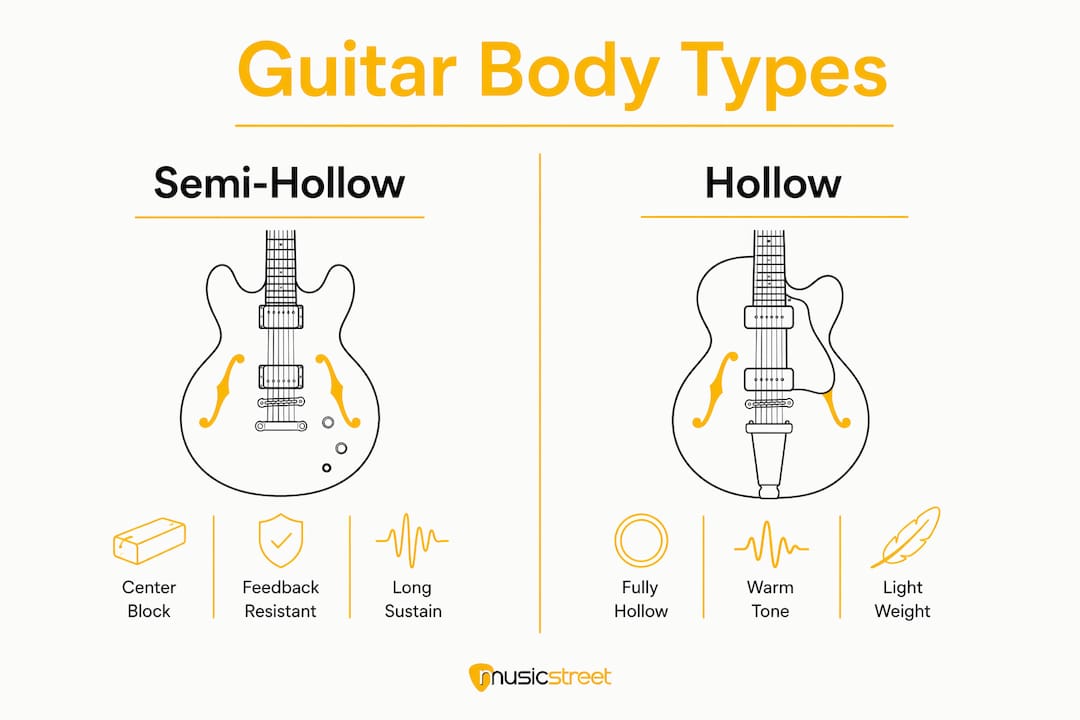
The core difference between semi-hollow and hollow body electric guitars comes down to one thing: whether there is a solid block of wood running through the centre of the body. Semi-hollow guitars have this centre block, which reduces feedback and supports sustain. Hollow body guitars have no such block at all. That single structural choice shapes everything else: tone, genre suitability, feedback behaviour, and how the guitar feels under your arm for a three-hour gig.
Here is a quick summary of where each type excels:
- Semi-hollow (e.g. Yamaha SA2200): solid centre block, sharper and more focused tone, better feedback resistance, suits rock, blues, jazz, and moderate gain
- Hollow body (e.g. Epiphone Broadway): fully hollow, warmer and woodier resonance, shorter sustain, more feedback-prone, best for jazz, blues, and clean playing
- Thinline variants: shallower body depth, can be fully hollow or semi-hollow, balance comfort with resonance
Both types weigh less than solid-body electrics, and both can be played unplugged at a low volume, though neither replaces a proper acoustic.
What makes a hollow body guitar sound the way it does?
Hollow body guitars are fully hollow inside, with no internal wood block for structural support. Their construction typically features arched tops and F-holes rather than the round soundhole you find on an acoustic, and pickups are mounted directly onto the top surface. The result is a guitar that behaves almost like a resonating acoustic chamber when amplified.

Tonally, hollow bodies deliver a warm, rounded sound with a focused midrange that cuts through a band mix more cleanly than a flat-top acoustic. The low end is rich but not tight, and the highs are clear without ever reaching the glassy sheen of a solid body. Sustain is noticeably shorter because the resonant top absorbs string energy quickly, causing notes to decay faster.
The biggest practical limitation is feedback. At higher volumes or with any meaningful gain, hollow bodies pick up sympathetic vibrations from the amplifier and feed them back through the pickups. This is why hollow body guitars are most at home in jazz, blues, and rockabilly, where clean or lightly overdriven tones are the norm.
Key characteristics at a glance:
- Fully hollow construction with no internal centre block
- Arched tops and F-holes (or similar narrow soundholes) are standard
- Warm, woody tone with a focused midrange
- Shorter note decay compared to semi-hollow or solid body guitars
- Prone to feedback at high gain or volume
- Suited to jazz, blues, rockabilly, and clean-tone playing
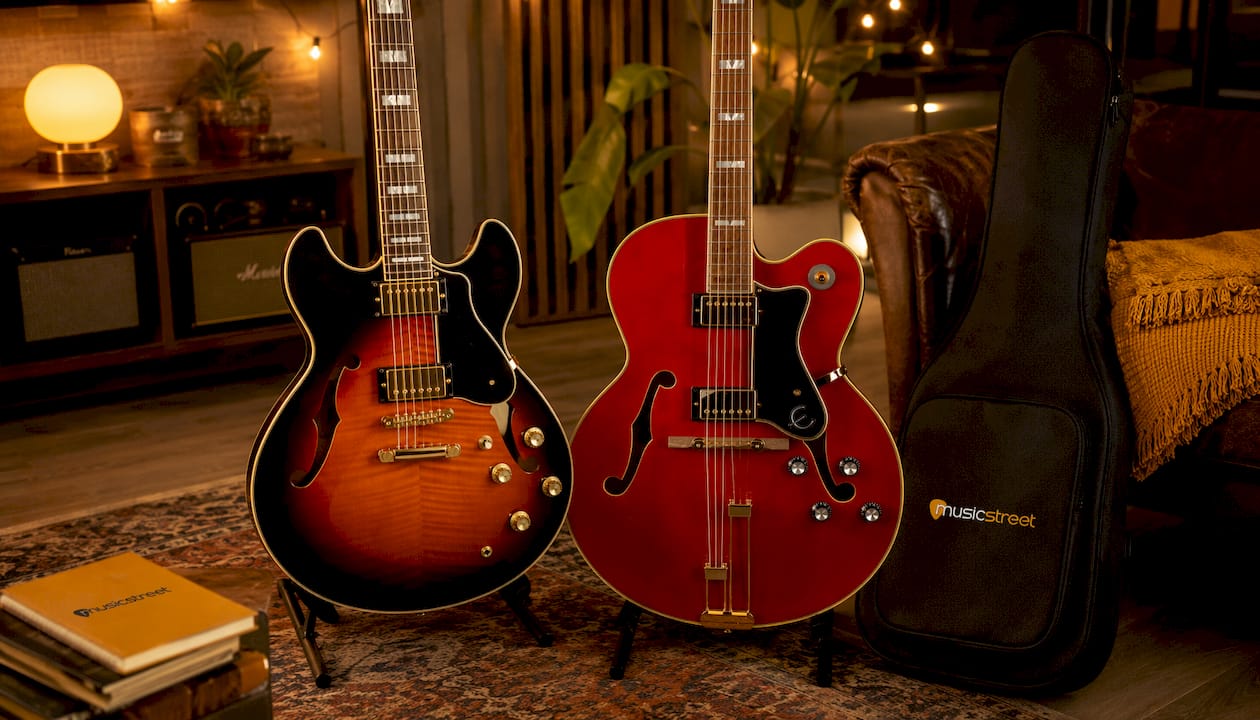
The Epiphone Broadway Electric Guitar is a textbook example. Available in a striking Wine Red finish and supplied with a premium gig bag, the Epiphone Broadway delivers the full-depth hollow body experience: rich acoustic resonance, vintage aesthetics, and the kind of warm, vocal tone that jazz players have relied on for decades. Its full-depth body and twin humbuckers give it authority in the lower midrange without sacrificing clarity on single-note lines.
How semi-hollow guitars work and why they sound different
The semi-hollow design was first commercialised in the late 1950s, built around the idea of combining hollow body warmth with solid body feedback resistance. The solution was straightforward: keep hollow wings on either side of the body, but run a solid block of wood down the centre. That centre block is where the bridge sits, and it changes the physics of the instrument entirely.
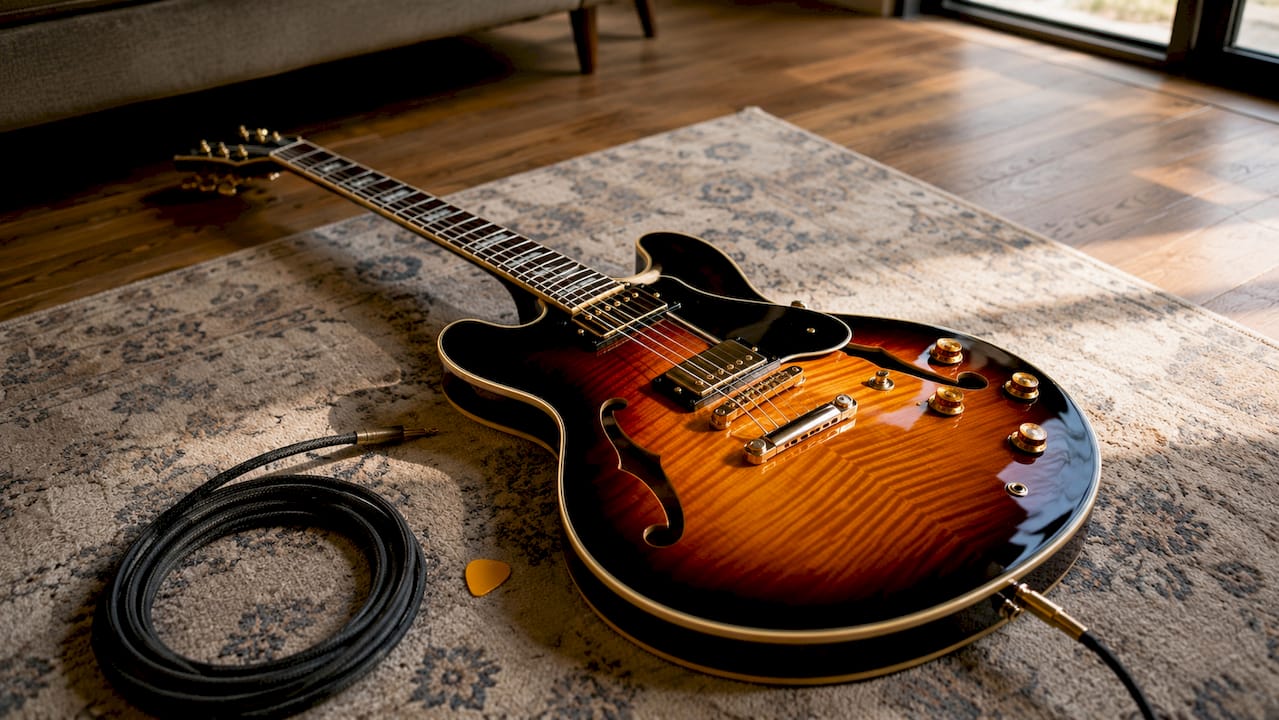
Because the bridge anchors to solid wood rather than a resonant top, the centre block moderates acoustic coupling, creating a sustain that is more controlled and harmonically richer than a hollow body produces. The block also deadens feedback by reducing the sympathetic vibrations that cause hollow bodies to squeal at volume. You can push a semi-hollow into moderate overdrive territory without fighting the instrument.
Tonally, semi-hollows sit between hollow bodies and solid bodies. The tone is sharper and more defined than a hollow body, with a midrange that feels focused rather than open. The hollow wings still contribute warmth and some acoustic character, but the centre block keeps everything tighter. Pickup placement matters here too: the neck pickup typically anchors to the solid block, capturing direct string motion, while the bridge pickup floats above the resonant top, blending in acoustic character.
Key characteristics at a glance:
- Solid centre block with hollow wings on either side
- Sharper, more defined tone than a hollow body
- Better feedback resistance, handles moderate gain well
- Longer sustain than a hollow body due to efficient energy transfer through the block
- Suits blues, jazz, rock, soul, R&B, and moderate gain styles
- Construction materials such as maple centre blocks offer bright tone and efficient sustain; laminates increase stiffness and feedback resistance further
The Yamaha SA2200 Semi Hollow Electric Guitar is one of the finest examples available to UK players. Its soft maple centre block, large acoustic chambers, and Alnico V humbucking pickups with a coil-tap feature give it a warm, woody tone alongside the clarity needed for arpeggiated chords in a dense mix. The Yamaha SA2200 suits R&B, blues, rock, jazz, and jazz-fusion players who want one guitar that genuinely covers multiple styles.
Thinline guitars: where do they fit?
Thinline guitars are a related design that often gets lumped in with hollow and semi-hollow bodies without much explanation. The defining feature is body depth: thinlines are shallower than standard hollow or semi-hollow guitars, typically sitting closer to the dimensions of a solid body electric in terms of thickness.
A thinline can be either fully hollow or semi-hollow inside. Some contain a centre block; others are completely hollow but simply built with a shallower body. The shallower depth reduces acoustic resonance slightly compared to a full-depth hollow body, which in turn reduces feedback sensitivity and makes the guitar easier to handle for players who find larger-bodied instruments awkward.
Key points on thinlines:
- Shallower body depth than standard hollow or semi-hollow designs
- Can be fully hollow or contain a centre block
- Slightly less resonant than full-depth hollow bodies, with reduced feedback risk
- More comfortable for players who find large-bodied guitars unwieldy
- Tone sits between a full hollow body and a semi-hollow, depending on internal construction
- Popular in country, blues, and lighter rock contexts
Which brands and models are available to UK players?
The UK market has strong representation across both body types, from entry-level instruments to professional-grade guitars. Here is an overview of what is worth knowing:
| Brand | Model | Body type | Tone character | Best for |
|---|---|---|---|---|
| Yamaha | SA2200 | Semi-hollow | Warm, woody, articulate | Blues, jazz, rock, R&B |
| Epiphone | Broadway | Hollow body | Rich, resonant, vintage | Jazz, blues, clean playing |
Yamaha has built a strong reputation for semi-hollow guitars in the UK. The SA2200 is the standout model: professional construction, a maple centre block, double F-holes, and coil-splittable Alnico V humbuckers. It is the kind of guitar that works equally well in a recording studio and on a live stage.
Epiphone brings the hollow body tradition to players at an accessible price point. The Broadway is a full-depth archtop with twin humbuckers, a laminate maple body, and a neck profile that suits both chord-heavy jazz comping and single-note blues lines. The Wine Red finish and included gig bag make it a practical choice for gigging musicians.
Musicstreet stocks both guitars and offers expert setup and post-sale support, which matters more than it might seem when you are buying a hollow or semi-hollow instrument. These guitars benefit from a proper professional setup to get the string action and intonation right, particularly on the adjustable bridges that most hollow and semi-hollow models use.
Playing feel and comfort: what UK guitarists should know
Weight is one of the first things players notice when they pick up a hollow or semi-hollow guitar. Both types are lighter than solid-body electrics, which makes a real difference over a long gig or rehearsal. Hollow bodies tend to be slightly lighter still, though their larger body depth can make them feel bulkier under the arm.
Body depth also affects how the guitar sits when you are seated. Full-depth hollow bodies, like the Epiphone Broadway, have a deeper body that can feel substantial, particularly for players used to slim solid-body instruments. Semi-hollows like the Yamaha SA2200 are typically shallower and closer in feel to a solid body, which many players find more comfortable for extended playing.
Neck profiles and string action vary between models rather than body types, but hollow and semi-hollow guitars often have adjustable bridges that allow more precise action setting than fixed bridges. Higher string action is more common on traditional hollow body archtops, which can feel stiff to players accustomed to low-action solid bodies. Getting a professional setup from a specialist like Musicstreet resolves this quickly.
Maintenance considerations are worth factoring in too:
- Hollow and semi-hollow bodies are more susceptible to humidity changes than solid bodies, as the larger air chambers can cause the top to shift over time
- Adjustable bridges require occasional intonation checks, especially after string changes
- F-holes make internal wiring more accessible for repairs but also allow dust and debris to accumulate inside the body
- Lacquer finishes on arched tops can be more delicate than the thick polyester coatings on many solid bodies
Pro Tip: If you are buying a hollow or semi-hollow guitar online, ask Musicstreet about their professional setup service before delivery. A correctly set-up instrument plays and sounds noticeably better straight out of the box, and it protects the guitar during transit adjustments.
How to choose between a semi-hollow and a hollow body guitar
The decision comes down to four practical questions. Work through them honestly and the right body type becomes clear.
1. What genres do you play? Jazz and blues players who stay clean or use light overdrive will thrive with a hollow body. The warmth and resonance suit those styles naturally. Rock, soul, R&B, and blues-rock players who use moderate gain will find a semi-hollow more practical, as the centre block keeps feedback under control without sacrificing warmth.
2. How much gain do you use? Hollow bodies and high gain are a difficult combination. If your pedalboard includes heavy overdrive, distortion, or fuzz, a semi-hollow is the better choice. If you play clean or with a light touch of breakup, a hollow body is perfectly manageable.
3. How important is comfort and weight? Both body types are lighter than solid bodies, but if you gig regularly and want something that feels close to a solid body in terms of depth and handling, a semi-hollow is the more practical option. Full-depth hollow bodies suit players who prioritise tone over ergonomics.
4. What is your budget? Entry-level hollow and semi-hollow guitars are available from around £300 upwards in the UK. The Epiphone Broadway sits at an accessible price point for a full hollow body, while the Yamaha SA2200 represents a professional-level investment for a semi-hollow. Both are available through Musicstreet with free UK delivery on qualifying orders.
A few additional tips:
- Audition both types if possible, either in Musicstreet’s Huntingdon store or by requesting detailed advice before buying online
- Consider a semi-hollow guitar if you are unsure, as its versatility covers more ground than a hollow body
- Factor in the cost of a professional setup, particularly for hollow body archtops with adjustable bridges
- Check whether the guitar includes a case or gig bag, as hollow and semi-hollow bodies need protection from humidity and knocks
Musicstreet’s team in Huntingdon can advise on both body types, arrange in-store trials, and set up your chosen guitar before it reaches you. Browse the full range of electric guitars at Musicstreet for current stock and pricing.
Key takeaways
Semi-hollow guitars suit the widest range of players because the centre block gives them feedback resistance and sustain that hollow bodies cannot match, while retaining genuine acoustic warmth.
| Point | Details |
|---|---|
| Centre block is the key difference | Semi-hollows have a solid centre block; hollow bodies have none, making them more feedback-prone. |
| Hollow bodies suit clean playing | Warm, woody tone with shorter sustain makes hollow bodies ideal for jazz, blues, and clean styles. |
| Semi-hollows handle gain better | The centre block reduces feedback, allowing moderate overdrive without the squeal hollow bodies produce. |
| Weight favours both types | Both hollow and semi-hollow guitars are lighter than solid bodies, benefiting gigging musicians. |
| Material affects tone and sustain | Maple centre blocks deliver bright tone and efficient sustain; laminates increase stiffness and feedback resistance. |
FAQ
Is a semi-hollow better than a hollow body guitar?
Neither is objectively better. Semi-hollow guitars handle more gain and offer longer sustain, making them more versatile. Hollow bodies deliver warmer, woodier resonance that suits jazz and clean blues playing specifically.
What is the point of a semi-hollow guitar?
The centre block in a semi-hollow guitar reduces feedback and supports sustain, giving players the warmth of a hollow body with enough feedback resistance to use moderate gain and higher stage volumes.
Are semi-hollow guitars harder to play than hollow bodies?
Not typically. Semi-hollows are often shallower in body depth and closer in feel to a solid body, which many players find easier to handle. Full-depth hollow body archtops can have higher string action, which may require adjustment.
What are the disadvantages of a hollow body guitar?
Hollow body guitars are prone to feedback at higher volumes and gain levels, which limits their use in rock and heavier genres. They also have shorter sustain than semi-hollow or solid body guitars, as the resonant top absorbs string energy quickly.







Share:
Bass vs electric guitar: key differences explained
Church sound system for online streaming: the complete guide