


For most UK players gigging regularly, an undersaddle piezo or magnetic soundhole pickup is the practical starting point. Studio players and fingerstyle musicians will get more natural results from a soundboard transducer or a blended system. If you want one pickup that handles both worlds, a hybrid dual-source system is worth the extra investment. The fastest next step is to try a few options in person before committing to a fitting.
Table of Contents
-
What types of acoustic pickups are there, and how do they work?
-
How do you choose the right pickup for your guitar and playing style?
-
Can you add a pickup to an acoustic? Installation, UK costs and timelines
-
Getting the best sound after installation: setup and troubleshooting
What types of acoustic pickups are there, and how do they work?
Acoustic guitar pickups convert string or body vibrations into an electrical signal using four principal methods. Each has a distinct character, and knowing the difference saves you from buying the wrong thing.
Undersaddle piezo pickups sit beneath the bridge saddle as a thin strip of piezoelectric material. String pressure compresses the crystal and generates a signal. They are the most common type on factory-fitted acoustic-electrics because they resist feedback well and are reliable night after night. The trade-off is a characteristic midrange peak that can sound thin or “quacky” without a good preamp to correct it.
Soundboard transducers (contact pickups) are glued or taped to the underside of the guitar top. Because they read the whole soundboard’s vibration rather than just string pressure, they produce a fuller, warmer tone than a piezo. The downside is feedback sensitivity at high stage volumes, which makes them better suited to quieter venues and studio work.
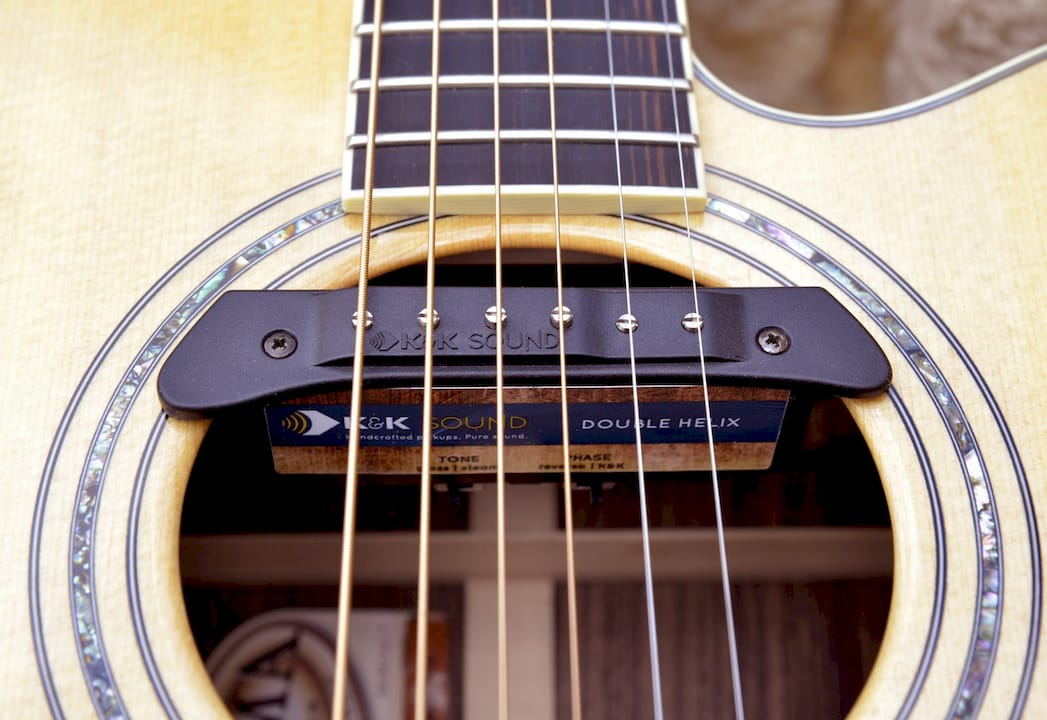
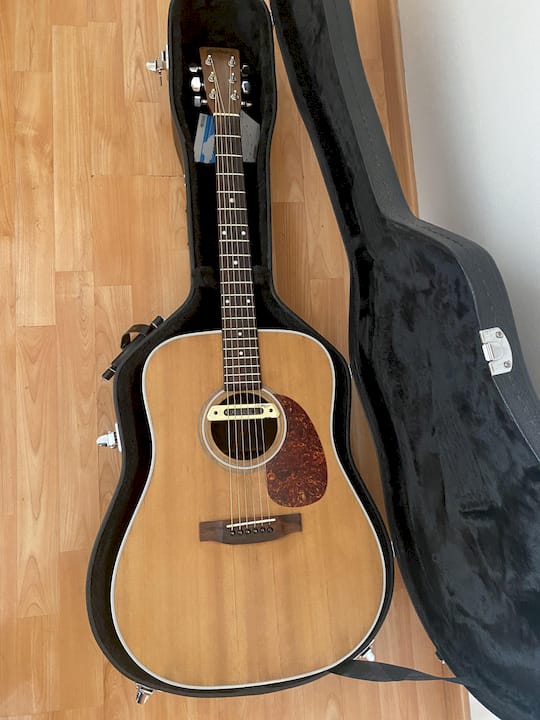
Magnetic soundhole pickups clip into the soundhole and sense steel-string vibration via a magnetic field, exactly as an electric guitar pickup does. They are the only genuinely no-drill option, which makes them popular for players who want reversibility. Tone leans slightly electric, which suits blues and folk players but may feel too far from the acoustic character for some.
Internal microphones capture the guitar’s natural resonance from inside the body. Standalone internal mics are rarely practical on stage because feedback control is difficult. They appear most usefully in blended hybrid systems that pair a mic with an undersaddle piezo, letting you dial in natural “air” while the piezo handles attack and feedback resistance.
| Type | Best for | Feedback risk | Reversible? |
|---|---|---|---|
| Undersaddle piezo | Live stage, loud band | Low | No |
| Soundboard transducer | Studio, quiet venues | High | Partial |
| Magnetic soundhole | Busking, folk, quick fit | Medium | Yes |
| Internal mic / hybrid | Touring, studio versatility | Low (blended) | No |
The core trade-offs in brief:
-
Piezo: reliable and feedback-resistant, but can sound thin without EQ correction
-
Soundboard transducer: warm and natural, but needs careful volume management
-
Magnetic: easy to fit and remove, but misses body resonance and only works with steel strings
-
Hybrid: best overall tone, highest cost and most complex installation
How do you choose the right pickup for your guitar and playing style?
Start with your environment, not your budget. Experts consistently recommend choosing the pickup type that matches where you play most, then narrowing by guitar construction and budget.
Work through these criteria in order:
-
Playing environment. Loud stage with a band? Prioritise feedback resistance: piezo or magnetic. Quiet venue or studio? A transducer or mic-based system will reward you with a more natural sound.
-
Guitar construction. Thin-topped guitars with scalloped bracing respond well to transducers. Heavily braced or laminate-top guitars often suit a piezo better. Check that your saddle slot is deep enough for an undersaddle strip before buying one.
-
String type. Magnetic pickups only work with steel strings. Nylon-string classical players should look at soundboard transducers or internal mics.
-
Reversibility. If you are reluctant to drill or modify your guitar, a magnetic soundhole pickup is the only genuinely reversible option. Undersaddle and transducer installations involve at minimum an endpin jack hole.
-
Preamp needs. Passive pickups benefit significantly from a high-impedance preamp. Without one, a contact transducer in particular can sound thin and scratchy. Budget for a DI box or preamp if you go passive.
-
Budget. A well-fitted entry-level magnetic pickup can outperform a premium piezo that has been installed carelessly. Fit quality matters as much as the component itself.
For versatile players who move between studio sessions and live gigs, a blended system is the answer. You can also explore acoustic-electric options if you are considering a new instrument rather than retrofitting.
Pro Tip: When auditioning a pickup, play at the volume you actually use on stage, not at bedroom level. Feedback issues and tonal thinness only reveal themselves under real conditions. Ask the shop to run the guitar through a PA-style signal chain, not just a small combo.
Can you add a pickup to an acoustic? Installation, UK costs and timelines
Yes, pickups can be retrofitted to almost any acoustic guitar. The method determines how much work is involved and whether the modification is reversible.
Installation types, from simplest to most involved:
-
Magnetic soundhole pickup: clips in and out in minutes, no drilling required
-
Adhesive contact transducer: stuck inside the body, requires drilling an endpin jack hole
-
Undersaddle piezo with endpin jack: requires saddle slot preparation, a 2–3mm cable hole drilled at an angle, and saddle height reduction of roughly 1–2.3mm to compensate for the pickup strip’s thickness
-
Side-mounted preamp with undersaddle: adds a battery compartment and controls to the guitar’s side
-
Blended dual-source system: combines two of the above, requiring careful routing and onboard preamp fitting
A professional fitter will inspect the saddle slot for flatness and debris, level the saddle base, drill and route cables, mount the endpin jack or preamp, and balance the output before testing through a PA. That last step, balancing, is where many DIY installs fall short.
| Installation type | Approximate UK cost | Typical timeline |
|---|---|---|
| Magnetic soundhole (DIY) | — | Same day |
| Contact transducer | — | 1–3 days |
| Undersaddle piezo | — | 1–5 days |
| Blended dual-source | — | Up to 2 weeks |
Installation checklist to bring to your booking:
-
Confirm your guitar’s saddle slot dimensions (width and depth)
-
Note whether your guitar has an existing endpin jack or strap button
-
Bring your preferred signal chain (DI box, preamp) so the fitter can balance to it
-
Ask whether the saddle will need replacing after fitting
-
Confirm warranty coverage on both the pickup and the fitting work
Reversibility matters if you own a vintage or high-value instrument. Magnetic pickups leave no trace. Undersaddle installations are not reversible without some remedial work on the saddle slot, so discuss this with your fitter beforehand.
Getting the best sound after installation: setup and troubleshooting
Most post-install problems come down to three things: output imbalance, phase issues, or a mismatch between the pickup and the signal chain.
Dead strings or uneven response after an undersaddle fit usually means the saddle slot base is not perfectly flat, or the pickup strip is not making full contact. A fitter can correct this by re-levelling the slot. Do not attempt to shim the saddle yourself without checking the strip seating first.
Thin or brittle piezo tone is almost always a preamp impedance problem. Piezo pickups have a very high output impedance and need a matching high-impedance input, typically 1 megaohm or above, to sound full. Plugging straight into a standard instrument input on a mixing desk will produce exactly the thin, harsh sound players complain about. Use a dedicated acoustic DI box or an onboard preamp.
Feedback loops in mic-heavy or transducer setups respond to three fixes: reduce stage monitor volume, apply a narrow notch filter at the frequency that rings (usually somewhere between 200Hz and 500Hz), and check that the guitar body is not resting against the speaker cabinet.
Blending a dual-source system requires a phase check. If the two sources are out of phase, the combined signal will sound thin and hollow. Most onboard preamps include a phase-flip switch. Engage it and listen for the blend that sounds fuller and more present.
Pro Tip: Technicians consistently report that correct saddle levelling and output balancing after an undersaddle fit affects the amplified tone more than the price of the electronics. A £60 pickup fitted with precision will outperform a £200 pickup dropped in without proper saddle preparation.
For a deeper look at how piezo systems interact with preamps and effects, the piezo pickup guide on the Musicstreet blog covers the signal chain in detail.
Key takeaways
Choosing the right pickup comes down to environment first, then guitar construction and budget. Installation quality consistently matters more than component price.
| Point | Details |
|---|---|
| Match type to environment | Use piezo or magnetic for loud stages; transducer or mic for studio and quiet venues. |
| Reversibility trade-off | Only magnetic soundhole pickups leave the guitar unmodified; all others require at least an endpin jack hole. |
| Budget for fitting | UK professional fitting costs vary depending on the installation type and complexity. |
| Preamp is not optional | Passive pickups need a high-impedance preamp or DI box to avoid thin, scratchy output. |
| Musicstreet for advice and stock | Musicstreet stocks pickups and offers professional fitting and aftercare from its Huntingdon store. |
Why fitting matters more than most players expect
The conversation around acoustic pickups tends to focus on brand names and price points. In practice, the single biggest variable in how an amplified acoustic sounds is how well the pickup was installed and balanced. A saddle that is not perfectly flat, a cable routed under tension, or an output that was never balanced to the player’s signal chain: any one of these will undermine even a well-specified pickup.
The other thing players underestimate is the preamp relationship. A pickup is only half the system. Matching it to the right input impedance and EQ curve is where the tone actually gets shaped. Spending £150 on a pickup and then running it into the wrong input is a surprisingly common mistake, and it is entirely avoidable with a brief conversation before purchase.
Musicstreet: pickups, professional fitting and aftercare
Musicstreet stocks a range of acoustic pickups and offers professional fitting from its store in Huntingdon, Cambridgeshire, with expert advice available before and after purchase.
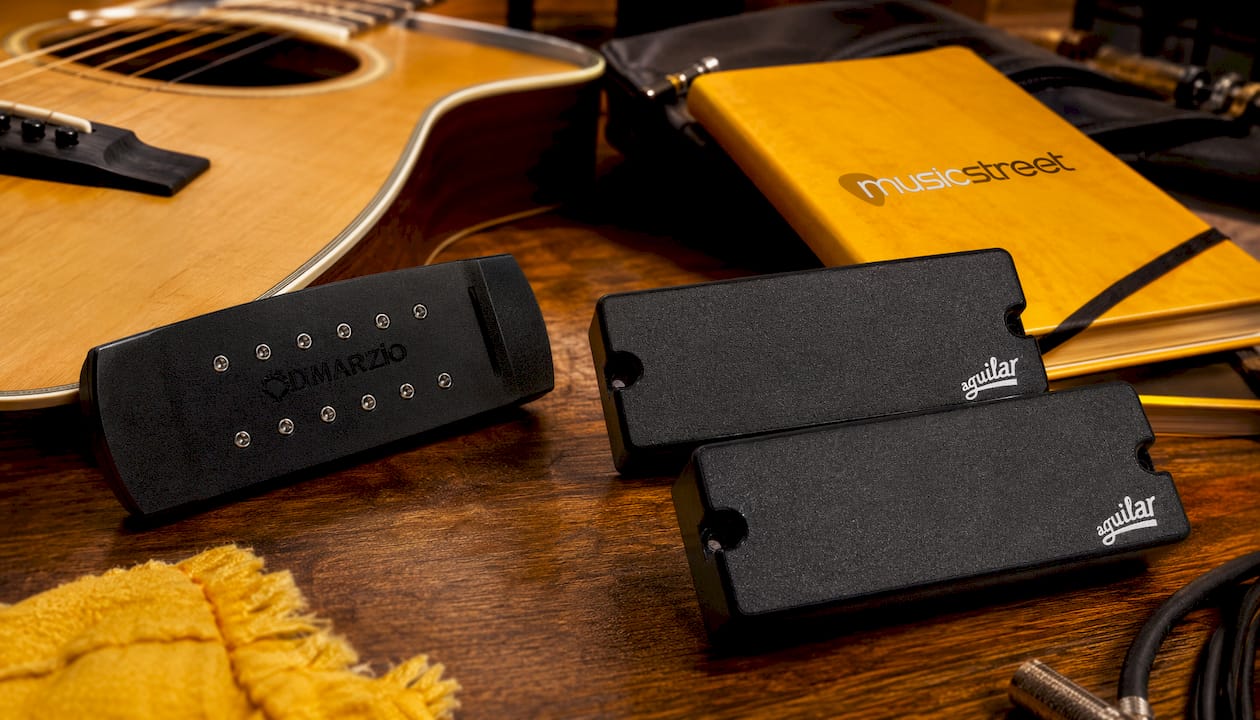
Current stock includes the DiMarzio Virtual Acoustic Pickup with onboard volume control, a plug-and-play magnetic option that requires no modification to your guitar. For players needing a ceramic-based set, the Aguilar DCB EMG-35 and Aguilar DCB EMG-45 dual ceramic sets are available, offering a different tonal character suited to players who want a fuller, more present response. All three can be viewed and tried in store.
Services include in-store demos, professional inspection and installation, saddle levelling, output balancing, and warranty-backed aftercare. Free UK delivery is available on qualifying orders. To book a fitting, request a quote, or ask a question about compatibility, contact Musicstreet directly through musicstreet.co.uk.
FAQ
What is the best type of pickup for an acoustic guitar?
For most gigging players, an undersaddle piezo or magnetic soundhole pickup offers the best balance of feedback resistance and reliability. Fingerstyle and studio players will get a more natural sound from a soundboard transducer or a blended dual-source system.
What do acoustic pickups do?
They convert the vibration of the strings or guitar body into an electrical signal that can be amplified through a PA or amplifier. Different pickup types capture vibration at different points, which is why they each have a distinct tonal character.
Can you add a pickup to an acoustic guitar?
Yes. Magnetic soundhole pickups clip in without any modification. Undersaddle and transducer systems require drilling an endpin jack hole and, in the case of undersaddle pickups, some saddle slot preparation by a professional fitter.
What acoustic pickup did Eric Clapton use?
Clapton used a Fishman Prefix system, a preamp-equipped undersaddle piezo system, for much of his unplugged work. His specific setup details are not publicly listed in full.


Share:
Bass and electric guitar difference: which should you learn?
What does reverb mean in music: a guitarist's guide