


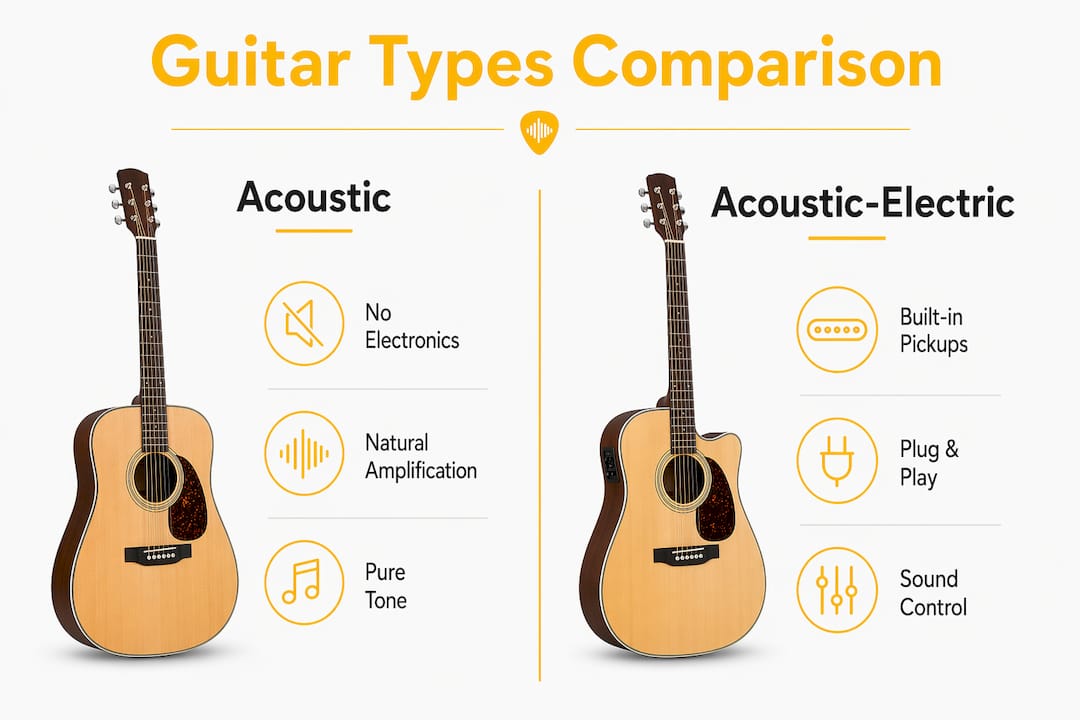
Acoustic-electric guitars include built-in pickups and preamp systems, allowing easy amplification. Acoustic guitars rely solely on their hollow body resonance, producing natural sound without electronics. Choosing depends on playing environment, with acoustics ideal for home and acoustics-electrics better for live performances.
An acoustic guitar produces sound purely through the vibration of its strings and the resonance of its hollow wooden body. An acoustic-electric guitar is defined as an acoustic instrument fitted with a built-in pickup system and preamp, allowing it to be amplified through a speaker or PA system. The difference between acoustic and acoustic electric guitar types comes down to one thing: electronics. Both instruments share the same fundamental construction, but the acoustic-electric adds components that open up live performance and recording possibilities. Brands like Martin and instruments fitted with Fishman pickup systems represent the two ends of this spectrum clearly.
What are the design and construction differences?
Acoustic and acoustic-electric guitars share the same core architecture: a hollow wooden body, a soundboard, a sound hole, and a neck. The key construction difference is that acoustic-electric guitars integrate pickup systems, preamp circuits, and battery compartments into the body. These additions require routing channels inside the guitar and a control panel on the upper bout, typically housing volume, tone, and tuner controls.

Tonewoods remain equally important in both types. Spruce tops, mahogany backs, and rosewood fingerboards appear across both categories, and the quality of these materials directly shapes the unplugged tone. A well-built acoustic guitar from a maker like Taylor or Yamaha will sound better unplugged than a poorly built acoustic-electric, regardless of how good the electronics are.
Acoustic-electric guitars often feature cutaway bodies, which trim away part of the lower bout to allow easier access to the upper frets. Pure acoustic guitars more commonly use a full dreadnought or orchestra body shape, which maximises internal air volume and natural projection. The cutaway trades a small amount of resonance for playability at higher fret positions.
-
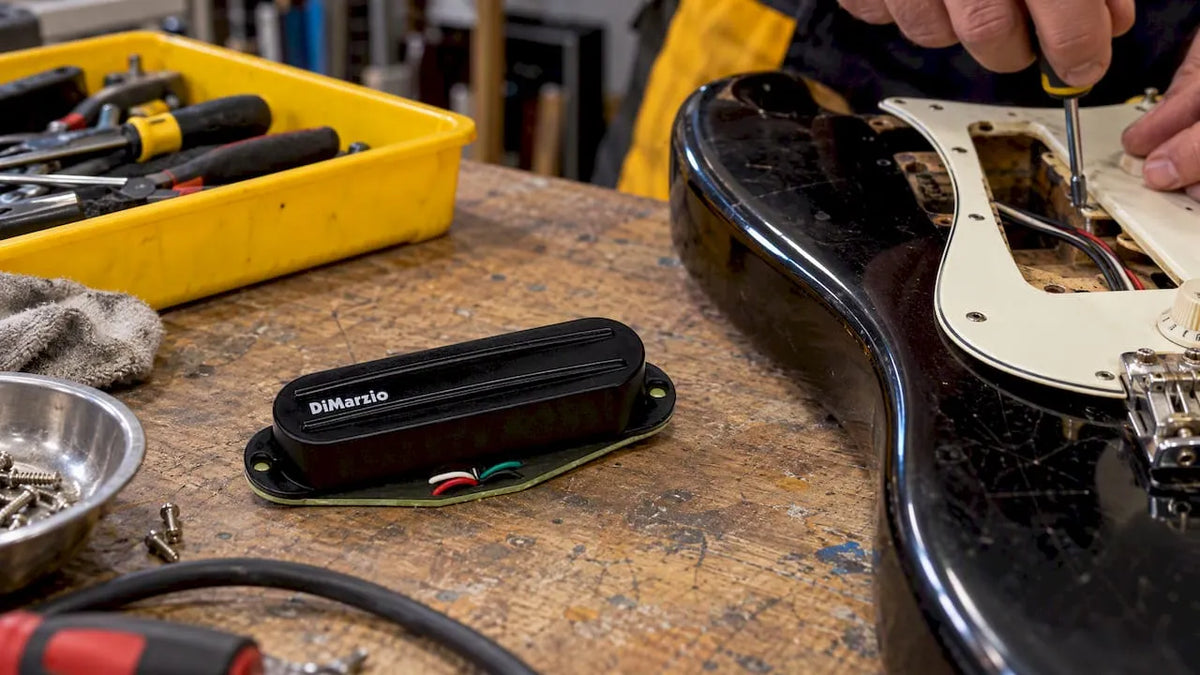
Pickup types: Piezo pickups sit under the saddle and sense string vibration directly. Internal microphones capture the body’s natural resonance. Magnetic soundhole pickups work similarly to electric guitar pickups.
-
Preamp controls: Most acoustic-electrics include a built-in preamp with volume, bass, mid, and treble controls, plus a chromatic tuner.
-
Battery compartment: Acoustic-electrics require a 9V battery to power the preamp, adding a small maintenance consideration.
-
Body depth: Some acoustic-electrics use a thinner body profile to reduce feedback when amplified at high volumes.
Pro Tip: When comparing two guitars at the same price point, always check the tonewood quality first. Electronics can be retrofitted later, but the wood cannot be changed.
How do acoustic and acoustic-electric guitars compare for sound?
An acoustic guitar projects sound through its sound hole and vibrating top. The body acts as a natural amplifier, converting string energy into air movement. This produces a warm, organic tone that varies with body size: a dreadnought delivers more bass and volume, while a parlour body sounds brighter and more intimate.
An acoustic-electric guitar produces the same unplugged sound as a comparable acoustic. Plugged in, the pickup and preamp convert string vibrations into an electrical signal, which is then shaped by the onboard controls before reaching an amplifier. The tone you hear through a speaker is a processed version of the acoustic signal, not the raw resonance of the wood.
| Feature | Acoustic guitar | Acoustic-electric guitar |
|---|---|---|
| Unplugged volume | Full natural projection | Identical to acoustic |
| Amplified output | Not possible without a mic | Direct output via pickup |
| Tone shaping | Fixed by body and tonewoods | Adjustable via onboard EQ |
| Feedback risk | High with microphone use | Lower with built-in pickup |
| Recording method | Microphone required | Direct input or microphone |
Feedback is a real issue for acoustic players performing live. Pointing a microphone at an acoustic guitar on a loud stage creates a feedback loop almost immediately. Acoustic-electric pickups reduce feedback significantly because the signal is captured internally rather than by an open microphone in front of a speaker. This makes acoustic-electrics far more practical for gigging musicians.
Pro Tip: If you play live regularly, always test your acoustic-electric through a PA system before buying. Some pickup systems colour the tone more than others, and the difference is only audible when plugged in.
What are the practical advantages and drawbacks of each type?
Choosing between the two types depends heavily on where and how you play. Each has clear strengths in specific situations.
-
Home practice and casual playing. A pure acoustic guitar is ideal here. No cables, no batteries, no amp required. You pick it up and play. The natural resonance of a well-built acoustic is more satisfying for solo practice than the processed sound of a plugged-in acoustic-electric.
-
Live performance. An acoustic-electric is the stronger choice. Direct connection to a PA system avoids the microphone positioning challenges that plague acoustic players on stage. Volume and tone can be adjusted from the guitar itself without involving a sound engineer.
-
Studio recording. An acoustic-electric simplifies the process. Plugging directly into an audio interface like a Focusrite Scarlett eliminates ambient room noise and microphone bleed. That said, many recording engineers still prefer a well-placed condenser microphone on a quality acoustic for the most natural sound.
-
Portability. Both types are equally portable. Neither requires an amplifier for basic use, though an acoustic-electric needs a battery for its preamp to function when plugged in.
-
Playability for beginners. Acoustic-electrics often have lower action and thinner necks than traditional acoustics. This makes fretting chords less physically demanding for players who are still building finger strength. Standard acoustic guitars typically have higher string action and heavier string gauges, which build technique but can discourage early learners.
-
Cost. Acoustic-electric guitars generally cost more than comparable pure acoustics at the same build quality. The electronics add manufacturing cost. Budget acoustic-electrics sometimes cut corners on tonewoods to offset the cost of the electronics, which is a poor trade-off.
The benefits of acoustic-electric guitars are most apparent for players who perform live or record regularly. For players who stay at home, a quality acoustic without electronics often delivers better value per pound spent.
How do you decide which guitar type suits you?
The right choice depends on your playing environment, budget, and long-term goals. Work through these questions before buying.
-
Where will you play most often? If the answer is at home or around a campfire, a pure acoustic is sufficient. If you plan to gig within the next year, an acoustic-electric is worth the investment.
-
What is your budget? At entry level, a quality acoustic from brands like Yamaha or Fender will outperform a budget acoustic-electric in pure tone. Spend the money on wood quality first.
-
Do you need electronics immediately? Electronics can be added later to many acoustic guitars via aftermarket pickups from brands like Fishman or LR Baggs. Buying a great acoustic now and upgrading later is a legitimate strategy.
-
What genres do you play? Singer-songwriters and folk players often prefer the warmth of a pure acoustic. Country, blues, and contemporary players who move between venues benefit from the flexibility of an acoustic-electric.
-
Have you played both? Always try both types before committing. The feel of the neck, the string tension, and the body size all affect comfort. Musicstreet’s physical store in Huntingdon, Cambridgeshire allows players to try instruments in person before buying.
When learning how to choose guitar type, the most common mistake is prioritising features over fundamentals. A guitar that sounds and feels right unplugged will always be more enjoyable to play than one loaded with electronics but built from inferior materials.
Pro Tip: Ask to hear the guitar unplugged first, then plugged in. If the unplugged tone disappoints you, no pickup system will fix it.
Key takeaways
The core difference between acoustic and acoustic-electric guitars is the presence of built-in electronics: an acoustic-electric can be amplified directly, while a pure acoustic relies entirely on its body’s natural resonance.
| Point | Details |
|---|---|
| Electronics define the difference | Acoustic-electrics have pickups and preamps; acoustics rely on body resonance alone. |
| Unplugged sound is identical | Both types produce the same natural tone when not connected to an amplifier. |
| Tonewoods matter most | Prioritise wood quality over built-in electronics, as pickups can be added later. |
| Acoustic-electrics suit live performance | Built-in pickups reduce feedback and simplify stage sound management significantly. |
| Beginners may find acoustic-electrics easier | Lower action and thinner necks make fretting less demanding for new players. |
My honest view on which one to buy first
Most buyers walk into a guitar shop convinced they need an acoustic-electric because it seems more versatile. I understand the logic, but I think it leads many players to overpay for electronics they will not use for the first two years of playing.
The quality of the instrument matters far more than whether it has a pickup fitted. A solid-top acoustic from a reputable maker will inspire you to practise more than a laminate-top acoustic-electric with a flashy preamp panel. The tone is richer, the resonance is more satisfying, and the playing experience is simply better.
Electronics can be retrofitted to most acoustic guitars at a later stage. A Fishman Sonitone or an LR Baggs Anthem can transform a quality acoustic into a performance-ready instrument for a fraction of the cost of buying a new acoustic-electric. That approach gives you the best of both worlds without compromising on build quality at the point of purchase.
My advice: buy the best acoustic your budget allows, learn to love its natural voice, and add electronics when you actually need them for a gig or recording session. If you are already gigging or know you will be within six months, then an acoustic-electric makes complete sense from day one. The key is being honest about your actual playing situation, not the one you imagine you might have.
— Music
Guitars for every player at Musicstreet
Musicstreet stocks a carefully selected range of acoustic and acoustic-electric guitars, from entry-level instruments to professional-grade models from brands including Taylor, Yamaha, and Fender.

Whether you are buying your first guitar or upgrading to a performance-ready acoustic-electric, Musicstreet’s team offers expert guidance to match you with the right instrument. Browse the full acoustic guitar range online, or visit the store in Huntingdon, Cambridgeshire to try guitars in person. Free UK delivery is available on qualifying orders, and every instrument comes with professional setup and post-sale support.
FAQ
What is the main difference between acoustic and acoustic-electric guitars?
An acoustic guitar produces sound through its hollow body and sound hole alone. An acoustic-electric guitar adds a built-in pickup and preamp, allowing it to be connected to an amplifier or PA system.
Can an acoustic guitar be converted to acoustic-electric?
Yes. Aftermarket pickup systems from brands like Fishman and LR Baggs can be fitted to most acoustic guitars, making a full factory acoustic-electric purchase unnecessary if you prioritise tone over convenience.
Do acoustic-electric guitars sound different unplugged?
No. An acoustic-electric guitar produces the same natural tone as a comparable acoustic when unplugged. The electronics only affect the sound when the guitar is connected to an amplifier.
Are acoustic-electric guitars better for beginners?
Acoustic-electrics often have lower action and thinner necks, which makes them physically easier to play. However, a quality pure acoustic at the same price point may offer better tone and long-term value.
Which guitar type is better for live performance?
An acoustic-electric guitar is better suited to live performance. Its built-in pickup system allows direct connection to a PA, reduces feedback, and gives the player control over volume and tone from the instrument itself.






Share:
How are guitar strings made: materials, winding and craft
How to choose a guitar size: beginner's guide