


Coil splitting disconnects one coil of a humbucker to create a brighter, single-coil-like sound.
Engaging coil split reduces output and hum cancellation, producing a thinner, more treble-focused tone.
The technique offers versatile tonal options but may introduce more electrical noise in some environments.
If you own a humbucker-equipped guitar and feel stuck between one thick, warm sound, you are not alone. Many guitarists assume their instrument is locked into a single tonal character, when in fact a simple feature called coil splitting can open up a completely different world of sound. This article breaks down exactly what coil splitting is, how it works mechanically, and where it fits into real playing situations. Whether you are a beginner curious about guitar wiring or an experienced player looking to squeeze more versatility from your instrument, this guide covers everything without the jargon overload.
Table of Contents
Key Takeaways
| Point | Details |
|---|---|
| Coil splitting defined | Splitting lets you isolate one coil of a humbucker, creating single-coil-like tones instantly. |
| Tone changes explained | It brightens your sound and alters volume, but doesn’t fully mimic real single coils. |
| Easy upgrades | Many modern guitars offer or can be modified for coil splitting with simple wiring changes. |
| Application tips | Strategic use helps cover more genres, from funk to pop, with a single guitar. |
What is coil splitting?
A humbucker pickup is made of two coils wound in opposite directions and wired together. This design cancels electrical hum, which is why humbuckers sound so quiet and full compared to single-coil pickups. Coil splitting is the process of disconnecting one of those two coils, leaving only a single coil active. The result is a brighter, thinner tone that mimics the character of a traditional single-coil pickup.
Understanding guitar pickup basics helps here. Think of a humbucker like a two-lane road. Coil splitting closes one lane, forcing all the signal through a single path. The road still works, but the traffic moves differently.
To activate coil splitting, you need a way to ground one coil. Mechanically, it uses a push-pull potentiometer or toggle switch to connect the junction between the two coils to ground, shorting one coil and leaving the other active. Most modern humbuckers use four-conductor wiring, which makes this straightforward. Older two-conductor humbuckers cannot be split without rewiring.
The feature has genuine historical roots. Originated in 1970s Gibson experiments for the Les Paul, the goal was to capture the bright, glassy character often described as “Fender sparkle.” Early versions suffered from volume loss and impedance issues, which limited how widely the feature was adopted. Over the following decades, better wiring techniques and improved potentiometers made coil splitting far more practical and reliable.
Today, coil splitting is a standard feature on many production guitars. It is typically activated by:
-
Pulling up on a push-pull volume or tone knob
-
Flicking a dedicated mini-toggle switch
-
Using a push-push button built into the control cavity
Coil splitting gives you two distinct tonal personalities from one guitar, without changing your instrument or your rig.
How coil splitting works: The technical details
When you engage the coil split, the circuit grounds one coil completely. The remaining active coil behaves like a standard single-coil pickup. Here is what actually changes in the signal:
-
Output drops significantly. The output drops roughly 40 to 50%, inductance halves from around 7.5 to 8kΩ DC resistance, and the resonant frequency rises by 1 to 2kHz, shifting the character toward brighter treble and mid punch.
-
The resonant frequency rises. This is what makes the tone feel airier and more open.
-
Hum cancellation is lost. With only one coil active, the noise-rejection benefit of the humbucker disappears.
| Feature | Humbucker mode | Split-coil mode |
|---|---|---|
| Output level | High | Reduced by 40 to 50% |
| DC resistance | 7.5 to 8kΩ | Roughly 4kΩ |
| Resonant frequency | Lower (warmer) | Higher (brighter) |
| Hum cancellation | Yes | No |
| Tone character | Thick, warm, full | Bright, punchy, open |
Understanding humbucker pickup design clarifies why these changes happen. The two coils in a humbucker add inductance together, which pushes the resonant peak lower and fattens the sound. Remove one coil and that peak shifts upward, letting more treble frequencies through.

For players exploring different electric guitar types, this tonal shift can feel dramatic the first time you hear it. One moment you have a thick Les Paul-style roar, the next you have something approaching Telecaster twang.
Pro Tip: Use coil splitting alongside your amplifier’s EQ. Boosting the mids slightly on your amp when in split mode can compensate for the output drop and make the two voices feel more balanced in a live mix.
Coil splitting vs coil tapping: What’s the difference?
These two terms are frequently confused, even by experienced players. They are genuinely different techniques.
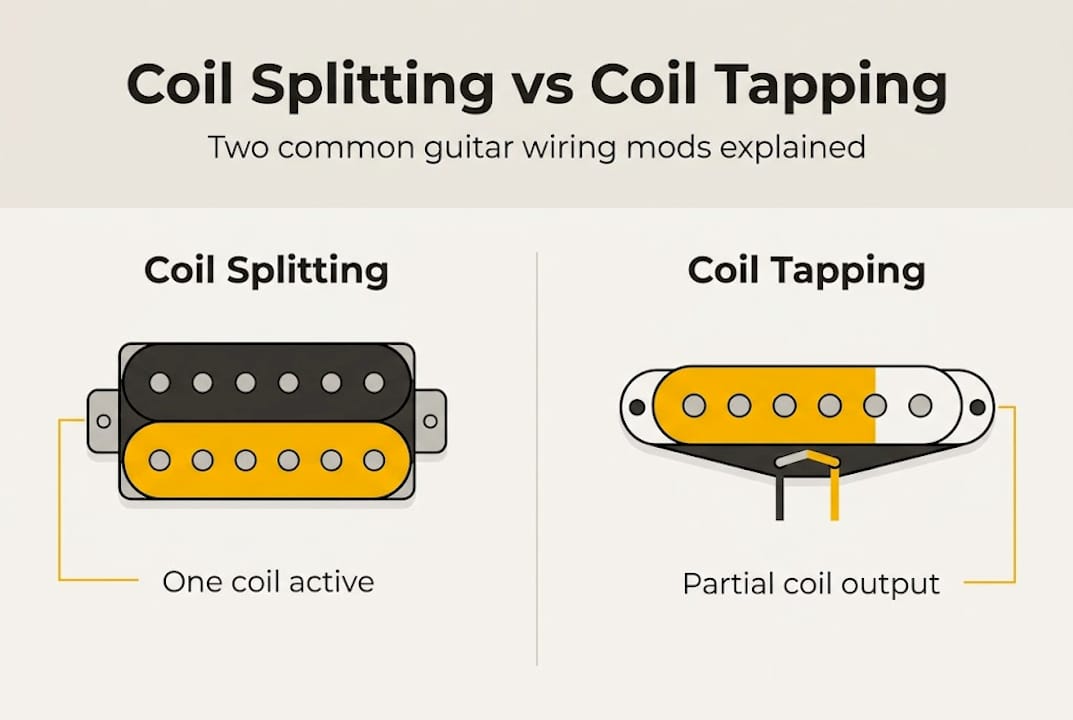
Coil splitting disconnects one coil of a humbucker entirely. You go from two coils to one.
Coil tapping works on a single-coil pickup that has been wound with an extra output wire partway through the winding. Engaging the tap brings in that mid-point output, giving you a lower-output, thinner version of the same coil. No coils are disconnected.
| Feature | Coil splitting | Coil tapping |
|---|---|---|
| Pickup type | Humbucker | Single-coil (special winding) |
| What changes | One coil disconnected | Output taken from mid-winding |
| Sound result | Brighter, single-coil-like | Softer, lower output |
| Hardware needed | Push-pull pot or switch | Tapped single-coil pickup |
| Common use | Versatility, genre switching | Vintage tone shaping |
There are also more advanced approaches worth knowing:
-
Partial splitting uses a resistor (typically between 470Ω and 1.2kΩ) to retain some warmth and output while still brightening the tone. Partial splitting with resistors retains some output and body, while a spin-a-split control blends the effect gradually via a pot.
-
Spin-a-split replaces the standard split switch with a rotary or pot control, letting you blend between full humbucker and fully split tones continuously.
-
North or south coil selection matters too. Which coil remains active affects the warmth and character of the split tone, so experimenting with both options is worthwhile.
When choosing the best electric guitar for tonal flexibility, knowing whether it offers splitting, tapping, or both is genuinely useful information.
When and why to use coil splitting
Coil splitting is not just a novelty. In the right context, it is a practical tool that solves real musical problems.
Here are four common scenarios where switching to split mode makes a real difference:
-
Funk and pop rhythm parts. The bright, percussive snap of a split coil cuts through a dense mix far better than a full humbucker. Think of the clean, clicky tone you hear on classic funk records.
-
Indie and alternative clean passages. Split mode adds shimmer and definition to clean chord work, making arpeggios and open chords ring with more clarity.
-
Jazz-fusion lead lines. A split coil with a touch of compression gives you a glassy, articulate lead tone that sits differently in the mix than a full humbucker.
-
Studio layering. Recording a rhythm track in humbucker mode and a second layer in split mode creates natural width and frequency separation without heavy processing.
The output drops roughly 40 to 50% when splitting, so volume management matters. Common pitfalls to watch for:
-
Volume drop between modes. Compensate with your amp’s gain or a clean boost pedal.
-
Increased noise. Without hum cancellation, you may pick up more electrical interference. Position yourself away from monitors and lighting rigs.
-
Tone mismatch with your amp setting. A setting dialled in for humbuckers can sound thin in split mode. Adjust the EQ accordingly.
When you choose an electric guitar for your style, consider whether coil splitting fits the genres you play most. For players just starting out, some electric guitars for beginners now include factory coil splitting, making tonal exploration accessible from day one.
Pro Tip: Raise your pickup height slightly when using split mode. This helps recover some of the lost output and keeps your two tones feeling more equal in volume without touching your amp.
Popular guitars and modifications with coil splitting
Many well-known production guitars now include factory coil splitting as a standard feature. Here are some worth knowing about:
-
PRS SE and Core series. Most PRS guitars with humbuckers include a push-pull coil split on the tone knob. The SE Custom 24 is a popular entry point.
-
Gibson Les Paul Standard (2019 onwards). Gibson reintroduced coil splitting via push-pull pots, giving Les Paul players access to brighter tones without modification.
-
Yamaha Pacifica series. Several Pacifica models include a coil split switch, making them excellent value for players wanting tonal range on a budget.
-
Schecter and ESP guitars. Many metal-oriented models include split-coil options to cover clean and crunch tones within a single instrument.
For aftermarket modifications, a push-pull potentiometer or toggle switch connects the junction between the two coils to ground, which is the core of any coil split mod. You will need a four-conductor humbucker to make this work. Most modern pickups from brands like Seymour Duncan, DiMarzio, and Bare Knuckle support this.
Factory-wired coil splitting is generally more reliable for beginners. Aftermarket mods involve soldering and a basic understanding of guitar wiring. If you are unsure, a qualified guitar technician can perform the modification cleanly.
When buying used, check whether the used electric guitars you are considering already have four-conductor humbuckers installed. It saves time and cost later. Also, understanding electric guitar and amp combinations helps you get the most from whichever coil split configuration you choose. If you are considering a Fender-style guitar with a humbucker in the bridge, Fender Stratocaster buying tips can help you navigate the options.
What most guitarists get wrong about coil splitting
Here is the honest truth: coil splitting does not make your humbucker sound like a genuine single-coil pickup. It gets close, but the body of the guitar, the pole piece spacing, the magnet type, and the physical construction all contribute to why a real Stratocaster sounds the way it does. A split humbucker is brighter and thinner than its full mode, but it carries its own character.
The noise issue is also underplayed in most product descriptions. Engaging split mode in a venue with dodgy lighting or a poorly earthed stage can introduce a noticeable hum. It is manageable, but it is real.
What coil splitting genuinely excels at is giving you a second, distinctly different voice within the same performance. The magic is not in pretending it is a different guitar. It is in using that contrast deliberately, pairing the split tone with a specific pedal, a clean amp setting, or a particular musical moment. When you use it with intention rather than expectation, it becomes one of the most useful tools on your instrument. We always encourage players to experiment and trust what their ears tell them rather than chasing what the spec sheet promises. If you are thinking about buying a new guitar with coil splitting, go in with curiosity rather than a fixed idea of what you will hear.
Find your next guitar with coil splitting
If this guide has sparked your interest in getting more tonal range from your instrument, MusicStreet is here to help you take the next step.

We stock a carefully selected range of electric guitars featuring factory coil splitting, from beginner-friendly models to professional-grade instruments. Whether you want to try one in our Huntingdon store or browse online, our team can guide you through the options and help you find the right fit for your playing style. Check out our full selection of best electric guitars or explore coil split guitars across new and pre-loved listings. Your next great tone is closer than you think.
Frequently asked questions
Does coil splitting make my guitar sound like a Stratocaster?
Coil splitting makes your humbucker brighter and more single-coil-like, but it rarely sounds identical to a true Stratocaster single-coil. The output drops 40 to 50% and the resonant frequency rises, but the guitar’s construction and magnet type still shape the final character.
Can coil splitting be added to any humbucker guitar?
Most modern four-conductor humbuckers support coil splitting, but not all vintage or basic models can be split without modification. A push-pull potentiometer or toggle switch is the standard hardware used to activate the split circuit.
Is coil splitting noisy or does it hum more?
Coil splitting disables the hum-cancelling effect of the humbucker, so you may notice more background noise compared with standard humbucker mode, particularly in environments with electrical interference.
What genres benefit most from coil splitting?
Funk, pop, indie, and jazz-fusion often use coil split tones for their bright, punchy, and articulate character, making them ideal genres for exploring this feature.
What’s the difference between coil splitting and coil tapping?
Coil splitting disconnects one coil in a humbucker, while coil tapping brings out an additional output from a specially wound single-coil pickup for lower output. Partial splitting with resistors offers a middle ground, retaining some warmth while still brightening the tone.


Share:
Guitar Shops Near Cambridge — Visit Music Street in Huntingdon
The Ultimate Guide to Our Acoustic Guitar Collection: Finding Your Perfect Sound at Music Street