


Playing a 12-string guitar means working with six courses of doubled strings, each pair tuned to produce a rich, chorus-like sound that no standard six-string can replicate. The instrument demands adapted technique, stronger finger pressure, and a reliable tuning routine. If you already play a six-string, you will recognise the chord shapes, but the physical demands are meaningfully different. This guide covers how do you play a 12-string guitar from the ground up, including tuning, chords, strumming, and the common pitfalls that catch beginners off guard.
What equipment do you need to start playing a 12-string guitar?
The right gear makes the difference between a frustrating first session and a productive one. Lighter gauge strings reduce finger strain and are the standard recommendation for beginners transitioning to a 12-string. The doubled string tension also means the neck is structurally different from a six-string. Reinforced neck bracing and a wider nut width are built-in features that directly affect how you position your fingers on the fretboard.

A clip-on chromatic tuner is non-negotiable. Tuning 12 strings accurately by ear alone is unreliable, especially when you are still developing your pitch recognition. A capo is worth having from day one, as it lets you play in different keys without learning barre chords immediately. A medium-weight pick gives you enough control for both strumming and light fingerpicking.
Essential gear at a glance
| Item | Why it matters |
|---|---|
| Lighter gauge strings | Reduces tension and finger fatigue for beginners |
| Clip-on chromatic tuner | Accurate double-course tuning across all 12 strings |
| Capo | Allows key changes without barre chord technique |
| Medium pick | Balances control and tone across paired strings |
| String winder and cutter | Speeds up restringing, which happens more often on a 12-string |
| Guitar maintenance kit | Keeps fretboard and tuning pegs in working order |
Restringing a 12-string is more involved than a six-string, so learning the process early pays off. Musicstreet’s restringing guide walks you through the correct method for maintaining string tension and tone. Good maintenance habits from the start will save you hours of tuning frustration later.
How do you tune a 12-string guitar correctly?
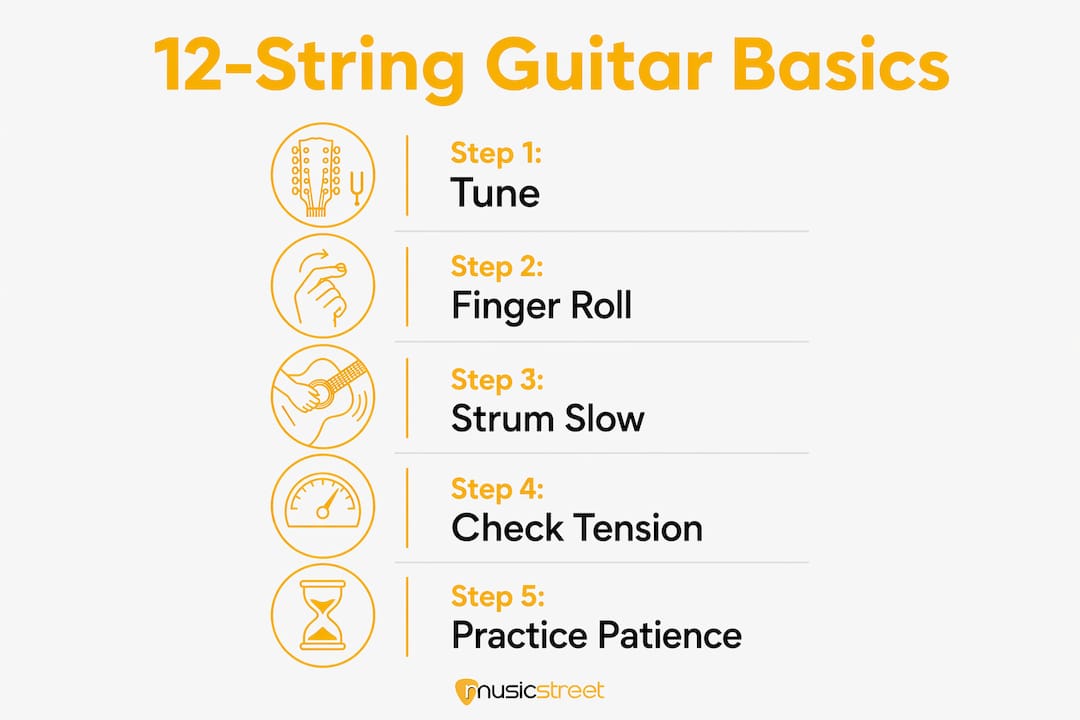
Tuning a 12-string guitar follows the double-course method, and getting it right is the foundation of everything else. Standard 12-string tuning pairs the lower four courses with one string at standard pitch and one tuned an octave higher. The top two courses, the B and high E, are tuned in unison rather than in octaves. That arrangement is what creates the instrument’s signature jangly, full sound.
Follow these steps each time you sit down to play:
- Tune the thicker string in each of the lower four courses (E, A, D, G) to standard pitch first.
- Tune the thinner octave string in each of those courses to match, one octave higher.
- For the B and high E courses, tune both strings to the same pitch (unison).
- Use a clip-on chromatic tuner and check each string individually, not just by ear.
- Play a few open chords and re-check. String tension shifts slightly once you start playing.
- Repeat the full check after your session ends.
Tuning checks after every session are necessary because the high string tension causes neck relief shifts that affect intonation. This is more demanding than a six-string’s maintenance routine, and skipping it leads to chords that sound off even when your technique is correct.
Pro Tip: Tune up to pitch rather than down. If you overshoot a note, drop below it and tune back up. This seats the string at the tuning peg more securely and reduces slippage during play.
What are the basic chord techniques for a 12-string guitar?
The chord shapes on a 12-string guitar are identical to those on a six-string. The challenge is execution. Beginners should start with simple open chords such as E, A, D, C, and G, and practise slow, deliberate transitions before attempting anything more complex. The wider neck and doubled strings demand more from your fretting hand than you might expect.
The key technique adjustment is finger rolling. Successful players roll their fingers slightly so the fingertip frets both strings within a course cleanly, without buzzing or muting either one. On a six-string, you press straight down. On a 12-string, a subtle tilt of the finger ensures both strings ring out together.
Chord pressure and positioning compared
| Aspect | Six-string approach | 12-string adjustment |
|---|---|---|
| Finger angle | Straight down onto string | Slight roll to cover both strings |
| Pressure required | Moderate | Firmer and more even across the course |
| Neck width | Standard | Wider nut requires broader hand stretch |
| Barre chords | Manageable for beginners | Best avoided until open chords are clean |
| Chord transitions | Moderate speed | Slow and deliberate to avoid ghost notes |
- Press firmly and evenly across both strings in each course.
- Keep your thumb positioned low on the back of the neck for maximum reach.
- Practise each chord shape in isolation before moving between them.
- Build calluses gradually. The doubled strings are harder on fingertips than a six-string.
- Avoid barre chords until your open chord tone is consistently clean.
Even string pressure and slow chord transitions are the two factors that most directly determine whether your chords sound clear or muddy. Rushing this stage is the most common mistake beginners make.
How does strumming change on a 12-string guitar?
Strumming a 12-string guitar requires a wider arc than you would use on a six-string. Strumming techniques on a 12-string demand dynamic control to play both strings in each course evenly and avoid buzzing or muting. A narrow strum that works fine on a six-string will clip only one string in a course, producing an uneven, thin tone.
The downstroke is your most reliable starting point. A firm, consistent downstroke across all six courses gives you the full, resonant sound the instrument is known for. Once that feels natural, introduce upstrokes gradually, keeping the arc wide and the wrist relaxed.
- Use a wide, sweeping strum arc to cover all strings evenly.
- Lead with downstrokes when learning rhythm patterns.
- Keep your wrist loose. Tension in the wrist causes uneven pressure across courses.
- For fingerpicking, assign one finger per course and pluck both strings simultaneously.
- Hybrid picking, using a pick for bass strings and fingers for treble courses, works well for melodic lines.
Pro Tip: Practise at half speed with a metronome before increasing tempo. The 12-string rewards patience. Rushing your strum before the arc is consistent produces buzzing that disappears the moment you slow down.
The chorus-like sound that defines the 12-string comes from slight pitch variances between the octave and unison pairs. That quality only emerges when your strumming is even and controlled. Sloppy technique masks the very thing that makes the instrument special.
What common challenges do beginners face on the 12-string guitar?
The 12-string guitar has a steeper learning curve than a six-string, and most of the difficulty is physical rather than theoretical. Wider necks and extra strings create demands on finger positioning and hand stretching that take time to adapt to. Expecting to play cleanly in your first week sets you up for unnecessary frustration.
- Finger fatigue: The doubled tension tires your fretting hand faster. Limit early sessions to 20–30 minutes and build up gradually.
- Muted or ghost notes: Uneven pressure causes muted notes. Slow down your chord changes and focus on pressing both strings in each course with equal force.
- Tuning instability: Check tuning before and after every session. New strings stretch and settle over the first few days of play.
- Chord transition speed: Resist the urge to speed up before your transitions are clean. Muscle memory built slowly is far more reliable.
- Adapting from a six-string: Your existing chord knowledge transfers directly, but your finger technique needs deliberate adjustment for the wider neck and doubled strings.
“The most common frustration for beginners is muted strings. The fix is almost always the same: slow down, press evenly, and roll the finger slightly. Clean tone comes before speed, every time.”
A guitar maintenance checklist helps you stay on top of string condition, tuning peg function, and neck relief, all of which affect playability more on a 12-string than on a six-string.
Key takeaways
Playing a 12-string guitar well requires mastering double-course tuning, adapting your finger technique for paired strings, and building hand strength gradually through consistent, slow practice.
| Point | Details |
|---|---|
| Double-course tuning | Lower four courses tune in octaves; top two courses tune in unison. |
| Lighter strings for beginners | Lighter gauge strings reduce tension and finger fatigue during early practice. |
| Finger rolling technique | Roll fingers slightly to fret both strings in a course cleanly without buzzing. |
| Wide strumming arc | A wider strum arc covers all paired strings evenly and avoids muted tones. |
| Frequent tuning checks | Check tuning before and after every session due to tension-induced neck shifts. |
Why the 12-string rewards patience more than any other guitar
The first time I handed a 12-string to a player who had only ever used a six-string, the reaction was always the same. They played a G chord, heard that full, shimmering sound, and immediately tried to play faster. That is the trap. The 12-string sounds so good that you want to push it, but the instrument punishes impatience more than most.
What I have found, working with players at Musicstreet, is that the ones who progress fastest are those who treat the 12-string as a new instrument entirely rather than a heavier version of what they already know. The chord shapes are familiar, yes, but the physical relationship with the neck is different. The tuning routine is different. The strumming mechanics are different. Accepting that early saves weeks of frustration.
The tuning routine is the part most beginners underestimate. Neck relief shifts from string tension are real and frequent. I have seen players blame their technique for a muddy sound when the actual problem was a guitar that had drifted out of tune mid-session. Build the habit of checking tuning every time you pick the instrument up.
The payoff is worth every bit of the effort. That chorus-like shimmer, the one that comes from the slight pitch variance between octave pairs, is something no pedal or effect truly replicates. When you hear it ring out cleanly from your own playing, it is one of the most satisfying sounds in guitar. Give the instrument the time it asks for, and it gives you something genuinely special in return.
— Music
Musicstreet’s 12-string guitars and accessories for beginners
Getting started with a 12-string is much easier when the instrument itself is set up well and suited to your level.

Musicstreet stocks a carefully inspected selection of 12-string guitars, including the Gretsch G5422G-12, a pre-loved 12-string electric that delivers the full double-course sound in a player-friendly package. Every instrument goes through a professional setup before it leaves, so intonation and action are already dialled in. Alongside guitars, you will find maintenance kits and accessories to keep your 12-string in top condition. If you have questions about which model suits your playing level, the team at Musicstreet’s Huntingdon store is available for in-person advice and tryouts.
FAQ
What is the main difference between a 6 and 12-string guitar?
A 12-string guitar has six courses of two strings each, producing a richer, chorus-like sound. The lower four courses are tuned in octaves, while the top two are tuned in unison.
How do you tune a 12-string guitar?
Tune the thicker string in each lower course to standard pitch first, then tune the paired string an octave higher. The B and high E courses are tuned in unison.
Is a 12-string guitar harder to play than a six-string?
Yes, the wider neck and doubled string tension require more finger strength and adjusted technique. Beginners should start with lighter gauge strings and simple open chords.
What chords should beginners learn first on a 12-string?
Start with open chords such as E, A, D, C, and G. These shapes are the same as on a six-string but require firmer, more even finger pressure to avoid muted strings.
How often should you tune a 12-string guitar?
Check tuning before and after every playing session. The high string tension causes neck relief shifts that affect intonation more frequently than on a standard six-string.










Share:
Acoustic vs electric guitar: which is right for you?
What does reverb do in music: a producer's guide