


Guitar string names are the six note letters assigned to each string on a standard guitar: E, A, D, G, B, and E. Every guitarist needs to know these names. They underpin tuning, chord learning, tab reading, and communication with other players. The guitar names strings system also includes a numbering convention, running from string 1 (the thinnest, highest-pitched) to string 6 (the thickest, lowest-pitched). Knowing both the letters and the numbers gives you a complete map of your instrument from the very first day you pick it up.
What are the standard guitar string names and their order?
The six standard string names, from lowest to highest pitch, are E, A, D, G, B, and E. The numbering runs in the opposite direction: string 6 is the low E (thickest), and string 1 is the high E (thinnest). That reversal trips up many beginners, so it is worth fixing in your mind early.

| String number | Note name | Pitch |
|---|---|---|
| 6 | E | Low E (E2) |
| 5 | A | A2 |
| 4 | D | D3 |
| 3 | G | G3 |
| 2 | B | B3 |
| 1 | E | High E (E4) |
The low E and high E share the same letter name but sit two octaves apart in pitch. The low E (E2) produces the deepest, heaviest tone on the guitar. The high E (E4) delivers the brightest, thinnest sound. Calling them both “E” reflects the fact that they share the same fundamental note, just in different registers.
-
String 6 (low E): thickest, deepest tone, closest to your chin when holding the guitar
-
String 5 (A): second thickest, the anchor for many bass-note chord shapes
-
String 4 (D): mid-range, central to open chord voicings
-
String 3 (G): the boundary string where the interval pattern changes
-
String 2 (B): the string most beginners find hardest to tune by ear
-
String 1 (high E): thinnest, highest pitch, closest to the floor
The mnemonic “Eddie Ate Dynamite, Good Bye Eddie” maps directly onto E, A, D, G, B, E and gives you the string order from thickest to thinnest. Other popular versions include “Every Amateur Does Get Better Eventually” and “Elephants And Donkeys Grow Big Ears.” Pick the one that sticks.
Pro Tip: Write the string names on a sticky note and attach it to your guitar case. Glance at it every time you open the case, and you will have them memorised within a week without any deliberate drilling.
How do guitar string intervals explain the naming and tuning?
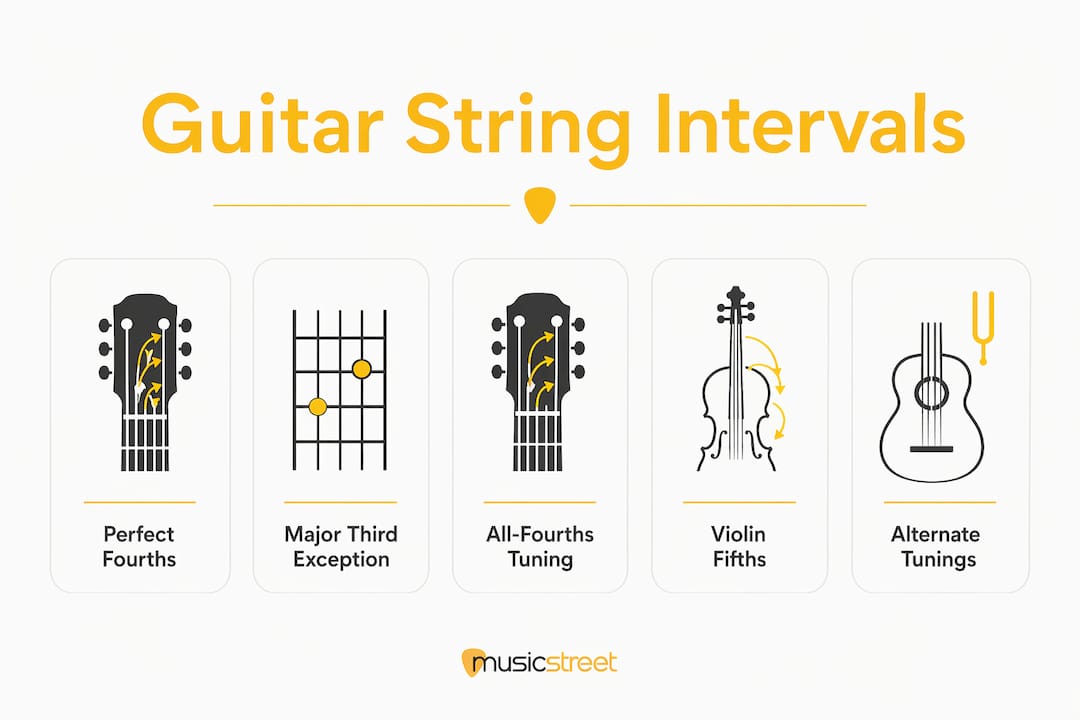
The intervals between the strings are not random. Standard tuning uses four perfect fourths between strings 6 and 5, 5 and 4, 4 and 3, and 2 and 1, with one major third between strings 3 and 2 (G to B). That single break in the pattern is the most important structural fact about the guitar’s tuning.
-
E to A: perfect fourth (5 semitones)
-
A to D: perfect fourth (5 semitones)
-
D to G: perfect fourth (5 semitones)
-
G to B: major third (4 semitones)
-
B to E: perfect fourth (5 semitones)
The major third between G and B is why barre chord shapes work the way they do. If the guitar used all perfect fourths, chord shapes would be symmetrical across every string pair. The major third creates an asymmetry that actually makes open chords like G major and C major easier to finger. It also means scale patterns shift slightly when crossing that string boundary, which is why many players find the G-to-B transition the trickiest to master.
“It took centuries to arrive at the standard tuning, aiming to balance playability and musical versatility. The intervals were chosen to avoid dissonant adjacent notes and to facilitate both chords and melody play.”
That historical process explains why all-fourths tuning was tried and largely abandoned. All fourths is logically tidy but makes common open chord shapes significantly harder to finger. The standard tuning compromise has endured because it serves the widest range of playing styles, from fingerpicked folk to heavy rock.
Compare this to the violin, which uses all perfect fifths (G, D, A, E). The wider intervals suit bowing technique but make simultaneous multi-string chords far more difficult. The guitar’s mix of fourths and one third sits in a practical middle ground that rewards both strumming and single-note playing.
What are the best ways to memorise guitar string names?
Memorising string names is a skill, not a talent. The players who learn them fastest use active recall rather than passive reading. These methods work consistently across all skill levels.
-
Say the names aloud while pointing. Touch each string physically and speak its name. The combination of touch, sight, and sound creates three memory pathways at once.
-
Learn thickest to thinnest first. Starting from string 6 (low E) and working down to string 1 (high E) mirrors the way most tutors and tab notation present strings.
-
Then reverse it. Once you know the order top-down, practise bottom-up (high E to low E). This prevents the common mistake of only recognising strings in one direction.
-
Use multiple mnemonics. “Eddie Ate Dynamite, Good Bye Eddie” works for most players. If it does not click, try “Every Amateur Does Get Better Eventually.” Having a backup phrase prevents blank-mind moments mid-lesson.
-
Name strings during warm-up. Before every practice session, name each string as you play it. After two weeks, the names become automatic.
The most common learner mistake is confusing string numbers with string pitch order. String 1 is the thinnest and highest, not the lowest. Players who think of “number 1” as the biggest or most important string get this backwards. Fixing that mental model early saves a lot of confusion when reading tabs and chord diagrams.
Pro Tip: When a teacher or tab says “play the 4th string,” always translate it immediately to its note name (D) in your head. That translation habit builds both number and name recall simultaneously.
How do string types and gauges connect to string numbers?
String number and string thickness are directly linked. String 6 is always the thickest, and string 1 is always the thinnest. That physical relationship holds across every guitar type, from a classical nylon-string to a seven-string electric.
String materials and gauges affect tone and playability in ways that matter from day one. The three most common materials are nickel (electric guitars), bronze (acoustic guitars), and steel (both types). Each material produces a different tonal character. Nickel strings sound warm and smooth. Bronze strings ring bright and open. Steel strings sit somewhere between the two, depending on the alloy.
String gauge refers to the thickness of each string, measured in thousandths of an inch. A set labelled “9s” on an electric guitar means the thinnest string (string 1) measures 0.009 inches. The remaining strings in the set scale up proportionally from there.
| Gauge label | Typical use | String 1 thickness |
|---|---|---|
| Light (9s electric) | Beginners, lead playing | 0.009 inches |
| Medium (11s acoustic) | Strumming, fingerpicking | 0.011 inches |
| Heavy (13s acoustic) | Fingerstyle, blues | 0.013 inches |
Beginners benefit from lighter gauges because they require less finger pressure to fret cleanly. Lighter strings reduce finger pain during the early weeks of learning, which keeps practice sessions longer and more consistent. Experts consistently recommend prioritising playability over tone at the start. A set of 9s on an electric or 10s on an acoustic gives beginners the best chance of building technique without discomfort.
Heavier gauges produce more volume and sustain, which suits experienced players who want a fuller sound. They also hold tune more reliably under aggressive strumming or picking. The trade-off is that they demand more developed finger strength. For a full breakdown of which gauge suits your playing style, the Musicstreet guide on choosing the right gauge covers the decision in practical detail.
How do string names work with alternate tunings and extended-range guitars?
String numbering stays fixed regardless of how you tune the guitar. String numbers always run from thinnest (1st) to thickest (6th), even when the pitch of each string changes. Drop D tuning lowers string 6 from E to D, but it remains string 6. The number describes physical position, not pitch.
-
Standard tuning: E, A, D, G, B, E (strings 6 to 1)
-
Drop D tuning: D, A, D, G, B, E (string 6 drops to D; all other strings unchanged)
-
Open G tuning: D, G, D, G, B, D (all strings retuned; numbering unchanged)
-
Half-step down: Eb, Ab, Db, Gb, Bb, Eb (same intervals, lower overall pitch)
Seven-string guitars add a seventh string below string 6, typically tuned to low B. That string becomes string 7. Eight-string guitars extend further, usually adding a low F# as string 8. The naming logic remains consistent: the new strings simply extend the numbering sequence downward.
Twelve-string guitars work differently. Each of the six standard strings is paired with a second string tuned either in unison or one octave higher. The pairs are still referred to by the original string names (E, A, D, G, B, E), but each name now represents a pair rather than a single string. The Gretsch G5422G-12 is a good example of a 12-string electric that uses this paired naming convention.
Knowing the standard string names and numbers makes alternate tunings far easier to navigate. When a tab says “tune string 6 down a tone,” you know immediately which string to adjust and by how much.
Key takeaways
Knowing guitar string names and numbers is the single most important piece of foundational knowledge for any guitarist, enabling accurate tuning, tab reading, and clear communication with other players.
| Point | Details |
|---|---|
| Standard string names | Strings run E, A, D, G, B, E from thickest (6) to thinnest (1). |
| Numbering direction | String 1 is the thinnest and highest-pitched; string 6 is the thickest and lowest. |
| Key interval | The G-to-B interval is a major third; all other adjacent strings are a perfect fourth apart. |
| Best memorisation method | Combine a mnemonic phrase with active recall during every warm-up session. |
| Gauge for beginners | Lighter gauges (9s electric, 10s–11s acoustic) reduce finger pain and aid consistent practice. |
Why I think string names are the most underrated beginner skill
Most beginners rush past string names to get to chords. That is a mistake I have seen slow players down for months. When you do not know your string names, every tab, every lesson, and every conversation with another guitarist requires a mental lookup. That friction adds up.
The players who learn string names in their first week pick up chord shapes faster. They read tabs without pausing to count strings from the top. They tune more confidently because they know which peg controls which note. String name knowledge is not glamorous, but it is the foundation everything else sits on.
The interval structure matters too, not just as theory, but as a practical tool. Once you understand that G to B is a major third while every other pair is a perfect fourth, you stop being surprised when a scale pattern shifts unexpectedly. You start to predict it. That shift from reactive to anticipatory playing is where real progress happens.
For players exploring different types of guitar strings, understanding string names and numbers first makes the material and gauge choices far easier to interpret. You cannot make a good decision about string 1 gauge if you are not sure which string string 1 actually is.
— Music
Guitars and strings worth playing at Musicstreet
Musicstreet stocks a wide range of guitars and string sets suited to players at every level, from first-time buyers to experienced guitarists looking for their next instrument.

Whether you are after a beginner-friendly acoustic, a quality electric, or something more unusual like the Gretsch G5422G-12 12-string electric with its paired string configuration, Musicstreet has options worth trying. The team at the Huntingdon store can advise on string gauges and materials in person, and every instrument is professionally set up before it leaves. For players who want to read further before buying, the Musicstreet guide on buying guitar strings covers materials, gauges, and string types in practical detail. Free UK delivery is available on qualifying orders.
FAQ
What are the names of the six guitar strings in order?
The six strings from thickest to thinnest are E, A, D, G, B, and E. In number order, string 6 is the low E and string 1 is the high E.
Why do the thickest and thinnest strings share the same name?
Both strings are tuned to the note E but sit two octaves apart in pitch. The low E (E2) is the deepest string; the high E (E4) is the brightest.
Does string numbering change in alternate tunings?
No. String numbers remain fixed regardless of tuning. In Drop D, string 6 drops to D in pitch but stays string 6 by position.
What string gauge should a beginner use?
Beginners should start with lighter gauges: 9s on an electric guitar or 10s to 11s on an acoustic. Lighter gauges reduce finger pain and make fretting easier during the early stages of learning.
What is the easiest mnemonic for guitar string names?
“Eddie Ate Dynamite, Good Bye Eddie” maps directly onto E, A, D, G, B, E from string 6 to string 1. It is the most widely used memory aid for this purpose.









Share:
What does reverb do in music: a producer's guide
Top 5 acoustic guitar brands: your 2026 guide