


Reverb is the accumulation of sound reflections that create a sense of space and depth in music. It varies based on room size, materials, and parameters like pre-delay and decay time, shaping how a source is perceived. Proper use involves shared buses, matching reverb types to sources, and subtle EQ adjustments to prevent muddiness and enhance clarity.
Reverb is defined as the accumulation of sound reflections that persist after the original source stops, creating the auditory impression of acoustic space. Every time you play a guitar chord in a room, the sound bounces off walls, floors, and ceilings before reaching your ears. Those reflections blend together into what we call reverberation. Understanding reverb is the difference between a flat, lifeless recording and one that breathes with dimension. Whether you are tracking guitars at home or mixing in a professional studio, reverb shapes every decision you make about space and depth.

What is reverb and why does it matter in music?
Reverb is the persistence of sound caused by multiple reflections within an enclosed environment. It differs from a distinct echo in one critical way: reflections arriving within 50 ms are perceived as reverb, while those arriving after 50–100 ms register as separate, audible echoes. That 50 ms boundary is where physics meets perception.
The definition of reverb matters because it explains why a guitar sounds alive in a cathedral and dead in a padded vocal booth. The room itself becomes part of the instrument. Producers and engineers working with tools like the Strymon Big Sky, the Lexicon 480L, and convolution processors all exploit this principle to place sounds convincingly in virtual spaces.
Two key parameters govern how reverb behaves. Pre-delay is the gap between the dry signal and the first reflection. Decay time, often measured as RT60, is the duration it takes for the reverb tail to fall by 60 dB. Together, these two values define the character of any reverb effect, whether it comes from a physical room or a digital algorithm.
How does reverb work acoustically and psychologically?
Sound travels at roughly 343 metres per second in air. When it hits a hard surface, it reflects. In an enclosed space, hundreds of reflections arrive at your ears from different angles and at slightly different times, layering into the dense wash we recognise as reverberation.
Acoustic engineers divide this process into two stages:
- Early reflections: The first discrete bounces arriving within the first 80–100 ms. Early reflections let listeners judge room size unconsciously and instantly. A mismatch between early reflections and the reverb tail produces an unnatural, unsettling effect.
- Late diffuse tail: The dense, blended wash of reflections that follows. This is the sustained “bloom” you hear after a snare hit or a guitar chord.
Pre-delay plays a psychoacoustic role that most beginners overlook. Pre-delay timing gives cues about room size: 1–2 ms suggests a tiny room, 20–40 ms evokes a concert hall, and 50 ms or more places the listener in a cathedral. Your brain reads these gaps automatically, which is why getting pre-delay right feels more natural even when listeners cannot explain why.
Reverberation time, or RT60, varies dramatically by space. Typical RT60 values range from under one second in small rooms to 2–3 seconds in concert halls, and beyond 10 seconds in large stone cathedrals. The materials in a room absorb different frequencies at different rates, which is why a tiled bathroom reverb sounds bright and a carpeted bedroom sounds dead.
Pro Tip: Record a short, sharp clap in any room and listen back. The decay you hear is the room’s natural RT60. Understanding that sound is the first step to choosing the right artificial reverb to complement it.
What are the main types of reverb?
Reverb technology has evolved from physical rooms to electromechanical devices to sophisticated digital processing. Each type carries a distinct sonic character that suits different musical contexts.
Artificial reverb development began in 1947, when engineers first experimented with echo chambers. The EMT 140 plate reverb arrived in the late 1950s, using a large suspended sheet of metal and electromechanical transducers to simulate room acoustics. It became the standard for studio recordings throughout the 1960s and 1970s. Spring reverb followed a different path, becoming the signature sound of surf guitar and dub reggae through its distinctive metallic wobble.
The table below compares the main reverb types by origin, character, and typical application.
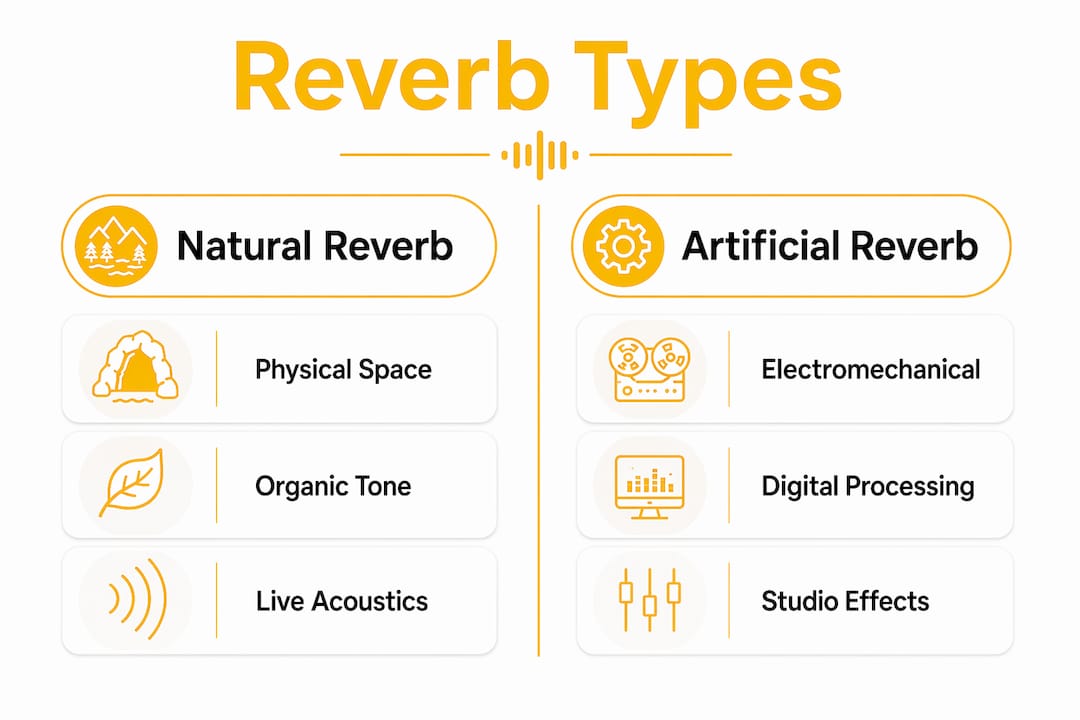
| Type | Origin | Sonic Character | Typical Use |
|---|---|---|---|
| Natural room | Physical space | Organic, complex | Live recording, acoustic instruments |
| Spring | Electromechanical coil | Metallic, splashy | Guitar amplifiers, surf, dub |
| Plate (EMT 140) | Sheet metal transducer | Smooth, dense | Vocals, snare drums, strings |
| Gated | Digital processing | Abrupt, punchy | 1980s drums, Phil Collins productions |
| Algorithmic | Digital algorithms | Flexible, controllable | General studio use, mixing |
| Convolution | Impulse responses | Hyper-realistic | Film scoring, classical, high-end mixing |
Gated reverb deserves a special mention. Developed in the early 1980s, it applies a noise gate to cut the reverb tail abruptly rather than letting it decay naturally. The result is the enormous, punchy drum sound that defined artists like Phil Collins and Peter Gabriel. It sounds artificial by design, and that is precisely its appeal.
Convolution reverb, available in real time from 1999, works by capturing an impulse response from a real space, such as the Royal Albert Hall or Abbey Road Studio Two, and mathematically convolving that response with any audio signal. The result is an accurate sonic replica of that physical environment. Plugins like Altiverb and Waves IR1 use this method extensively in film and music production.
Algorithmic reverb, by contrast, uses mathematical models rather than recorded spaces. This gives producers far more control over individual parameters. Tools like the Lexicon PCM series and the Eventide SP2016 built their reputations on algorithmic processing, and modern plugins such as Valhalla Room and FabFilter Pro-R continue that tradition.
How is reverb applied effectively in modern music production?
Applying reverb well is one of the clearest signs of a skilled mix engineer. The most common mistake is overuse. Overuse of reverb leads to washy, distant, and cluttered mixes. That muddiness kills definition and makes individual instruments harder to place in the stereo field.
Here is a practical framework for using reverb in a mix:
- Set up a shared reverb bus. Using reverb buses via aux sends creates spatial unity across all tracks and saves significant CPU load compared to inserting reverb on every channel individually. Route multiple instruments to the same reverb return and they will occupy the same acoustic space convincingly.
- Dial in pre-delay before touching decay. Increasing pre-delay separates the dry sound from the reverb tail, keeping lead instruments clear and present even when the reverb itself is long and lush. Start at 20–30 ms for most sources and adjust by ear.
- Shape the frequency content of the reverb tail. Rolling off high frequencies in the reverb tail pushes sounds further back in the mix and adds warmth. Rolling off low frequencies prevents the reverb from muddying the low end. Use a simple EQ on the reverb return channel to achieve this.
- Match reverb type to the source. A plate reverb suits vocals and snare drums. A room reverb suits acoustic guitars. A hall reverb suits strings and pads. Mismatching type to source is a subtle but audible error.
- Automate the wet level. Reverb that stays constant throughout a track can feel static. Automating the send level so reverb increases during choruses and pulls back during verses adds movement and emotional contrast.
Treating reverb as a spatial tool rather than a masking layer is the professional approach. The best engineers use reverb to define where each instrument sits in an imaginary three-dimensional space, not to hide tuning issues or thin tones.
Pro Tip: Try cutting the reverb return at around 300 Hz with a high-pass filter on every reverb bus. This single adjustment removes the low-end build-up that makes mixes sound muddy, and it works on virtually every genre.
What digital tools create reverb effects for guitarists?
Guitarists have more reverb options available today than at any point in history. The choice broadly falls into three categories: hardware pedals, rack units, and software plugins.
Hardware pedals are the most practical choice for live performance and home studios. The Strymon Big Sky is widely regarded as one of the most versatile reverb pedals available, offering twelve reverb types including plate, hall, shimmer, and cloud. It handles both subtle room ambience and dramatic textural effects with equal authority. For guitarists seeking a broader overview of effects options, the guitar effects types guide at Musicstreet covers how reverb fits alongside modulation, delay, and drive in a complete signal chain.
Rack units like the Lexicon PCM96 and the TC Electronic M6000 remain the choice for professional studios where pristine audio quality and deep parameter control are non-negotiable. These units process audio at high sample rates and offer routing flexibility that pedals cannot match.
Software plugins divide into two camps. Algorithmic plugins such as Valhalla Room, Eventide Blackhole, and Lexicon PCM Native give producers precise control over every parameter. Convolution plugins such as Altiverb 8 and Waves IR1 deliver photorealistic acoustic spaces captured from real locations. Many producers use both in the same session, placing instruments in a convolution room for realism and adding an algorithmic shimmer reverb for texture.
For home studio setups, routing reverb correctly matters as much as the plugin itself. A well-configured home studio setup with proper acoustic treatment will reveal reverb nuances that a reflective, untreated room will mask entirely.
Key takeaways
Reverb is the foundation of spatial audio in music production, and understanding its parameters is the single most effective way to improve the depth and professionalism of any mix.
| Point | Details |
|---|---|
| Core definition | Reverb is sound reflections arriving within 50 ms, blending into perceived acoustic space. |
| Pre-delay is critical | Setting pre-delay correctly separates the dry signal from the tail, preserving clarity. |
| Use shared reverb buses | Routing multiple tracks to one reverb return creates cohesion and saves CPU resources. |
| Match type to source | Plate suits vocals and snare; room suits guitars; hall suits strings and pads. |
| Avoid overuse | Excessive reverb creates muddy, distant mixes; subtlety and EQ shaping maintain definition. |
Why reverb is the most misunderstood tool in the mix
Most musicians learn reverb by turning it up until something sounds “bigger.” That instinct is understandable, but it is the wrong approach. After years of listening to mixes across every genre, the pattern is clear: the best-sounding records use reverb sparingly and deliberately, not generously.
The producers who get reverb right treat it as a member of the band. It occupies space, has a frequency character, and interacts with every other element in the mix. When Phil Collins and Hugh Padgham stumbled onto gated reverb in 1980 during the recording of “In the Air Tonight,” they were not adding reverb for size. They were creating a new sonic identity. That is the level of intentionality reverb deserves.
The emotional dimension is equally real. A long, dark hall reverb on a guitar chord creates melancholy. A short, bright plate on a vocal creates intimacy and presence. These are not accidental effects. They are compositional decisions. Treating reverb as an emotional and spatial tool, rather than a simple effect, separates professional mixes from amateur ones.
The uncomfortable truth is that most reverb problems in home recordings come from the room, not the plugin. An untreated room adds its own reverb to every recorded signal before the engineer even opens a plugin. Acoustic panels, bass traps, and proper microphone placement address the source of the problem. The plugin then has clean, dry audio to work with, and the reverb you add is entirely under your control.
Experiment with removing all reverb from a mix entirely, then add it back one track at a time. You will hear exactly what each reverb is contributing, and you will almost certainly use less of it than you started with.
— Music
Explore reverb gear at Musicstreet
Understanding reverb is one thing. Hearing it through quality gear is another experience entirely.

Musicstreet stocks a carefully selected range of effects pedals and processors suited to every stage of your playing journey, from first pedalboard builds to professional live rigs. The Strymon Big Sky reverb pedal is available through Musicstreet alongside expert advice on how to integrate it into your setup. If you are building out your sound and want guidance on where reverb fits in the signal chain, the team at Musicstreet’s Huntingdon store is available to help you find the right combination. Browse the full range at Musicstreet and take the next step in shaping your sound.
FAQ
What is reverb in simple terms?
Reverb is the sound you hear after the original note stops, caused by reflections bouncing off surfaces in a room. It gives audio a sense of space and depth.
How does reverb differ from echo?
Reflections arriving within 50 ms blend into reverb, while reflections arriving after 50–100 ms are perceived as distinct echoes. The timing of the reflection determines which effect you hear.
What is rt60 in reverb?
RT60 is the time it takes for a reverb tail to decay by 60 dB after the sound source stops. Concert halls typically have RT60 values of 2–3 seconds, while small rooms measure well under one second.
What is convolution reverb?
Convolution reverb uses a recorded impulse response from a real acoustic space to recreate that environment digitally. It has been available in real-time processing since 1999 and is widely used in film scoring and high-end music production.
Why does too much reverb make a mix sound muddy?
Excessive reverb fills the frequency spectrum with sustained reflections that overlap with the dry signal, reducing clarity and pushing instruments further back in the mix. Careful use of pre-delay, EQ on the reverb return, and shared buses keeps the mix clean.


Share:
How to replace guitar strings: a step-by-step guide
How to pick electric guitar strings: your full guide