

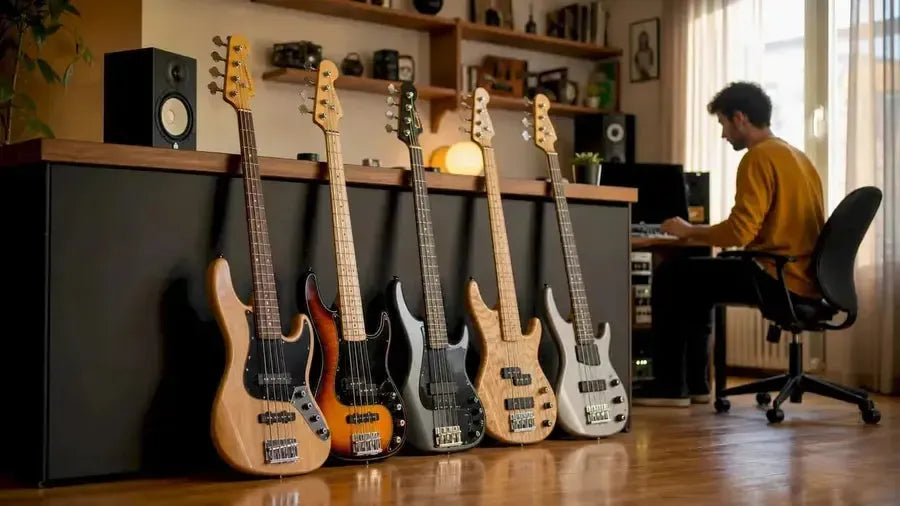
The global bass guitar market is dominated by five major brands—Fender, Gibson, Yamaha, Ibanez, and Warwick—accounting for over half of revenue. These companies lead with distinct strengths, from Fender’s iconic models to Warwick’s European craftsmanship, spanning entry-level to premium instruments. Choosing the right bass depends more on specific model features and personal comfort than on brand alone, emphasizing the importance of in-person testing and understanding price tiers.
The bass guitar brands list for 2026 is led by five manufacturers — Fender, Gibson, Yamaha, Ibanez, and Warwick — who together account for 52% of global bass guitar market revenue. That figure tells you something important: the market is not fragmented. A small group of makers dominates professional stages, recording studios, and bedroom practice spaces worldwide. Whether you are buying your first four-string or upgrading to a professional instrument, understanding who makes what, at which price point, and for which style of playing is the foundation of a smart purchase decision.
1. The complete bass guitar brands list: who leads the market
The recognised industry term for this category is “bass guitar manufacturers,” and the leading names appear consistently across professional endorsements, sales charts, and player surveys. Five brands dominate the global market, but the broader list includes Squier, Music Man, ESP, Rickenbacker, Spector, Sterling by Music Man, and Schecter, each serving distinct player communities.
Fender holds 30% of the US guitar market, a share built on decades of consistent production and the enduring popularity of the Precision Bass and Jazz Bass. Gibson commands the premium segment with a 34% share of that tier, driven by the Thunderbird and SG Bass. Yamaha, Ibanez, and Warwick fill out the top five with contrasting strengths: reliability and value, modern playability, and European premium craftsmanship respectively.
2. Fender: the standard every other brand is measured against
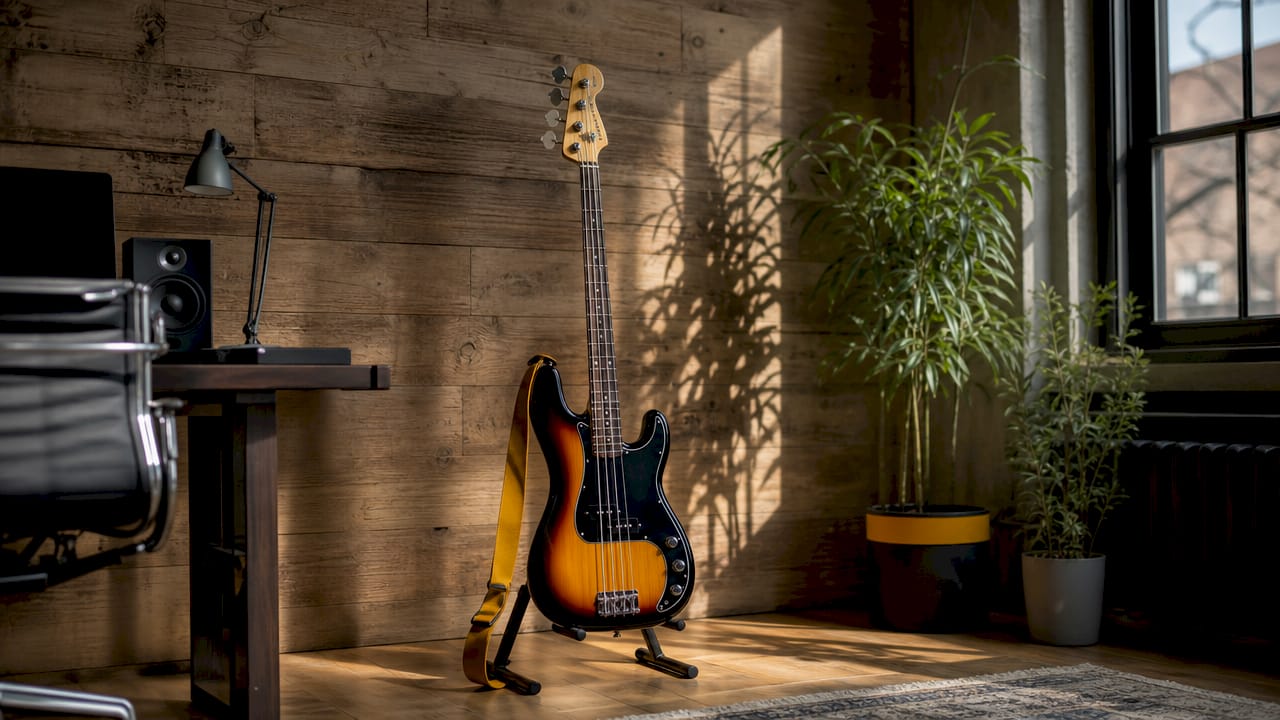
Fender is the most widely recognised name on any bass brands list, and for good reason. The Precision Bass, introduced in 1951, defined the electric bass as an instrument. The Jazz Bass followed in 1960 and gave players a slimmer neck, dual pickups, and a brighter tonal character that became the sound of soul, funk, and jazz recording.
The Fender American series is the benchmark for professional players, valued for its consistent build quality, American alder and ash bodies, and the reliability demanded by touring musicians. Squier, Fender’s entry-level sub-brand, uses the same iconic body shapes at a fraction of the price, making it the most popular choice for beginners entering the market. The gap between a Squier Affinity and a Fender American Professional II is significant in feel and tone, but both share the same DNA.
3. Gibson: premium heritage and rock credibility
Gibson’s position in the bass market is built on the Thunderbird, one of the most visually striking and tonally distinctive instruments ever produced. The reverse-body design, set neck construction, and powerful humbucking pickups produce a deep, aggressive tone that has defined hard rock and alternative bass playing since the 1960s.
Gibson dominates the premium segment with a 34% share, which reflects both the price of its instruments and the loyalty of its player base. The SG Bass and the EB series offer alternatives for players who want Gibson quality in a more compact format. Gibson basses are not the most versatile instruments on this list, but for players who need that specific sound, nothing else comes close.
4. Yamaha: the most underrated name on the list
Yamaha produces some of the most consistent and well-specified instruments at every price point, yet the brand rarely receives the recognition it deserves in popular bass guitar brand reviews. The TRBX series covers entry-level through mid-range with a precision that few manufacturers match. The TRBX174 starts at an accessible price, while the TRBX504 and 604 offer active electronics and premium tonewoods that compete with instruments costing considerably more.
Entry-level models from the Yamaha TRBX204 lead high-volume sales in the affordable bass guitar options category. The BB series, used by professional players including Nathan East, demonstrates that Yamaha can compete at the top of the market as well. The brand’s manufacturing consistency, backed by its broader engineering expertise, means quality control is rarely an issue across the range.
5. Ibanez: modern playability and player-focused design
Ibanez built its reputation on fast, thin necks and aggressive styling that appealed to rock and metal players, but the brand’s bass catalogue is far broader than that reputation suggests. The GSR series is one of the best-selling affordable bass guitar options globally, offering lightweight bodies, comfortable neck profiles, and reliable electronics at entry-level prices.
The Ibanez GSR is a consistent top seller in the entry-level bracket, and the SR series scales that playability up through mid-range and professional price points. The SR Premium and SR Prestige lines use exotic tonewoods including ovangkol and bubinga, which deliver distinct frequency responses that beginners often overlook but experienced players actively seek. Ibanez also produces the BTB series for players who want extended range and a longer scale length.
6. Warwick: European craftsmanship at the premium tier
Warwick is Germany’s most significant contribution to the global bass market and represents a different philosophy from the American and Japanese manufacturers. Where Fender and Ibanez prioritise consistency and accessibility, Warwick prioritises tonal character and material quality. The Streamer, Corvette, and Thumb models use wenge necks, ovangkol bodies, and brass just-a-nut hardware as standard features.
The Thumb Bass, in particular, is regarded as one of the finest production basses ever made. Its compact body, balanced weight distribution, and MEC active electronics produce a tone that is immediately recognisable on recordings by players including Marcus Miller and Jack Bruce. Warwick’s Rockbass series offers the brand’s design language at a more accessible price point, making it a credible option for players who want European character without the full premium outlay.
7. Price tiers explained: what each budget actually buys you
Understanding where popular bass guitar manufacturers position their models across price segments is critical to making a smart purchase. Bass guitars are categorised as entry-level at £100 to £300, mid-range at £500 to £800, professional from £800 upwards, and premium above £2,000.
| Price tier | Typical brands and models | What you get |
|---|---|---|
| Entry level (£100–£300) | Squier Affinity, Ibanez GSR200, Yamaha TRBX174 | Solid construction, passive electronics, proven body shapes |
| Mid-range (£500–£800) | Yamaha BB434, Ibanez SR500E, Fender Player | Active or passive options, better tonewoods, improved hardware |
| Professional (£800–£2,000) | Fender American, Music Man StingRay, Warwick Corvette | USA or premium overseas manufacture, superior pickups, consistent setup |
| Premium (£2,000+) | Warwick Thumb, Gibson Custom, Music Man Bongo | Exotic materials, hand-finished details, boutique-level specification |
Professional bassists represent 20% of unit sales but contribute 41.6% of total market revenue, which confirms that serious players invest significantly more per instrument. The professional segment is dominated by specific lines rather than brand names alone. A Fender American Professional II and a Music Man StingRay are both professional instruments, but they sound and feel quite different from one another.
Pro Tip: Do not buy the cheapest instrument in a brand’s range and expect it to represent that brand’s quality. A Squier and a Fender American share a name family but not a specification. Always research the specific model series, not just the badge on the headstock.
8. Unique features that separate top bass guitar brands
The features that distinguish one manufacturer from another go well beyond cosmetics. Neck profiles and scale length have a direct impact on playability, particularly for players with smaller hands or those transitioning from guitar. A standard long scale bass measures 34 inches, while short scale instruments at 30 inches suit younger players and those who find standard necks uncomfortable.
Key differentiators across the top brands include:
- Active versus passive electronics: Ibanez SR and Warwick models favour active preamps for tonal flexibility. Fender Precision and Jazz basses use passive circuits that many players prefer for their natural, uncoloured response.
- Neck construction: Gibson uses set necks for sustain and warmth. Fender uses bolt-on construction for brightness and easy replacement. Warwick uses through-neck designs on premium models for maximum resonance.
- Tonewood choices: Alder and ash dominate Fender production. Ibanez SR Premium and Warwick models use ovangkol and bubinga for a warmer, more complex tonal character.
- String configuration: Five-string basses extend the tonal range downward but require wider fretboards that can challenge players with smaller hands. Most brands offer five-string variants of their flagship models.
You can read more about choosing the right bass for your playing style in the Musicstreet buying guide.
9. Regional strengths and global market trends
The bass guitar market is not uniform across regions, and understanding where brands hold their strongest positions helps explain why certain instruments are more prevalent in different musical traditions.
| Region | Leading brands | Market characteristic |
|---|---|---|
| North America | Fender, Music Man, Gibson | Fender holds 30% US share; Gibson leads premium tier at 34% |
| Europe | Warwick, Fender, Yamaha | Warwick dominates premium European market; Fender leads volume |
| Asia-Pacific | Ibanez, Yamaha, ESP | Fastest growing region globally in 2025 and 2026 |
| Emerging markets | Squier, Ibanez GSR, Yamaha TRBX | Entry-level volume brands lead adoption in developing markets |
The Asia-Pacific growth story is particularly significant. Ibanez and Yamaha are both Japanese manufacturers, and their dominance in the region reflects both cultural familiarity and the genuine quality of their instruments at competitive price points. ESP, another Japanese brand, has built a strong following among metal and progressive rock players globally, with its LTD sub-brand serving the mid-range market effectively.
For a broader view of how brands compare across price tiers, the Musicstreet guide to guitar brands by budget covers the full spectrum from entry-level to premium.
Key takeaways
The specific model series matters more than the brand name alone when evaluating quality, resale value, and long-term satisfaction.
| Point | Details |
|---|---|
| Five brands lead the market | Fender, Gibson, Yamaha, Ibanez, and Warwick hold 52% of global bass guitar revenue. |
| Price tiers define expectations | Entry-level starts at £100; professional quality begins at £800 with brands like Fender American and Music Man. |
| Model series over brand name | A Squier and a Fender American share a family name but differ significantly in specification and sound. |
| Regional trends shape availability | Asia-Pacific is the fastest growing market, led by Ibanez, Yamaha, and ESP. |
| Resale value favours established names | Fender and Music Man hold resale value significantly better than budget alternatives. |
What I have learned from years of watching players choose the wrong bass
The most common mistake I see is players buying a brand rather than an instrument. Someone walks in wanting “a Fender” without knowing whether they want the Precision’s thick, punchy midrange or the Jazz Bass’s brighter, more articulate character. Those are genuinely different instruments that suit different genres and playing techniques.
The second mistake is underestimating the importance of trying the instrument in person. The best bass depends on comfort with neck width, scale length, and tonal range. A Warwick Thumb sounds extraordinary on a recording, but its body shape and balance point feel unusual to players accustomed to a Fender. That is not a flaw. It is a design choice that suits some players and not others.
My honest recommendation for beginners is to start with a Squier, Ibanez GSR, or Yamaha TRBX. All three are well-made, widely available, and easy to resell if you decide to upgrade. For players ready to invest at the professional level, the Fender American and Music Man lines offer the best combination of quality, resale stability, and long-term satisfaction. Warwick is the right choice if you want a distinctly European tonal character and are prepared to invest in an instrument that will last decades.
The brands list is a starting point. The instrument you actually play is what matters.
— Music
Explore bass guitars at Musicstreet
Musicstreet stocks a carefully selected range of bass guitars from the top brands covered in this article, including Fender, Yamaha, Ibanez, and Warwick, across every price tier from entry-level to premium.

Whether you are buying your first bass or upgrading to a professional instrument, the team at Musicstreet’s Huntingdon store offers hands-on advice and expert setup on every instrument sold. Browse the full bass guitar collection online, or visit in person to try before you buy. Free UK delivery is available on qualifying orders, and every instrument comes with post-sale support to make sure your new bass plays exactly as it should from day one.
FAQ
Which bass guitar brand is best for beginners?
Squier, Ibanez GSR, and Yamaha TRBX are the leading entry-level options, all offering reliable construction and playable neck profiles at prices between £100 and £300. Any of the three makes a sound starting point for a new player.
What are the top five bass guitar brands by market share?
Fender, Gibson, Yamaha, Ibanez, and Warwick are the five leading manufacturers, collectively accounting for 52% of global bass guitar market revenue in 2025. Fender alone holds 30% of the US market.
Does brand name affect resale value?
Established brands like Fender and Music Man hold resale value significantly better than budget alternatives, making them a sounder financial choice for players who may want to upgrade later.
What is the difference between active and passive bass electronics?
Passive electronics, as found on most Fender Precision and Jazz basses, produce a natural, uncoloured tone and require no battery. Active preamps, standard on Ibanez SR and Warwick models, allow broader tonal shaping but require a battery and add circuitry to the signal chain.
Is a five-string bass worth buying for a beginner?
Five-string basses extend the lower tonal range but feature wider fretboards that can be physically demanding for players with smaller hands. Most teachers and experienced players recommend starting on a four-string and moving to a five-string once technique is established.







Share:
Acoustic guitar string differences: your 2026 guide
How to select a guitar for beginners: your first guide