


Finding the right guitar off a production line can feel like searching for a needle in a haystack. Mass-produced instruments are built to suit the average player, which means they rarely suit anyone perfectly. Whether you struggle with hand fatigue after long sessions, crave a specific tone you simply cannot find in a shop, or need an instrument that works with your body rather than against it, a custom guitar can change everything. In this guide, we explore the real, tangible advantages of going custom: from playability and tone to ergonomics, investment value, and long-term satisfaction.
Table of Contents
- Effortless playability and comfort: tailored for you
- Superior tone and sonic versatility
- Ergonomics and unique physical needs
- Value, investment, and long-term satisfaction
- Head-to-head: custom vs. production guitars
- A luthier’s insight: what players overlook about custom guitars
- Ready to experience your own custom guitar?
- Frequently asked questions
Key Takeaways
| Point | Details |
|---|---|
| Custom fit and comfort | Guitars tailored to your own hands and style reduce fatigue and boost enjoyment. |
| Unique tonal control | Choice of wood, pickups, and hardware lets you shape a signature sound unlike standard models. |
| Addresses special needs | Custom options can resolve ergonomic or medical challenges that production guitars cannot. |
| Stronger investment value | Quality custom guitars often hold or increase their value and offer unique satisfaction for owners. |
| Better for all skill levels | Both beginners and pros benefit from a guitar built expressly for their needs and playing style. |
Effortless playability and comfort: tailored for you
The most immediate benefit of a custom guitar is how it feels in your hands. Production guitars are designed around averages, but your hands, your technique, and your playing style are uniquely yours. A custom instrument is built around you from the ground up.
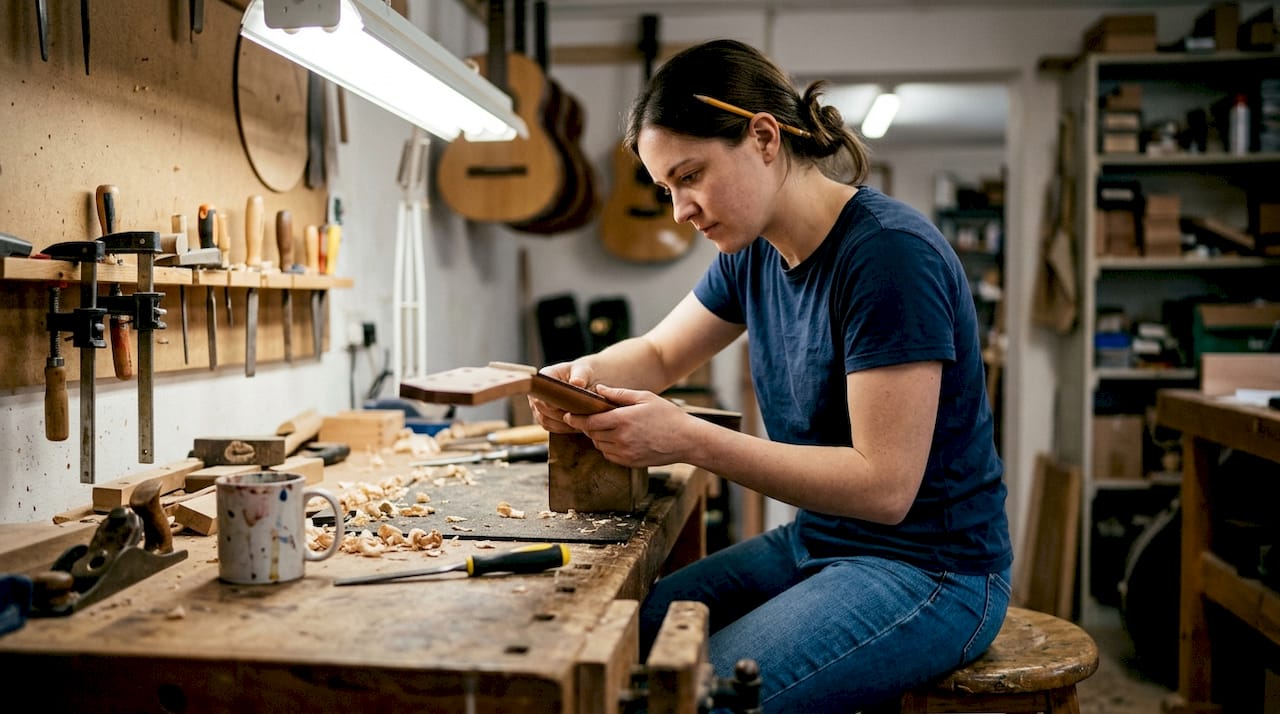
When you work with a luthier or custom builder, you can specify everything from the neck profile to the fretboard radius. Understanding guitar neck shapes is the first step to realising just how much these choices affect your comfort. A flatter fretboard radius suits fast shredding and low action, while a rounder radius feels more natural for chord work and blues bends. Precise scale length and neck adjustments for techniques like shredding or blues playing have been shown in empirical playability tests to reduce hand strain significantly.
Here is what you can typically personalise for playability:
- Neck profile: C, D, U, or asymmetric shapes to match your grip
- Fretboard radius: Flatter for lead work, rounder for rhythm and chords
- Scale length: Shorter for smaller hands, longer for added tension and clarity
- Nut width: Wider for fingerpicking, narrower for fast lead playing
- Fret size: Jumbo frets for bending ease, smaller frets for precise fretting
These adjustments are not cosmetic. They directly influence how quickly you develop as a player. When the instrument fits, you spend less energy fighting it and more energy making music. Exploring options for personalising guitar playability can reveal just how transformative the right setup can be.
“The best guitar is the one that makes you want to pick it up every single day.”
Pro Tip: If you are unsure which neck profile suits you, visit a shop and spend time with several guitars before committing to a custom spec. Your instincts after 20 minutes of playing are usually right.
Superior tone and sonic versatility
Playability is only half the story. Tone is where custom guitars truly separate themselves from the crowd. When you choose a custom instrument, you are not limited to the tonewoods, pickups, or hardware combinations that a manufacturer decided would appeal to the broadest market.
Instead, you can select every element of the tonal chain. Want a mahogany body with a maple cap and a single P-90 pickup for that raw, mid-forward growl? Done. Prefer a chambered alder body with boutique hand-wound humbuckers for a more complex, airy resonance? Also possible. Understanding what makes a boutique guitar helps you appreciate why these choices matter so deeply.
Key tonal elements you can customise include:
- Body wood: Affects sustain, warmth, and resonance
- Top wood: Influences brightness and harmonic complexity
- Neck and fretboard wood: Shapes attack and clarity
- Pickup selection: The single biggest influence on amplified tone
- Hardware and bridge: Affects sustain and tuning stability
It is worth noting that expert reviews of boutique instruments like the Iris MS-00 consistently confirm effortless playability, responsive tone, and a high-end feel that rivals or surpasses many production Custom Shop models. However, honesty matters here. Blind tests on tonal differences suggest that while differences exist, they diminish with skill level and amplifier choice. Playability advantages, though, remain consistently noticeable regardless of experience. The reasons to go custom are real, but tone alone may not be the strongest one.
Pro Tip: Prioritise pickups and playability over exotic tonewoods if budget is a concern. A well-set-up guitar with quality electronics will outperform a beautifully wooded instrument with poor hardware every time. Exploring custom shop guitar benefits can help you allocate your budget wisely.
Ergonomics and unique physical needs
Comfort goes well beyond technique. For many players, the physical demands of a standard guitar body create real barriers. Custom guitars can remove those barriers entirely.
Consider a player with shorter arms who struggles to reach the higher frets on a standard double-cutaway. A custom builder can adjust the upper bout, deepen the cutaway, or alter the body contour so that fret access becomes effortless. The ergonomic advantages of custom guitars extend to players of all body types, not just those with medical conditions.
For players managing conditions such as arthritis, tendinitis, or hypermobility, the benefits are even more significant. Custom offset cuts and tailored neck profiles for high-fret access or medical needs like arthritis are well-documented adaptations that allow players to continue performing comfortably.
Here is a quick overview of common ergonomic customisations:
| Challenge | Custom solution | Benefit |
|---|---|---|
| Arthritis in fretting hand | Thinner neck profile, lower action | Reduced joint strain |
| Short reach to high frets | Deeper cutaway, repositioned body | Easier upper-register access |
| Shoulder or back pain | Lighter body wood, contoured back | Less fatigue during long sessions |
| Small hands | Shorter scale length, narrow nut | More comfortable chord shapes |
| Wrist tendinitis | Asymmetric neck profile | Neutral wrist position maintained |
These are not luxury adjustments. For some players, they are the difference between playing and not playing at all. A custom guitar built around your body is an investment in your long-term relationship with the instrument.
Value, investment, and long-term satisfaction
Let us talk about money, because the upfront cost of a custom guitar can feel daunting. However, the long-term picture is often more favourable than it first appears.
Custom guitars from respected luthiers tend to hold their value exceptionally well. Unlike mass-produced instruments, which depreciate the moment they leave the shop floor, a well-crafted custom piece carries the maker’s reputation and your personal specification. Both of those factors contribute to evaluating guitar resale value in a way that production models simply cannot match.
Expert reviews consistently confirm that custom boutique guitars often rival or surpass production Custom Shop models in terms of investment and collectibility. A guitar built by a luthier with a growing reputation today could be worth considerably more in a decade.
Beyond financial value, there is the emotional dimension. Owning something made specifically for you creates a connection that is genuinely difficult to replicate. Here is what players consistently report after going custom:
- Greater motivation to practise regularly
- Stronger emotional attachment to the instrument
- Reduced desire to keep searching for “the one”
- Pride in ownership that enhances performance confidence
“A custom guitar is not just an instrument. It is a statement of intent.”
Understanding the benefits of boutique guitars for UK players specifically can help frame this investment in a local context, where the market for quality instruments continues to grow.
Head-to-head: custom vs. production guitars
All the benefits sound compelling, but how do custom guitars truly stack up against production models in a direct comparison? Here is an honest breakdown.
| Criteria | Custom guitar | Production guitar |
|---|---|---|
| Playability | Tailored to your technique | Built for average player |
| Tone | Fully specified by you | Manufacturer’s choice |
| Ergonomics | Adapted to your body | Standard dimensions |
| Resale value | Often strong, luthier-dependent | Varies, generally lower |
| Upfront cost | Higher | Lower to mid-range |
| Availability | Made to order | Immediate |
It is important to be realistic. Blind tests on tonal differences between expensive and mid-range guitars suggest that tonal gaps diminish with skill level and amplifier quality. A production guitar can absolutely serve many players well, particularly at the start of their journey.
Here is a simple decision framework to guide your thinking:
- Assess your current pain points: Is hand fatigue, tone, or physical discomfort a genuine issue?
- Set a realistic budget: Custom does not always mean unaffordable.
- Research luthiers: Reputation matters enormously for both quality and resale.
- Try before you commit: Play as many production guitars as possible to understand what you want.
- Prioritise playability: It will impact your playing more than any tonal difference.
Using these guitar shopping tips as a foundation will help you make a decision you will not regret.
A luthier’s insight: what players overlook about custom guitars
Here is something most articles on this subject miss entirely: custom guitars are arguably more valuable for beginners than for seasoned professionals.
Experienced players have already adapted their technique to whatever instrument they own. They have built muscle memory around a neck that may not actually suit them. A beginner, by contrast, learns on the custom instrument from day one. Their technique develops around an instrument that fits, which means fewer bad habits, less frustration, and faster progress.
There is also a persistent myth that custom guitars are exclusively for wealthy professionals. Many luthiers, including those featured in our boutique guitar guide, offer instruments at prices that are genuinely competitive with mid-range production models. The difference is that every pound you spend goes directly into the instrument rather than into marketing budgets and retail margins.
The daily satisfaction of picking up something made just for you is also chronically underestimated. It sounds sentimental, but it is practical. Players who love their instrument practise more. Players who practise more improve faster. A custom guitar is, in that sense, one of the most efficient investments a musician can make.
Ready to experience your own custom guitar?
If this guide has sparked your curiosity, the next step is simpler than you might think. At MusicStreet, we work with players at every level to help them find instruments that genuinely fit their needs, whether that means a bespoke build, a boutique production model, or a pre-loved gem with a custom setup.

Our team in Huntingdon, Cambridgeshire is passionate about matching players with the right instrument. We offer expert consultations, professional instrument setups, and access to some of the finest guitars available in the UK. Whether you are ready to explore custom guitars or simply want to talk through your options, we are here to help. Get in touch or browse our full range online today.
Frequently asked questions
Are custom guitars worth the investment for beginners?
Custom guitars can offer transformative comfort and playability even for new players, with empirical tests showing reduced hand strain and faster adaptation. Starting on an instrument built for your hands means developing better technique from the very beginning.
How do custom guitars compare in resale value?
Reputable custom guitars tend to retain or increase their value over time, particularly when crafted by respected luthiers. Experts note strong investment value in quality custom instruments compared to most production equivalents.
Do custom guitars really sound better than production models?
Custom guitars often provide more responsive tone and a higher-end feel, but blind tests suggest tonal differences diminish with skill level and amplifier quality. Expert reviews of boutique customs consistently highlight playability as the more impactful advantage.
Can custom guitars be adapted for medical or ergonomic needs?
Yes, custom builders can tailor necks, body shapes, and hardware to address physical or medical challenges directly. Custom necks for arthritis and adapted body shapes are well-established solutions that allow players to continue performing comfortably for years.
Recommended
- Discover the advantages of custom guitars in 2026 – MusicStreet
- 6 Key Benefits of Boutique Guitars for UK Guitarists – MusicStreet
- Why Custom Shop Guitars Transform Player Experience – MusicStreet
- How to Personalise Guitars for Optimal Playability – MusicStreet
- Guitar Bridge Tremolo vs Tele Tremolo Bridge: A Comparison – Stevie The Manager aka Stangr The Man


Share:
Tube amps vs digital: Find your perfect guitar sound
Locking tremolos explained: stability, setup and why they matter