


TL;DR:
- Guitar tonewoods significantly influence sound, sustain, and playability, often more than hardware or pickups.
- Different woods provide distinct tonal qualities suited to specific genres and playing styles.
- Comfort and feel of the wood are crucial for long-term playability and overall enjoyment.
Choosing the right guitar often comes down to one factor that many players overlook entirely: the wood. You can obsess over pickups, hardware, and finish all you like, but the timber beneath your fingers shapes everything from sustain and resonance to how the neck feels after a two-hour set. Whether you’re buying your first serious instrument or customising a build, understanding guitar woods gives you a genuine edge. This guide breaks down the most important tonewoods, compares their qualities side by side, and helps you match wood choice to your playing style and musical goals.
Table of Contents
- Key factors when choosing guitar woods
- Top body woods for acoustic and electric guitars
- Neck and fretboard woods: Where feel meets sound
- Side-by-side comparison: Guitar woods at a glance
- Our take: Why playing comfort rivals tone in wood choice
- Explore premium guitar choices for every player
- Frequently asked questions
Key Takeaways
| Point | Details |
|---|---|
| Wood type shapes tone | The species and density of wood impact your guitar’s sound, sustain, and overall playability. |
| Body, neck, fretboard all matter | Each part of the guitar uses different woods to balance feel, resonance, and durability. |
| Choose for comfort as well as sound | Playability and personal comfort can matter as much as tonal variation in long-term satisfaction. |
| There’s no single ‘best’ wood | What’s right for you depends on your hands, your style, and the genres you love to play. |
Key factors when choosing guitar woods
The term tonewood refers to any timber selected specifically for its acoustic properties. Luthiers have spent centuries refining which woods produce the most musical results, and their choices are never arbitrary. Every piece of timber has a unique combination of density, stiffness, and grain structure that determines how it vibrates and transmits sound.
When evaluating a tonewood, there are several core criteria worth understanding:
- Density: Denser woods tend to produce brighter, tighter tones with more sustain. Lighter woods often sound warmer and more resonant.
- Janka hardness rating: This measures resistance to denting and wear. Harder woods like Maple and Ebony last longer on fretboards but can feel stiffer under the fingers.
- Grain structure: Straight, tight grain generally improves resonance and consistency. Wild or irregular grain can introduce unpredictability in tone.
- Weight: Heavier guitars fatigue players faster. A beautiful-sounding Mahogany body may not be your friend at a three-hour gig.
- Sustainability: With tighter global regulations on certain timbers, many manufacturers now use plantation-grown or certified alternatives.
As wood density, hardness, and grain all directly impact sound and playability, no single factor tells the whole story. You need to consider how these properties interact across the full instrument.
For a deeper foundation, understanding tonewood and the role of guitar woods in construction will help you make far more confident buying decisions.
Matching wood to genre matters too. Blues and jazz players often gravitate towards warm, resonant timbers, while metal and shred players typically prefer brighter, tighter woods that support fast articulation and aggressive attack.
Pro Tip: Don’t fixate solely on body wood. The neck and fretboard timber you choose will have an enormous impact on how comfortable the guitar feels to play, especially during long sessions.
Top body woods for acoustic and electric guitars
With the criteria in mind, here’s how the most popular body woods actually perform in practice.
Acoustic body woods:
- Sitka Spruce: The most widely used acoustic top wood. Balanced tone, strong projection, and excellent dynamic range make it the benchmark against which others are measured.
- Western Red Cedar: Warmer and more immediately responsive than Spruce. Favoured by fingerstyle players who want sensitivity at lower playing volumes.
- Engelmann Spruce: Softer than Sitka with a sweeter, more complex midrange. Suits players who want a less aggressive acoustic voice.
- Mahogany: Used for backs, sides, and occasionally tops. Produces a focused, warm tone with strong midrange presence and good sustain.
Electric body woods:
- Alder: The standard for many classic electric guitars. Balanced across the frequency spectrum with a slight warmth.
- Mahogany: Dense and resonant, producing thick lows and singing sustain. Widely used in single-cutaway designs.
- Ash: Bright and punchy with excellent resonance. Open-pored and visually striking.
- Maple: Very bright and tight. Often used as a cap over Mahogany to add clarity without sacrificing warmth.
- Basswood: Neutral and lightweight. Common in budget and mid-range instruments due to its workability.
Common guitar body tonewoods each carry distinct tonal and physical properties that suit different players and genres. Similarly, electric body wood tonalities vary considerably in weight and frequency response.
Pro Tip: Swamp Ash, a lighter variant of Ash, is particularly prized for vibrant clean sounds with a scooped midrange. It’s a favourite for players who want that classic twangy character. Explore more about swamp ash guitars to see why it remains so sought after.
Neck and fretboard woods: Where feel meets sound
The neck and fretboard are where your hands spend most of their time, yet these woods receive far less attention than body timbers. That’s a mistake. The fretboard material influences both the tactile experience and the upper harmonic content of your tone.
The three dominant fretboard woods are:
- Rosewood: Warm, slightly oily texture with a smooth feel. Janka rating typically between 1,650 and 2,200 lbf depending on species. Naturally conditions itself to some extent and requires minimal maintenance. Produces a warmer, rounder tone with softer attack.
- Maple: Brighter and snappier than Rosewood, with a Janka rating of around 950 to 1,450 lbf. Sealed with a finish, which gives it a slicker feel. Requires more attention to keep the finish intact over time.
- Ebony: Extremely dense and hard, with a very high Janka rating. Produces a fast, articulate response with a snappy attack. Preferred by many classical and jazz players for its precision.
Rosewood, Maple, and Ebony each bring distinct playing and tonal qualities that suit different hands and styles.
Neck wood matters too. A Maple neck adds brightness and stiffness, while a Mahogany neck contributes warmth and a slightly more relaxed feel. The neck finish is equally important. A thick gloss finish can feel sticky during fast playing, whereas a satin or oil finish allows the hand to glide more freely.
“Many professional players choose their neck and fretboard primarily by feel during a soundcheck, not by spec sheet. The wood that keeps you playing longer is ultimately the right wood for you.”
Session fatigue is a real concern. A heavier neck, a rough finish, or a fretboard that doesn’t suit your hand size can quietly erode your playing enjoyment over months and years.

Side-by-side comparison: Guitar woods at a glance
After exploring each wood individually, a direct comparison helps clarify their strengths and best contexts. The density and tonal descriptions of popular tonewoods vary considerably, as do the electric body wood tonalities across different builds.
| Wood | Use | Tone | Approx. Janka (lbf) | Common models |
|---|---|---|---|---|
| Sitka Spruce | Acoustic top | Balanced, bright, dynamic | 700 | Taylor 214ce, Martin D-28 |
| Western Red Cedar | Acoustic top | Warm, responsive, soft | 350 | Yamaha LL-TA, Takamine GC5CE |
| Mahogany | Acoustic/electric body | Warm, midrange-focused | 900 | Gibson Les Paul, Martin 000-15M |
| Alder | Electric body | Balanced, slightly warm | 590 | Fender Stratocaster, Telecaster |
| Swamp Ash | Electric body | Bright, scooped mids, resonant | 700 | Fender 52 Telecaster reissues |
| Basswood | Electric body | Neutral, lightweight | 410 | Ibanez RG series |
| Maple | Electric body/neck/fretboard | Bright, tight, articulate | 1,450 | Fender Telecaster, Music Man |
| Rosewood | Fretboard | Warm, smooth, rounded | 1,650+ | Gibson SG, PRS Custom 24 |
| Ebony | Fretboard | Snappy, precise, fast | 3,000+ | Gibson Custom Shop, ESP |
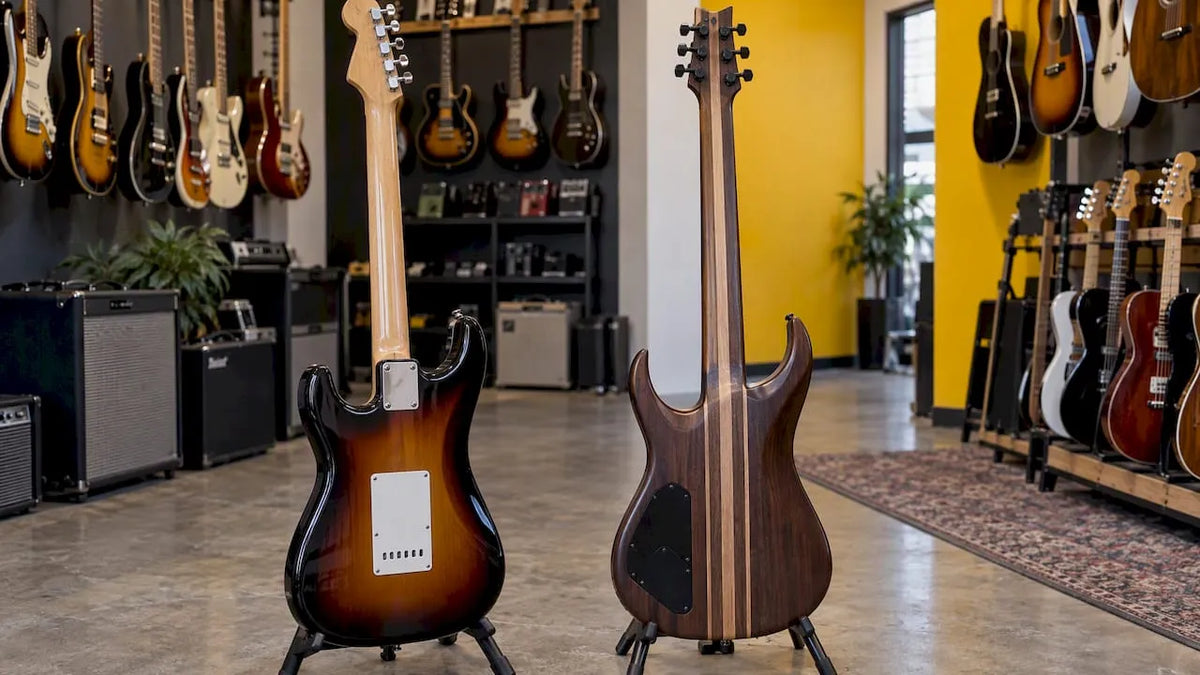
The real art lies in pairing woods intelligently. A Mahogany body with a Rosewood fretboard produces a famously warm, vocal tone. Add a Maple cap and you introduce clarity without losing depth. For brighter, more cutting sounds, an Alder body with a Maple neck and fretboard keeps every note defined and articulate.
When choosing the perfect guitar, thinking about how your body, neck, and fretboard woods interact will get you far closer to your ideal instrument than focusing on any single component alone.
Our take: Why playing comfort rivals tone in wood choice
Here’s something the spec sheets rarely tell you. After years of working with players across every genre and skill level, we’ve noticed a consistent pattern: the guitars that get played most are rarely the ones with the most impressive tonal credentials on paper. They’re the ones that feel right.
Tone is essential. Nobody disputes that. But comfort and playability quietly shape your practice habits, your confidence on stage, and how long you actually want to keep playing. A guitar that sounds extraordinary but weighs a tonne, or has a neck finish that grabs at your hand, will spend more time on the stand than in your hands.
Many experienced players choose their fretboard wood by feel first, then consider tone. They’ll pick up an instrument, run their thumb along the back of the neck, and know within seconds whether it suits them. That instinct is worth trusting.
Studio and live settings can also reveal surprising preferences. A wood combination that sounds perfect in a quiet room might feel fatiguing after two sets. We’d always encourage you to think about choosing a guitar for your playing style as a whole-body decision, not just a tonal one.
Explore premium guitar choices for every player
If this guide has sharpened your sense of what you’re looking for in your next instrument, you’re already ahead of most buyers.

At MusicStreet, we stock a carefully curated range of electric, acoustic, and bass guitars covering every major tonewood combination discussed here. Whether you’re drawn to the warmth of a Cedar-topped acoustic or the punchy resonance of a Swamp Ash electric, our team can help you find the right match. Visit our premium guitar shop to browse new and pre-loved instruments, or get in touch for personalised advice from specialists who play and understand these instruments at a serious level.
Frequently asked questions
Which guitar wood produces the warmest tone?
Mahogany and Western Red Cedar are both known for warm, rounded tones, with Cedar particularly common in acoustic guitars favoured by fingerstyle players.
Does fretboard wood affect playability or just sound?
Fretboard wood influences both feel and overtones, with Maple offering a slicker, brighter response and Rosewood or Ebony providing a warmer, smoother touch under the fingers.
Is Swamp Ash better than Basswood for electric guitars?
Swamp Ash is brighter and more resonant with greater tonal complexity, while Basswood is neutral and lightweight. The differences in resonance between the two make Swamp Ash the stronger choice for players who want character in their clean tone.
Are there sustainable guitar woods?
Many manufacturers now source timber from certified sustainable plantations, with plantation-grown Mahogany and Maple becoming increasingly standard across mid-range and high-end instruments alike.
Recommended
- Role of Guitar Woods – How Tonewoods Shape Sound – MusicStreet
- Understanding tonewood: How guitar woods shape your sound – MusicStreet
- Role of Guitar Electronics – Shaping Your Sound – MusicStreet
- Understanding What the Perfect Guitar Tone Is for You | MusicStreet
- Why choose analog gear: Unlock warmth and character in mastering





Share:
Guitar Tuners: Types, How They Work, and the Best Ones to Buy in the UK
What Is a Guitar Capo and Which One Should You Buy?